


23 Jul, 2025
US electric utilities prepare for stormier weather, growing climate threats

By Karin Rives
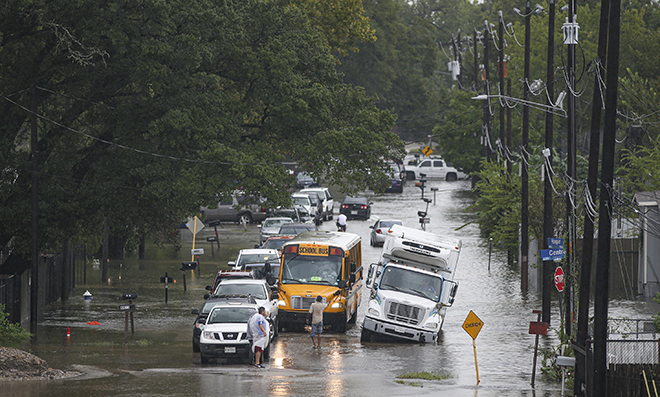
| Tropical Depression Imelda dumped more than two feet of water across Houston in September 2019, one of several such flooding events in recent years. The power company serving part of Houston is embarking on an ambitious plan to build resilience against increasingly extreme weather. Source: Thomas B. Shea/Getty Images News via Getty Images. |
CenterPoint Energy Inc. is among dozens of US electric utilities, grid operators and energy sector participants from Canada and Europe that have teamed up with the Electric Power Research Institute (EPRI) to better prepare for climate risks.
"As the population, economy and energy needs of the Greater Houston area changes and grows, so does the challenges we face from a range of extreme weather threats of the future," CenterPoint said in an email. "It is clearer than ever before that it is vital to act now to strengthen and enhance the overall resiliency of the electric system and reduce the impacts of outages for our customers."
EPRI's Climate READi initiative recently released a new framework with publicly available tools and guidance to help the power sector in the US and beyond assess and plan for climate-related hazards. The idea is to bring more consistency to such planning, said EPRI's Laura Fisher, principal team lead for climate resilience analysis.
EPRI spent three years developing the tools with input from the industry. They include a new method for calculating hourly future meteorological data, which utilities use to better plan for risks.
"It shows how you can take historical climate and weather data, which is available at an hourly resolution, and shift it forward according to changes that you're seeing in global climate models," Fisher said in an interview. "So now you have a new weather dataset that is climate-adjusted, or that is taking into account changes in future climate but is also at a resolution that is available to be input in power system models."
Another is a climate risk screening tool that can help electric utilities identify periods when their grid will likely be under high stress from heat, storms or other weather challenges. Utility planners can download computer code and customize it for a particular geographical area or grid system. A group of utilities using the tool is available to help troubleshoot, Fisher said.
Since its inception in 2022, EPRI's Climate READi program has more than doubled its number of participants. All have slightly different needs, just like some have different views of what it means to be climate-ready and how to prioritize resilience.
Power poles withstanding 132 mph winds
As part of a $3.2 billion resilience plan announced in June, CenterPoint Energy Houston Electric LLC plans over the next three years to bury more than 50% of its power lines to protect the system from strong wind and falling trees. Cables already underground will be strengthened to avoid outages.
The utility will also install or brace 130,000 distribution poles that can withstand wind speeds up to 132 mph and adopt three-year vegetation management cycles to better protect equipment. Power lines will be equipped with devices that can automatically pinpoint problems or even re-route power in case of a failure.
By 2029, such investments are expected to reduce storm-related outages by nearly 1 billion minutes, the company said.
CenterPoint's goal: to build the most resilient coastal grid in the US.
A 'global battle'
The Tennessee Valley Authority (TVA), another participant in EPRI's climate readying initiative, said it needs "best-in-class tools" to deal with heat waves, freezing cold, drought storms and floods. Adding to such challenges is rising demand for power, said Scott Fiedler, a spokesperson for the federally owned utility.
"The average system temperature on June 25, 2025 — 96 degrees — was the same as June 25 a year ago, but TVA saw an approximate 500-megawatt increase in demand," Fiedler wrote in an email. "The year-over-year power increase reflects population growth, economic expansion and the integration of new electricity-dependent technologies."
The utility has a new smart thermostat program that pays customers $65 annually for allowing TVA to adjust their thermostat to conserve power during times of high demand.
TVA is also planning to build more than 5.5 GW of new natural gas-fired power plants by 2029 — investments TVA says will make its grid more reliable while replacing more polluting coal plants. Natural gas-powered generation still emits greenhouse gas emissions into the atmosphere, increasing climate risks.
"It's much bigger than being climate ready," Fiedler said, noting that more than 50% of the power TVA produces is carbon-free today. "Over the next few decades, the global battle for leadership that will shape our society and planet, is going to primarily be the strength of the economy. The strongest, most robust, economy will set the agenda for the world and that will be determined by the strength of the energy infrastructure."
To bolster that energy infrastructure, TVA also plans to invest in up to 10 GW of new solar generation over the next decade, along with new nuclear generation.
Energy storage saved the day
Across the northern border in Toronto, the Independent Electricity System Operator (IESO) for Ontario, another Climate READi participant, credits a large rollout of energy storage for its ability to ride through a major heat wave in late June.
Canada's largest active battery installation provided 1 GW of power to the grid "when it was needed most," said Michael Dodsworth, a spokesperson for the grid operator.
IESO has also procured nearly 1.8 GW of additional energy storage that will come online in 2028 and provide enough power to meet peak demand from about 900,000 homes, Dodsworth said in an email. In all, Ontario will soon have 26 facilities with a total capacity of 2.9 GW, he said.
It made a lot of sense for the grid operator to get involved in EPRI's initiative to help bring more consistency to utility and grid planning, Kadra Branker, IESO's senior sustainability adviser, said in an interview.
"It aligned with our own main value around our focus around reliability," Branker said. "We've always seen value in sharing our knowledge and developing our expertise in maintaining the reliability of the system, and that involves learning from others."
The Ontario grid operator views the program as a complement to efforts already underway to tackle challenges associated with planning and designing for climate change, Branker said. The IESO it will soon conduct an Ontario-specific case study to determine if some areas need improvement and whether it has broader use for the EPRI framework, she said.