15 Jul, 2025
Moratorium failure a watershed moment for AI as spotlight shifts to states

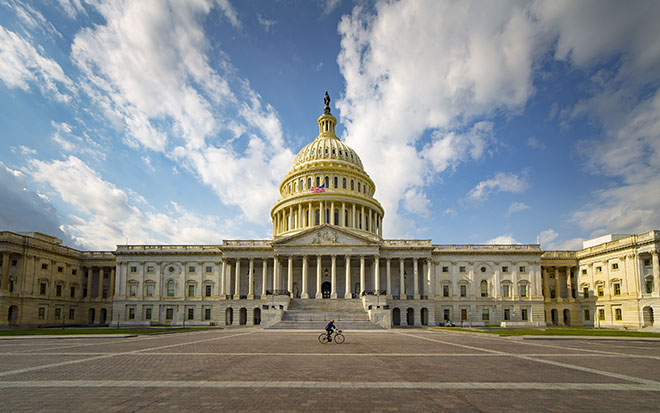
| The Senate voted 99-1 to remove a 10-year federal moratorium on state regulation of artificial intelligence from the federal budget reconciliation package, leaving states and localities able to regulate AI. Source: Mike Kline (notkalvin) via Getty Images |
With a controversial artificial intelligence provision removed from the federal budget reconciliation package, states, tech companies and policy experts are working to better understand how AI should and should not be regulated.
Congressional Republicans joined Democrats in voting to exclude a provision in the federal budget reconciliation package that would have blocked states and localities from imposing new regulations on AI for five to 10 years. Proponents argued the provision was necessary to prevent a patchwork of regulatory frameworks, while critics worried the moratorium infringed on states' rights and potentially left consumers vulnerable to various uses of the rapidly advancing technology.
Now, with no clear path forward about what other legislation or regulation could take the moratorium's place, stakeholders and lawmakers are sifting through complex legislative proposals as they seek an equilibrium between AI safety and leaving room for innovation.
"It's not that state regulation is some unalloyed good," said Peter Salib, an assistant professor at the University of Houston Law Center, law and policy adviser for the Center for AI Safety and co-director of the Center for Law and AI Risk. "It would be better to have good laws rather than bad laws, and better to have one set of laws instead of 50 sets of laws. It's just that's not what the moratorium was offering."
Groups like Americans for Responsible Innovation celebrated their lobbying efforts to kill the state-level AI pause, arguing that the measure would remove consumer safeguards, kids' online safety laws, and protections for artists and creators.
"Let this be a lesson to Congress — freezing state AI laws without a serious replacement is a political nonstarter," Americans for Responsible Innovation President Brad Carson said.
A new paradigm
Many in the policy world view the current period of stasis at the federal level as a watershed moment for AI, as any precedents and standards established at the federal level would break new ground in the regulation of many emerging technologies.
"A moratorium should be judged by two core metrics: whether it strengthens public trust and whether it provides clarity for innovation," said Patrick Murphy, a former Biden administration official and US Representative from Florida. "If regulation builds confidence in AI without crushing startups or overwhelming smaller firms, that's a win. But sweeping pauses can delay critical safeguards."
While the federal preemption was removed from President Donald Trump's budget bill, policy organizations like NetChoice and TechNet remain supportive of a federal framework that would impose limitations on states' authority to regulate AI. OpenAI LLC CEO Sam Altman and venture capitalist Marc Andreesen of Andreessen Horowitz LLC were among the major players in Silicon Valley who urged Congress to implement a ban on state laws that might slow tech growth.
Developing effective educational systems internally is more difficult without standardization and uniformity across jurisdictions, said Hilary Wandall, chief compliance officer and associate general counsel at Dun & Bradstreet.
"Businesses want to do the right thing, of course, but we don't want it to be overly complicated, because that's an impediment to having good, concise strategy," Wandall said. "Having too many different kinds of laws is really not well received and never will be well received by businesses because it puts too much work in the system from a complexity standpoint, that prevents efficiency."
The pace of regulation will always trail the pace of innovation in AI, said Ashley Casovan, managing director of International Association of Privacy Professionals' AI Governance Center.
"AI is not one monolithic thing," Casovan said. "It's not one type of technology. It's not used in one context, so it's really challenging to create legislation that is one size fits all for these various different types of uses. At the same time, the absence of having any of those legislative guardrails is demonstrating that it's really difficult. These processes don't happen overnight."
What's happening this week?
Below is a list of hearings, webinars and other tech, media and telecom-related events taking place virtually and in person in the nation's capital and beyond this week:
July 15
➤ S&P Global Market Intelligence: H1 Review of GenAI Funding — Can the Market Keep Up with Record Volumes?
➤ House Energy and Commerce Subcommittee on Commerce, Manufacturing and Trade: Markup of H.R. 4312, the SCORE Act — legislation that would standardize Name, Image, and Likeness for student-athletes.
July 16
➤ House Judiciary Subcommittee on Crime and Federal Government Surveillance: Artificial Intelligence and Criminal Exploitation — A New Era of Risk.
➤ Senate Judiciary Subcommittee on Criminal Justice and Counterterrorism: Hearings to examine the AI industry's mass ingestion of copyrighted works for AI training.
➤ National Institute of Standards and Technology: Information Security & Privacy Advisory Board July 2025 Meeting.
July 17
➤ S&P Global Market Intelligence: The What, Where, When and How of Tariffs — Q3 2025 Trade & Supply Chain Outlook.