06 Jul, 2025
Major Asia-Pacific banks post market cap gains in Q2 as interest rates fall
By Gaurav Raghuvanshi and Uneeb Asim
Most of the major banks in Asia-Pacific increased their market capitalization in the second quarter as falling interest rates attracted investors to bank stocks in anticipation of increased economic activity.
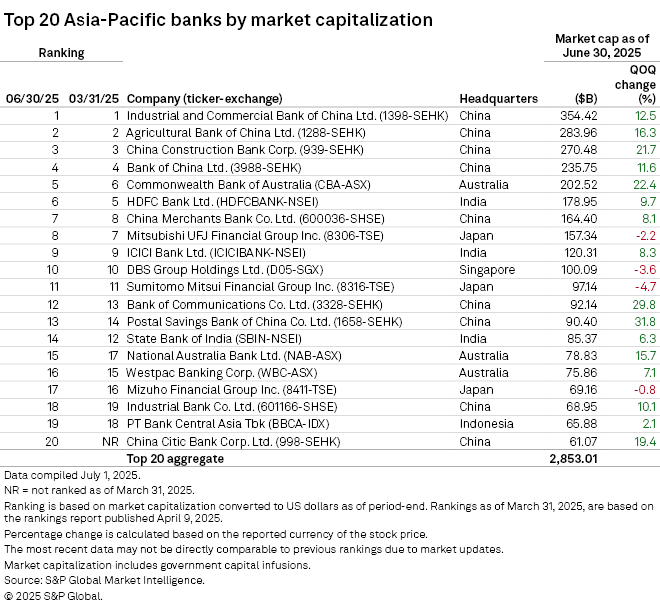
Commonwealth Bank of Australia became the fifth-biggest lender in the Asia-Pacific region by market cap during the quarter, swapping places with India's HDFC Bank Ltd. A booming property market and falling rates boosted the Australian lender's market cap 22.4% quarter over quarter to $202.52 billion, according to S&P Global Market Intelligence data. HDFC Bank gained 9.7% in market cap to $178.95 billion.
Central banks in India, Australia and other large regional economies have cut rates in recent months amid confidence that inflation will stay benign. China has maintained an easing stance since the pandemic. Bank of Japan, an outlier in the region seeking to normalize monetary policy after ending its experiment with negative interest rates in March 2024, has held steady after its last hike in January, waiting for more signals before it raises its benchmark rate further.
Chinese banks dominate
Chinese banks continued to dominate their regional peers in size. Industrial and Commercial Bank of China Ltd., Agricultural Bank of China Ltd., China Construction Bank Corp. and Bank of China Ltd., the world's biggest lenders by assets, retained their top-four positions as the largest banks in the region by market cap. Each of the four Chinese megabanks posted double-digit growth in market cap during the second quarter, with China Construction Bank up 21.7% to $270.48 billion. ICBC's market cap grew 12.5% to $354.42 billion.
China Merchants Bank Co. Ltd., the best-performing major lender in the region according to Market Intelligence analysis, gained 8.1% in market cap to become the seventh-largest bank in the region.
China's economic data have shown some strength recently after the central bank cut two key lending reference rates to new all-time lows. The China Composite Purchasing Managers' Index climbed to 51.3 in June from 49.6 May, according to Market Intelligence data released on July 3.
The People's Bank of China on May 20 cut its one-year loan prime rate, referenced for general lending, to 3.0% from 3.1%. The five-year rate, the benchmark for mortgage lending, was cut to 3.5% from 3.6%.
Nomura noted "less urgency in the near term to cut" reserve requirement ratio or interest rates during the Chinese central bank's second-quarter monetary policy review. "We believe it is not a time for Beijing to be complacent, particularly in view of much stronger growth headwinds in [the second half of the year]," Nomura said in a June 30 note.
Trade tensions
Asia-Pacific economies remain vulnerable to global trade tensions as US President Donald Trump's July 9 deadline for deals with major trading partners approaches.
Overall, 16 of the 20 biggest banks in the region increased their market cap during the second quarter. Postal Savings Bank of China Co. Ltd. posted the highest gain of 31.8%, followed by local peer Bank of Communications Co. Ltd., which recorded a 29.8% increase.
Japanese megabanks were notable laggards, giving up a part of their prior gains. Sumitomo Mitsui Financial Group Inc. shed 4.7% in market cap during the second quarter, while Mitsubishi UFJ Financial Group Inc. lost 2.2%. Mizuho Financial Group Inc.'s market cap was down 0.8%.
Singapore-based DBS Group Holdings Ltd. posted a 3.6% drop in market cap during the quarter. The biggest bank in Southeast Asia by assets is among the lenders most exposed to global trade tensions due to its role as a major trade financier in the region.