30 Jul, 2025
Job openings nearly match unemployment as labor market steadies

By Brian Scheid
The number of Americans actively looking for work nearly matched the number of US job openings in June as hiring slowed while companies assessed the impact of political changes on US policy.
In June, there were nearly 7.44 million job openings in the US, the US Bureau of Labor Statistics reported July 29. That is a roughly 40% decline from the March 2022 peak when there were more than 12.13 million job openings amid a post-pandemic hiring spree.
While job openings have plunged since 2022, the number of Americans actively looking for work has nearly caught up with the number of job openings. There were about 7.02 million unemployed workers in June, up about 17% from March 2022.
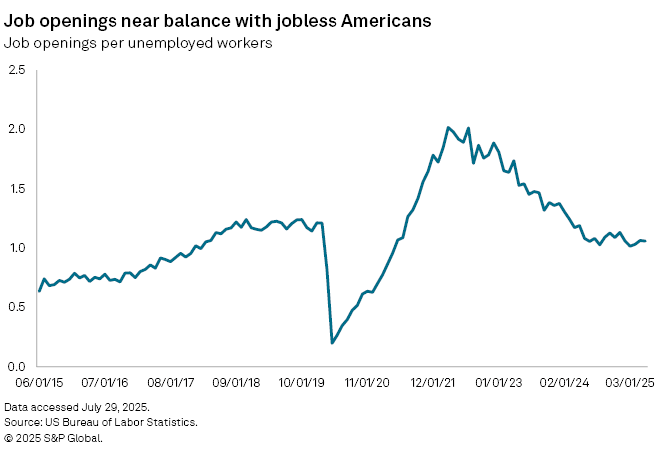
By contrast, in March 2022, there were more than two jobs for every unemployed worker. As of June, that ratio was 1.06. It has averaged less than 1.05 since February.
While US companies may not be hiring at the pace they were three years ago, they are not laying off workers, and there are no signals that a steep rise in unemployment is coming, said Aaron Sojourner, a labor economist at the W.E. Upjohn Institute for Employment Research.
"Employers are like deer in the headlights, uncertain what's coming and frozen in place," said Sojourner. "Not hiring and not firing."
Notably, the ratio of job openings to unemployed workers can be a flawed measure of the overall health of the job market, said Preston Mui, a senior economist at Employ America. Job openings have shown a secular upward trend for years relative to other labor market variables, and job posting technology is constantly changing, making it difficult to measure.
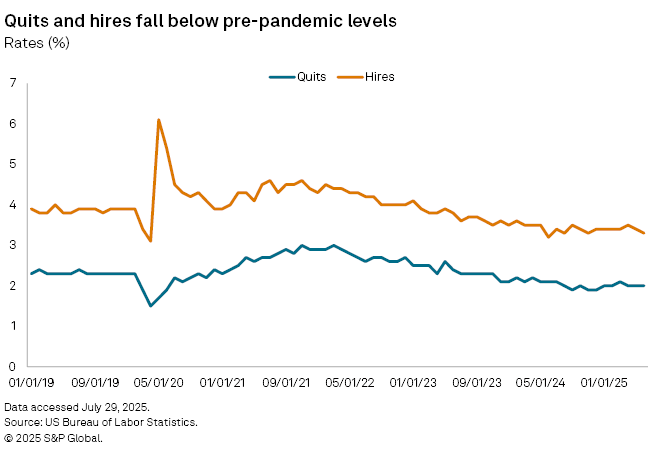
Still, the overall data on the jobs market — including the rates of quits, hirings, layoffs and total employment — has been consistently steady for months, Mui said.
"It does feel like the job market is in something resembling a steady state," Mui said. "The question is whether or not that will remain the case with quits, hires and layoffs so low."
This steady state may be short-lived.
"Businesses are happy to tread water for now while they wait for tariff uncertainty to resolve," Mui said. "But that can only last so long."
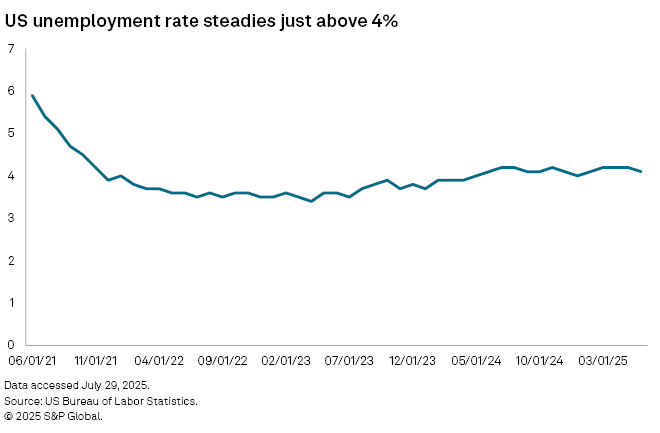
Many of the key indicators in the jobs market — including quits, hiring, layoffs and job openings — have stabilized, said Guy Berger, a workforce economist at Guild and a senior fellow at the Burning Glass Institute.
The data shows that the labor market is not getting weaker, a surprise to economists due to heightened policy uncertainty, Berger said. He still expects market conditions to worsen eventually.
"We have some big crosscurrents hitting the economy right now: tariffs, the big fiscal bill, and tight restrictions on immigration," Berger said. "So, I think a very wide range of outcomes is possible."