20 May, 2025
US energy secretary urges nuclear industry to get aggressive on its future

US Energy Secretary Chris Wright urged the nuclear power industry to shift gears, become more aggressive and position the technology as a solution to accelerating electricity demand.
"We've got to bring confidence back in to what we are," Wright told attendees at the Nuclear Energy Institute's (NEI) Policy Forum on May 20. "That's not easy."
In the past 25 years, Wright said, nuclear worldwide has lost "a third" of its market share, and he hopes to change that by assisting the US nuclear industry in becoming more market-driven and less contingent upon regulatory outcomes and federal assistance.
"[I'm] willing to put my hand on the scale and do everything I can to nudge and encourage the development," Wright said. "But ultimately, it's got to be driven — doubly driven — by private money, by private construction. It is up to us if we're going to make the nuclear renaissance go now."
Wright encouraged the industry, which he characterized as historically cautious, to be aggressive instead.
"We have to think, 'How can we do that faster?'" he said. "It is time to seize this moment and get those first five or 10 or 12 reactors in the next several years. ... That'll start to build a supply chain that'll make this industry sexy again."
One early move may be to develop nuclear generation on federal property.
"Definitely on DOE lands or [Defense Department] lands, we will move quickly," Wright said. "We will permit quickly. ... We are ready to move on our lands."
Wright said he is working with the National Energy Dominance Council, established by the Trump administration in February, to remove barriers to nuclear generation development.
"We have an administration that's all in. We want America to build things again," Wright said. "We don't want the government to decide what is to be built. We want the government to enable and empower private businesses and entrepreneurs to build what they want to build."
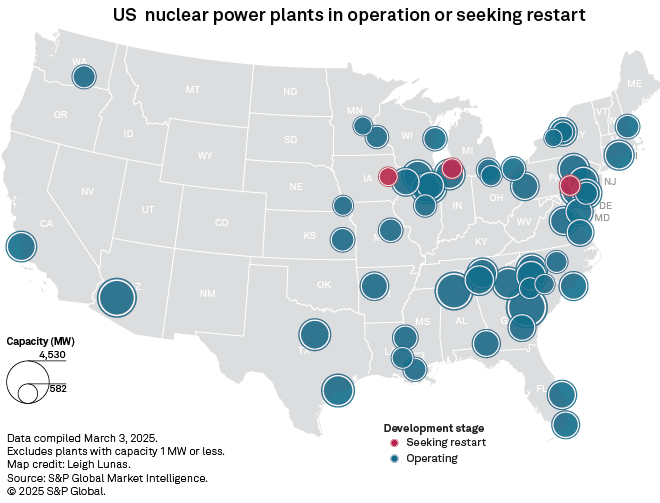
In the past year, the industry has seen two nuclear plant restart applications, two initial license renewals to 40 years, six subsequent license renewals to 80 years, and "more than 25 new projects are in the pipeline, and there's more to come," NEI President and CEO Maria Korsnick said at the conference May 20.
NEI member companies plan to submit at least eight construction permit applications for new reactors and four operating license applications for new reactors, which would enable construction at five sites, according to Korsnick, with operations to begin in the next two years for two microreactors. Plant restarts "are also on the horizon," she said, including the Palisades plant in Michigan and potentially the Duane Arnold Energy Center plant in Iowa.
Just a few years ago, Korsnick said she was in a meeting with Silicon Valley companies who told her they would not partner with nuclear generation.
"Now, fast-forward to today," she said. "We're in a whole new reality. [Google LLC, Meta Platforms Inc., Amazon.com Inc.], they've all joined 14 of the world's biggest banks and financial institutions to pledge to triple global nuclear power by 2050."
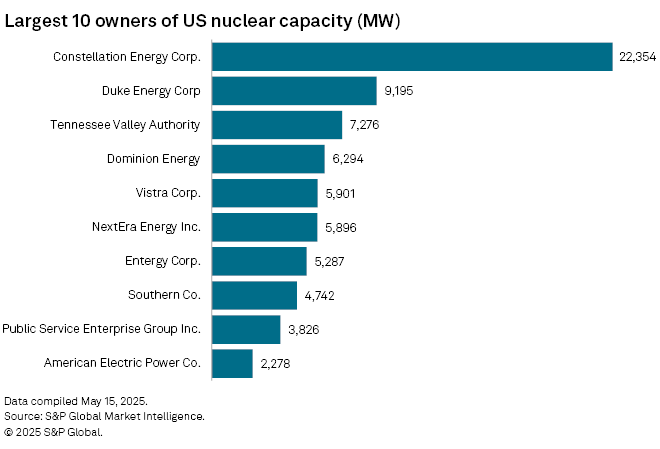
Tech companies have also partnered individually with nuclear operators and developers to power projects such as datacenters, totaling 30 GW of commitments across the US so far, Korsnick said.
"Corporations aren't running away from nuclear, they're running to us," Korsnick added. "And our arms are wide open."
Incentives
Wright encouraged the private sector to "lean in" to nuclear development and said his agency will help.
"Buyers are willing to pay a premium for low-carbon energy from nuclear," he said. "So we can get premium purchase agreements. We can get equity capital from hyperscalers. We can provide low-interest loans to go along with that equity capital through the Department of Energy. And, of course, we're working in Congress to see what incentives we can get."
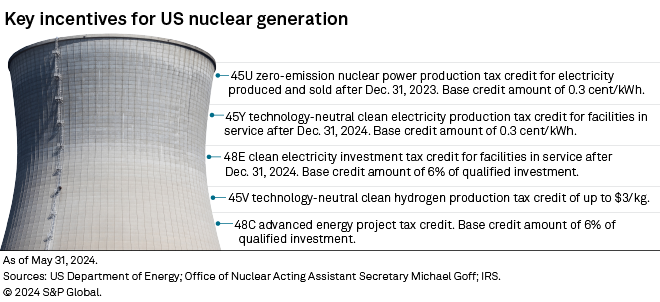
The House Ways and Means Committee's budget reconciliation bill has put tax credits and other key benefits for nuclear power into question at a pivotal point for the industry, advocates, developers and operators have said. NEI recently released a letter with more than 120 of its member companies, including major US utilities, urging Congress to preserve nuclear incentives.
"We cannot afford to go backwards," Korsnick said. "Above all, there's one thing that our industry needs to meet this moment, and that's investment. ... And yes, I'm talking again about tax credits.
"The future of our industry is in the hands of Congress and this administration. So is the future of American energy security."
Wright said he would prefer federal nuclear incentives that "have a sunset" within 10 to 15 years of a new plant's construction. Wright also said he wants to see incentives for other forms of generation, particularly renewables such as wind and solar, sunset much sooner, arguing that the country has not seen significant benefit from those tax credits.
"I'm a passionate, free-market guy," Wright said. "I'm in favor of every nudge, every incentive we can get from the federal government to restart [the nuclear] industry."