28 May, 2025
Joblessness surges for youngest US workers as firms slow entry-level hiring

By Brian Scheid
The youngest workers in the US are currently facing a challenging job market, with an increase in joblessness and reduced career opportunities, making it more complex for them to secure entry-level positions.
Over the past two years, the unemployment rate for Americans aged 16 to 19 has jumped to 12.9% from 9.4%, while the unemployment rate for those aged 20 to 24 has climbed to 8.2% from 5.5%, according to the latest government employment data. Since bottoming at 3.4% in April 2023, the lowest level since the late 1960s, the overall US unemployment rate has risen about 80 basis points to 4.2% in April 2025 and hovered between 4% and 4.2% for the past 12 months.
While older, more established American workers continue to see unemployment steadying near historic lows and stable levels of job security, younger workers face a tougher outlook. The data signals an ongoing slowdown in the domestic market and may be an early indicator of further trouble to come.
"Younger workers are aging into a labor market that has been cooling for the better part of three years now," said Cory Stahle, an economist at the Indeed Hiring Lab. "The supply of job openings has contracted, and we've seen employers' recruiting intensity fade. In other words, there are fewer jobs out there now than a few years ago, and employers are hiring less urgently for the positions that are available."
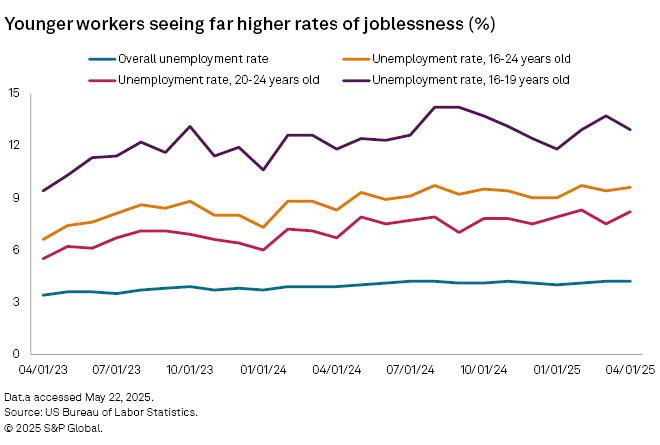
The rate of joblessness for younger workers has climbed much higher and much faster than for nearby age groups, government data shows.
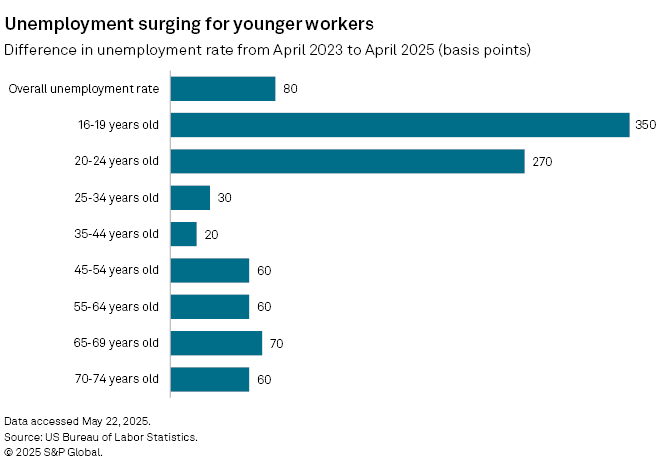
The unemployment rate for individuals aged 16 to 19 has climbed about 350 basis points from April 2023 to April 2024. In comparison, the rate for those aged 20 to 24 has increased by 270 bps. Meanwhile, unemployment for Americans aged 25 to 34 has risen to 4.2% from 3.9%, only a 30-bps increase. Additionally, the joblessness rate for individuals aged 35 to 44 has only risen by 20 bps, moving to 2.9% from 2.7% over the past two years.
"We have a low hiring and low firing labor market, which creates insiders and outsiders," said Guy Berger, director of economic research at the Burning Glass Institute.
Insiders in the current labor market are the Americans who already have a job, a group that tends to skew older and many who found employment in the wake of the pandemic when demand for workers vastly outpaced supply. Outsiders are those who still need to find a job, a group that is currently heavily tilted younger in age, as companies have slowed hiring, but have not increased their pace of firing.
Slow hiring
In March, there were fewer than 7.2 million job openings in the US, near the lowest monthly number since December 2020, according to the latest government data. Meanwhile, there were fewer than 1.6 million layoffs and discharges in March, the lowest number of firings since June 2024.
"The labor market is definitely not as tight as it was a few years ago," said Augustine Faucher, chief economist of The PNC Financial Services Group. "After having too few workers in 2022, firms have now adequately staffed up and have therefore cut back significantly on hiring."
This has left younger Americans entering the workforce with fewer job opportunities than they had in 2022 and 2023, and has increased the amount of time it now takes to find work, pushing up the unemployment rate, Faucher said.
The decline in hiring has also led to companies hiring older, more experienced workers over younger workers with less experience, since demand is on the decline. These workers are also less likely to leave these jobs once hired, creating additional hurdles for younger potential workers, Faucher said.
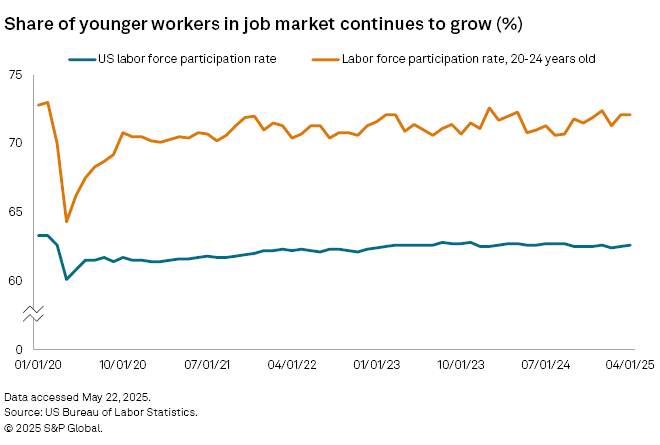
The labor force participation rate for younger Americans is also on the rise, and unemployment is climbing, a signal that these younger workers are engaging more with the labor market, but finding more difficulty getting hired.
The labor force participation rate, which measures the percentage of a population either employed or actively seeking work, was at 72.1% for Americans aged 20 through 24, up about 120 bps from two years earlier, according to government data. The participation rate for the entire labor force was 62.6% in April, unchanged from two years prior.
"Young people are still joining the labor force, but they are joining as unemployed due to the lack of job vacancies that match their skillset," said Nicole Cervi, an economist with Wells Fargo.
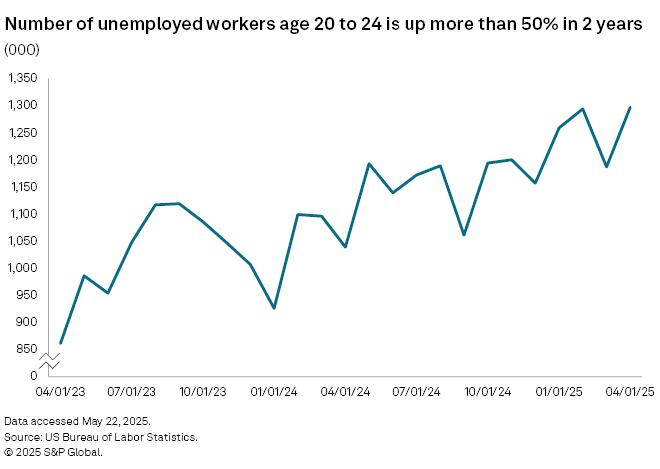
As companies have pulled back on hiring new workers, the recent high school and college graduates who tend to be the new labor market entrants have seen opportunities steeply decline, Cervi said. Many of the firms that are hiring are prioritizing positions that have become vacant due to natural attrition, such as retirements and quits. These positions often require skillsets and experience that younger workers may lack, Cervi said.
"As firms are reluctant to expand headcounts and aim to preserve current payroll levels, the opportunity for younger individuals to break in narrows," Cervi said.
Lack of entry
Joblessness among younger workers has coincided with a "dramatic pullback" in jobs for college graduates and in internship job postings, said Stahle with Indeed.
In an April report, Indeed researchers found that internship postings have fallen below 2019 levels and were 11 percentage points below the same point a year ago.
In addition, listings for entry-level roles are concentrated in in-person and often lower-paying sectors, such as food service, driving and sanitation, according to the report.
"The rise in unemployment among these younger workers is concerning," Stahle said. "It suggests that pockets of the labor market are not providing the volume or type of jobs needed to sustain economic growth."
The rise in youth unemployment is an indication of weak labor demand, Cervi with Wells Fargo said. And while it may not be a leading indicator of an overall weakening job market, it is a sign that cracks are forming.
"It does suggest that there is untapped potential, which could weigh on productivity growth in the long run as sidelined workers' skills atrophy during prolonged spells of unemployment," Cervi said.