10 Apr, 2025
US climate actions struggle along nearly 3 months into Trump administration

By Karin Rives
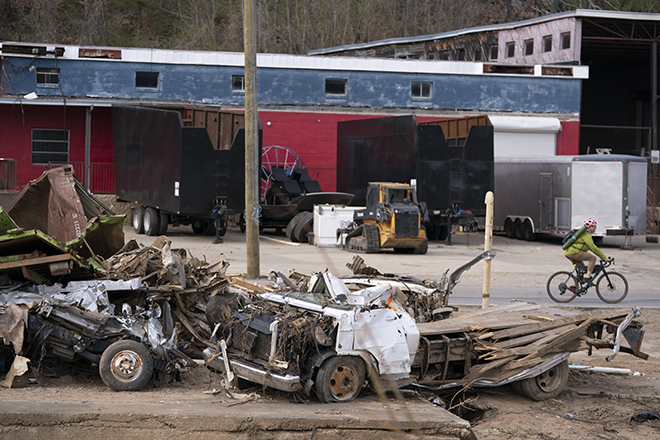
| A person bikes through Asheville, North Carolina, on March 24, 2025. The recovery continues six months after Hurricane Helene devastated the city. |
This is the second article in a two-part series about US climate efforts under the Trump administration. Follow this link to the first part.
Shortly before former President Joe Biden's term ended, his administration set ambitious new emission reduction goals for the US under the assumption that Democrat-leaning states and market forces favoring clean energy would maintain climate progress during the second Trump administration.
Since then, policy upheaval and economic uncertainty have unnerved investors, causing a wave of cancellations of clean technology manufacturing projects. Deep federal funding cuts have brought a sobering new economic reality for states. US utilities are planning large fossil fuel investments, and corporate America at large — once vocal about net-zero goals — is lying low nearly three months into the Trump administration
"Climate change has taken a backseat," Anjuli Ramos-Busot, an air quality scientist and New Jersey chapter director of the Sierra Club, said during an interview. "People are distracted. People are burned out."
Others caution that it is too early to dismiss US efforts to tackle climate change. Democrat-run states are better positioned today to withstand President Donald Trump's fossil fuel-friendly deregulatory agenda because of laws the states enacted over the past eight years that mandate greenhouse gas reductions, said Casey Katims, executive director of the 24-state US Climate Alliance.
"Governors have filled the void left by President Trump before, and they're prepared to do it again," Katims said in an interview.
Trump on April 8 directed the US Attorney General to identify state laws seeking to address climate change and to "expeditiously" take action to halt the enforcement of such laws. The president homed in on California, New York and Vermont as states that target fossil fuels. The US Climate Alliance has objected, citing states' independent constitutional authority.
Meanwhile, markets are showing signs of strain.
Cleantech cancellations jump
Between Jan. 17 and April 2, companies canceled $7.73 billion of investments in the manufacturing of electric vehicles, batteries, heat pumps, solar panels and other clean energy-related products, according Atlas Public Policy, a data policy research firm tracking planned facilities. The withdrawn investments translated into 11,450 missed job opportunities, the firm found.
By comparison, canceled clean energy manufacturing facilities during all of 2024 accounted for $1.9 billion in lost investments and 1,400 missed jobs, according to the group.
"There is a high level of uncertainty in the economy, driven by tariffs, possible changes to federal tax credits and a big shift in regulations," Matthew Vining, a policy analyst with Atlas Public Policy, said in an email. "This uncertainty is an impediment to investors wanting to build in the US."
Americans are focusing on other challenges for now. According to a Pew Research Center poll from early March, 41% of Americans think climate change is a "very big problem." This compares with 72% of people polled who cited the role of money in politics as their top concern.
Sixteen other pressing domestic issues, including healthcare affordability and "the way the US political system operates," ranked above climate change, the survey showed.
The Democrat-led states determined to protect climate goals during Trump's second term are facing headwinds as well.
State offshore wind trouble
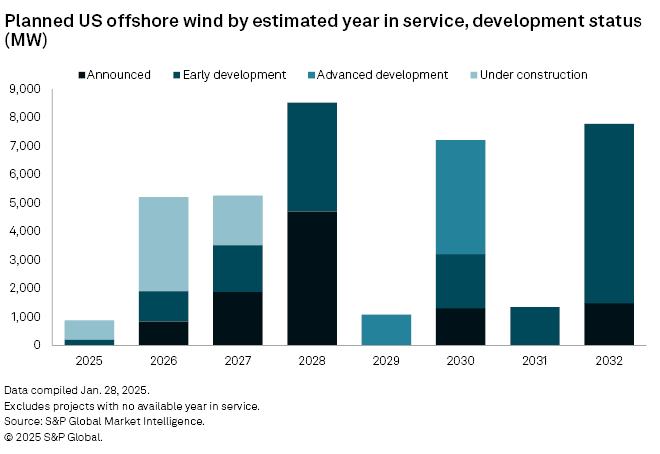
New Jersey, Massachusetts, Maryland, California and other states depend on large offshore wind projects to meet their climate goals. They are facing new barriers, with billions in investments on the line.
On his first day back in office, Trump halted federal leasing on the Outer Continental Shelf and paused permits for offshore and onshore wind projects. An appeals board with the US Environmental Protection Agency then rescinded an air permit for the 2.8-GW Atlantic Shores wind project off the coast of New Jersey, another setback for Democrat Gov. Phil Murphy's ambitious plans for wind energy.
Local group Save Long Beach Island had petitioned the EPA to cancel the New Jersey permit. Another group, ACK for Whales, asked the agency to rescind permits for the 800-MW Vineyard Wind 1 and 2.6-GW New England Wind projects off the coast of Massachusetts.
"In New Jersey, we're going to hold on tight, we're going to wait for when the time is right, and we're going to push forward with offshore wind," Ramos-Busot said.
Financial firms bucking the trend
Some companies, however, continue to see market opportunities a dozen weeks into the Trump administration.
Among those that still see business booming is a rapidly growing lender that markets itself as the world's first federally insured community bank "founded to combat the climate crisis." Florida-based Climate First Bank announced in March that it hit $1 billion in assets, citing its solar loan financing program as a major driver for the growth.
"The demand for commercial solar was a really hard product to sell over the last 10 years, and now we're seeing high levels of demand — so much so that we've built proprietary, automated lending solutions for customers applying for solar," Lex Ford, Climate First Bank's CEO, said during an interview. "It's really driving our product development."
Ford said he has positioned his bank as a consistent alternative to financial institutions that abandoned climate alliances and disavowed environmental, social and governance policies amid pressure from Republican-led states. Climate First Bank now operates in 41 states despite being in business for less than four years.
"If we were not a mission-based business working to solve the problem of efficiently financing solar, we wouldn't be the size we are today," Ford said.
The US installed 50 GW of new solar capacity in 2024, more than any technology added to the grid in more than two decades, the Solar Energy Industries Association reported in March.
Whether the record growth will continue in 2025 is uncertain. The solar and battery build-out would slow down and energy costs rise if Congress repeals investment and production tax credits for clean energy technologies under the 2022 Inflation Reduction Act, the Solar Energy Industries Association and other industry trade groups warned.
Peter Davidson of Aligned Climate Capital LLC, an asset management firm, has a different outlook. More established technologies such as battery storage, solar and wind will continue to thrive in the US because they are already cheaper than natural gas-fired generation, Davidson said in an interview.
"It's going to be an increasingly bifurcated market," said Davidson, who led the US Energy Department's loan office under President Barack Obama. The hydrogen economy, small nuclear reactors, and "even to a large degree, carbon capture and sequestration," still will not be financially viable without government support, Davidson said.
Still, Davidson expects the energy translation to continue to carry momentum.
"There may be choppy waters on the surface, which is certainly what's happening now at the federal level, but the underlying current is still every strong," Davidson said.