07 Apr, 2025
Financially strapped states see funds for disaster resilience projects at risk

By Karin Rives
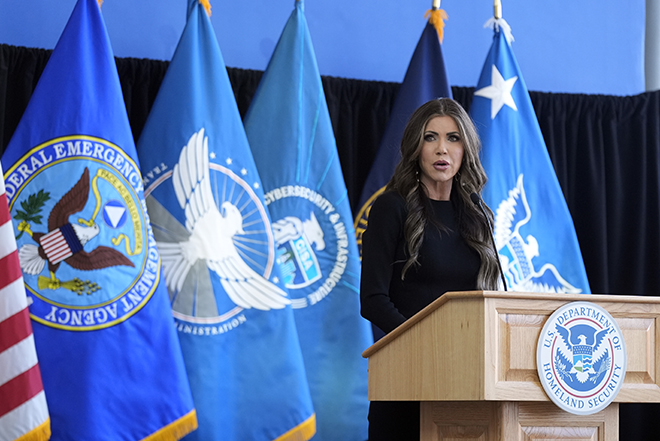
| US Homeland Security Secretary Kristi Noem has suggested the Federal Emergency Management Agency should be closed and responsibility for disaster management should be transferred to states. |
This is the first article in a two-part series about US climate efforts under the Trump administration. Follow this link to the second part.
Just weeks before the 2025 hurricane season kicks off, US states are facing new uncertainty over how to prepare for increasingly violent storms.
An April 2 internal memo from the Federal Emergency Management Agency (FEMA) laid out plans to eliminate a popular disaster mitigation program that helps communities ravaged by flooding, wildfires and other disasters rebuild with more durable infrastructure. The memo, written by FEMA head Cameron Hamilton, is another sign that the Trump administration is planning to shift climate change adaptation and resilience projects to states at a time when governors and state lawmakers already struggle with budget shortfalls.
Just two days earlier, a federal judge in Rhode Island ordered the FEMA to "immediately comply" with a previous ruling and unfreeze hundreds of millions of dollars due to states to deal with disaster management. As of April 7, no funds had been released.
In recent years, about 20% of state revenue, on average, has consisted of transfers from the federal government, said Jesse Keenan, an architecture professor and director of Tulane University's Center on Climate Change and Urbanism. With federal funding dwindling, that translates into smaller budgets for climate resilience projects, he said.
"As we see transfers begin to erode and evaporate with the current administration, it's going to put enormous stress on the fiscal stability of local governments," Keenan said in an interview. "They've got to prioritize where their limited dollars are going to go and they're not going to be spent on climate adaptation and risks that may manifest in the future."
Infrastructure grants canceled
In his memo, Hamilton suggested that grants issued under the Building Resilient Infrastructure and Communities (BRIC) program "have not increased the level of hazard mitigation as much as desired, and may supplant state, local, tribal and territorial capital investment planning." Grants that had been approved but not yet disbursed will not be awarded, and projects already underway must undergo a "program review," the memo said.
Some of the funding from BRIC came from the 2021 bipartisan infrastructure law.
In fiscal year 2023, FEMA received 1,234 grant applications from all 50 states, 35 tribes, five territories and the District of Columbia for nearly $5.7 billion in federal cost share, according to the agency's website. The program was able to fund less than one-fifth of the projects.
FEMA said in an April 4 press release that it will return about $882 million appropriated for BRIC to the US Treasury or that the money will be reapportioned by Congress in the next fiscal year.
"The BRIC program was yet another example of a wasteful and ineffective FEMA program," an agency spokesperson said in a statement. "It was more concerned with political agendas than helping Americans affected by natural disasters."
The Trump administration has indicated it wants to close FEMA — which, like many other federal agencies, is being downsized. Project 2025, the policy blueprint conservatives developed for the Republican administration, also proposed to "shift the majority of preparedness and response costs to states and localities instead of the federal government."
"I think we're going to see costs and harms being pushed on communities," Shana Udvardy, a senior climate resilience policy analyst with the Union for Concerned Scientists, said in an interview. "With the layoffs and freezing of grant programs, it's just a disaster in the making."
In 2024, extreme weather cost the US economy more than $500 billion in insured and uninsured losses, the weather forecasting company AccuWeather estimated. Hurricane Helene, which devastated Western North Carolina, was the world's costliest storm in 2024, according to insurer Munich Re.