15 Apr, 2025
Community development banks, credit unions funding in jeopardy
By Zoe Sagalow and Zuhaib Gull
A reduction of the Community Development Financial Institutions Fund stands to have resounding impacts on those institutions and the communities they serve.
Community banks and credit unions designated as community development financial institutions (CDFIs) could lose a key source of their funding following an executive order from President Donald Trump seeking to restrict the fund. Though such a possibility is up in the air as the CDFI industry and bipartisan members of Congress fight it, a potential loss would have negative ripple effects.
A reduction or removal of these funds threatens CDFIs' private funding too, which would reduce services for the demographics these banks serve, such as small businesses and low-income and underserved communities.
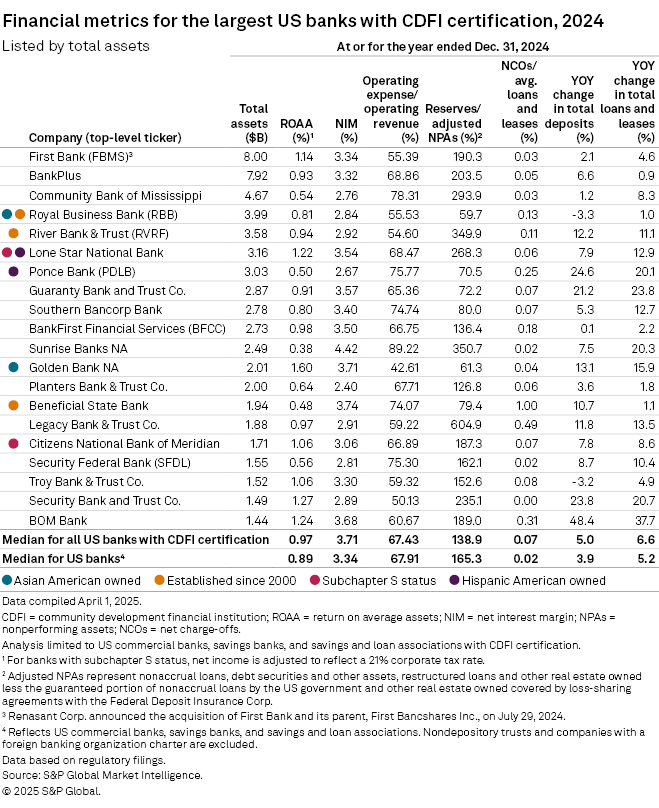
"What we should be talking about is how do we actually invest more in this because it's a very efficient way to provide support across the country for rural communities to urban," said Randell Leach, CEO of Beneficial State Bank, the 14th-largest CDFI bank at year-end 2024. "It's really just trying to support the American economy and strengthen it."
According to the CDFI Fund website, CDFIs originated over $24 billion in loans last year, which included more than 109,000 loans to businesses and 45,000 affordable housing units.
That funding contributed to CDFI banks' 6.6% median loan growth in 2024, above the median of 5.2% for all US banks last year, according to an analysis by S&P Global Market Intelligence.
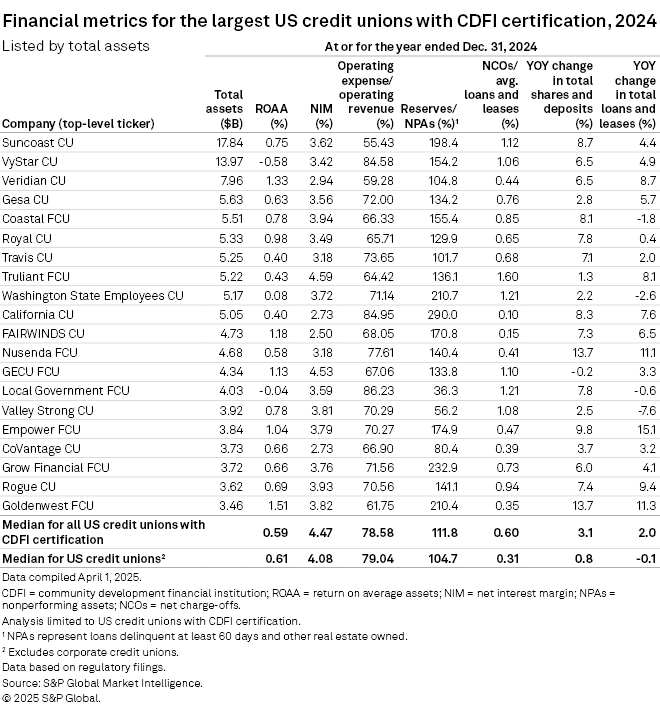
CDFI-designated credit unions also posted an above-industry loan growth in 2024 at 2%, compared to a shrinkage of 0.1% for all credit unions.
CDFI banks have also outpaced all US banks' year-over-year loan growth every year but one since 2020. However, they've also posted weaker asset quality, with a higher median net charge-off ratio compared to the industry every year since at least 2014.
Conversely, CDFI banks have been more profitable, posting an above-industry median return on average assets every year since 2021.
Trends were similar for credit unions, with CDFI credit unions reporting higher profit margins and loan growth but weaker asset quality than credit unions overall.
Ripple effects
Following the executive order, the Treasury sent a letter to the White House's Office of Management and Budget saying all the CDFI programs are statutorily required, according to a document that multiple outlets reported. The Treasury did not respond to requests from Market Intelligence.
While the ultimate impact of the executive order is up in the air as CDFI supporters argue the fund is statutory, CDFIs are vowing to remain committed to their mission regardless of the fund's future.
"CDFIs are going to keep doing what they do," Sunrise Banks NA Chairman, President and CEO David Reiling said in an interview. "The more funds that enter into this arena of being invested into low-income communities is just the more leverage that happens and the more jobs that can be created. ... We're going to continue [regardless] of whether there is a CDFI Fund or not or whether there's funding or not."
But the loss of federal funding poses a risk to private funding too, sources told Market Intelligence.
Since some of the CDFI Fund programs incentivize private investments in CDFIs through perks such as tax breaks, removing that public funding would, in turn, reduce private funding. For example, the new markets tax credit program generated $8 of private investment for each dollar of federal funding as of fiscal year-end 2023, according to the CDFI Fund.
CDFIs "leverage the received federal funds to attract additional investment from private and philanthropic sources that kind of takes that government's initial investment and multiplies it," Kelly Brown, chairman and CEO of Ampersand Inc., said in an interview. "It's almost like a multiplier effect" in which government funding "provides immediate relief, but it also helps stimulate the growth and sustainability with the private funding that comes along the backside of that."
Ultimately, any hit to funding, federal or private, will hurt underserved communities, individuals and small businesses the most.
"The entire reason the CDFIs exist is for the human impact," Brown said. "It's more than just a spreadsheet. It's more than just a bunch of numbers. It's people. This affects real young people, children, families, small businesses, people that just wouldn't otherwise be able to use a traditional bank."