


19 Mar, 2025
Calif. regulator considers new policies to phase down gas utility service


| A future of gas proceeding at the California Public Utilities Commission is tackling near- and long-term issues to facilitate transition away from natural gas use. Source: Nicholas Klein/iStock/Getty Images Plus. |
California's utility regulator began fielding proposals for near-term actions to cap natural gas distribution system growth, decommission pipelines and facilitate building electrification retrofits.
In comments filed to the California Public Utilities Commission (CPUC), utility operators, environmental groups and other stakeholders largely supported requirements for gas distributors to explore non-pipeline alternatives (NPA) to planned infrastructure projects. They also weighed in on changes to ratemaking that would facilitate building electrification.
The CPUC solicited the comments to inform the next chapter of its proceeding to align gas system planning with the state's climate goals (Rulemaking 24-09-012). At this stage of the future of gas proceeding, the CPUC aims to identify near-term actions to expedite decarbonization and cut system costs while also developing long-term approaches to a managed gas transition.
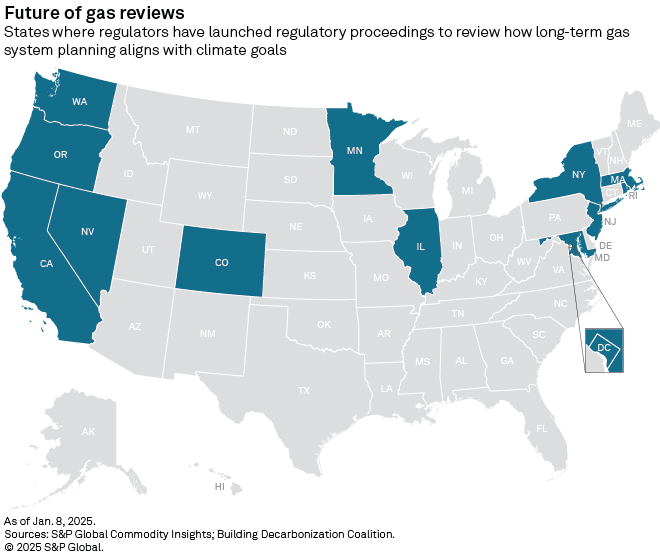
Sempra subsidiaries Southern California Gas Co. and San Diego Gas & Electric Co. in December 2024 urged the CPUC to prioritize long-term issues and only afterward consider near-term policy changes. But in a Jan. 31 scoping memo, the CPUC said it would advance both initiatives concurrently, along with a third track to pursue neighborhood-scale building electrification, known as zonal decarbonization.
Stakeholders that submitted comments on near-term actions included Pacific Gas and Electric Co. (PG&E), Southern California Edison Co. (SCE), environmental groups Sierra Club and Natural Resources Defense Council (NRDC), clean energy industry association Advanced Energy United and ratepayer advocates Utility Consumers Action Network (UCAN) and the Center for Accessible Technology.
Introducing non-pipeline alternatives
In March 14 comments, stakeholders broadly agreed that the CPUC has authority to require gas utilities to consider NPAs to infrastructure repair and replacement projects — and that commissioners should use that authority.
The environmental groups and Advanced Energy United said gas utilities should have to conduct NPA analysis for virtually all non-emergency system work. SCE also said gas distributors should have to prioritize NPA analysis. PG&E said commissioners could require the companies to consider NPAs "on a relevant basis" during rate cases, consistent with safety, affordability, reliability and emission reduction considerations.
Stakeholders also generally agreed that the CPUC must clarify whether revenues authorized in rate cases for gas system capital costs and expenses can be used for cost-effective NPAs.
PG&E said utilities should be able to capitalize the costs of NPAs and earn a rate of return on these behind-the-meter investments, even though the utilities would not own the asset. The CPUC must adopt cost-effectiveness and cost recovery criteria for the projects in order to provide regulatory certainty, PG&E said.
PG&E and SCE said a broad clarification would suffice, but Sierra Club and NRDC argued for establishing specific rates of return and recovery periods for behind-the-meter NPAs. This approach would be more efficient than case-by-case analysis and promote the policy clarity needed for utilities to invest in NPAs.
The environmental groups proposed requiring gas utilities to offer building electrification in lieu of infrastructure replacement, pressure betterment and system reinforcement projects, particularly for projects serving a small number of customers. They also recommended adopting a standard framework for evaluating NPA cost-effectiveness and requiring independent review of companies' NPA analysis.
New rate case requirements
The CPUC also solicited comments on several changes to foundational aspects of ratemaking.
Sierra Club, NRDC and Advanced Energy United said commissioners should require electric and gas utilities to propose an option for proportional depreciation in order to protect ratepayers from stranded asset risk. Compared to standard straight-line depreciation, the approach would accelerate depreciation of gas assets and decelerate appreciation for electric system investments, according to SCE.
PG&E and SCE both opposed proportional depreciation requirements. SCE said the requirement would slow the gas transition because proportional depreciation depends on "reasonably accurate" demand forecasts specific to a gas phasedown scenario. Sierra Club and NRDC said gas utilities could use California Energy Commission forecasts.
SCE instead proposed a new charge on gas utility bills to fund gas transition escrow accounts. Gas distributors would use these accounts to pay down liabilities as customers exit the gas grid. This would be a new fixed charge, the part of the bill that is uniform for residential customers and which covers things like system maintenance.
PG&E said the CPUC should not require gas utilities to propose rate options without fixed charges, saying the charges do not affect the pace and cost of decarbonization. However, the environmental groups, ratepayer advocates and Advanced Energy United opposed fixed rate charges, saying they increase costs for low-usage customers and conflict with California's decarbonization goals.
UCAN recommended implementing time-of-use rates for gas customers, one of several alternative rate structures that make electric heat pumps more cost-effective in places where electric rates are higher than gas rates. UCAN, Sierra Club and NRDC additionally recommended ending energy efficiency rebates for gas heating equipment.
Next steps
Replies to the proposals are due March 31, and the CPUC plans to hold workshops on near-term actions by the third quarter of 2025. The CPUC anticipates considering foundational data and analytics issues for long-term gas transition planning by the end of the second quarter.
CPUC staff filed a proposal in February for natural gas system mapping that would inform zonal decarbonization efforts. Utility mapping is due by July 1, and the CPUC anticipates designating priority neighborhoods for zonal decarbonization in the second half of 2025, with a decision scheduled for Jan. 1, 2026.