


26 Mar, 2025
Austrian lenders face bank tax hike

By Beata Fojcik
A planned bank tax hike in Austria is expected to have a limited impact on the country's lenders, according to analysts.
With a new government in place following the September 2024 elections, Austria plans to raise its existing bank levy as part of its fiscal consolidation efforts. The proceeds will increase to about €200 million from €150 million in 2024. Banks will also make additional payments in 2025 and 2026, totaling about €300 million per year.
The tax hike is expected to have an additional €350 million impact on the Austrian banking sector in both 2025 and 2026.
The impact should be "relatively limited," representing about 3.5% of the total unconsolidated net income for 2024 or about 2.5% of the projected consolidated annualized income for 2024, Halil Senturk, assistant vice president of European Financial Institutions at Morningstar DBRS, told S&P Global Market Intelligence.
The current bank levy in Austria is charged at 0.024% based on balance sheet totals of between €300 million and €20 billion, and 0.029% on balance sheet totals of over €20 billion.
The increase comes at a time when profitability in the European financial sector has been significantly supported by net interest income; it appears to be a reaction to domestic fiscal pressures, positioning the financial sector as a political target, according to Natasha McSwiggan, senior economist at Market Intelligence.
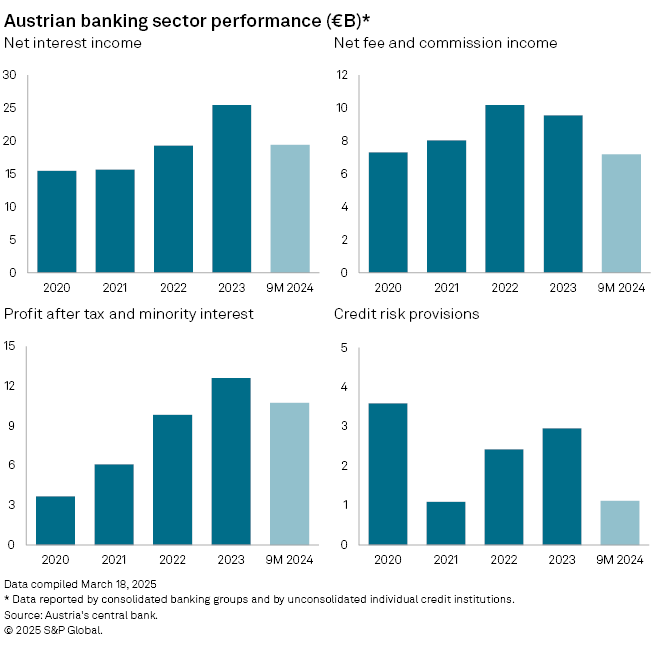
The Austrian Federal Economic Chamber criticized the tax hike, warning it could diminish local banks' lending capacity.
"Austria is ill-advised to weaken the basis for the urgently needed investments [and] the lending capacity of Austrian banks by increasing the bank levy," Dr. Franz Rudorfer, managing director of the Bank and Insurance division of the Austrian Federal Economic Chamber, told Market Intelligence. It will weaken investment and put jobs at risk, he said.
Although the proposed tax hike raises concerns about financial stability and a potential credit slowdown, McSwiggan pointed out that countries such as the Netherlands and Romania experienced only short-lived lending slowdowns after implementing bank levies while profitability was maintained.
Senturk said DBRS does not expect any meaningful impact on lending capacities or capital positions in general.
"Still, some small banks with limited earnings capacities could feel strong pressure," he said.
Impact on large banks
Stefan Dörfler, CFO of Austria's Erste Group Bank AG, criticized the bank levy hike at a Feb. 28 earnings call but said the impact would be "digestible." Erste CEO Peter Bosek said the bank could pay between €140 million and €160 million in both 2025 and 2026 under the increased bank levy based on very initial estimates. A spokesperson for the bank told Market Intelligence that, based on the latest available information, this figure is now probably closer to €130 million or less. Erste paid €40 million under the Austrian bank levy in 2024.
Raiffeisen Bank International AG estimates the bank levy hike will result in an additional burden of roughly €50 million in 2025, on top of the €21 million initially projected for this year, a spokesperson for the bank told Market Intelligence. The bank paid €23 million under the tax levy last year.
UniCredit SpA's unit UniCredit Bank Austria AG paid €21 million under the levy in 2024. The bank did not provide estimates for Market Intelligence regarding what it would pay following the changes.
The three Austrian banks reported robust net interest income in 2024. Erste and UniCredit Bank Austria also improved their profits, but RBI's result was negatively affected by its exposure to Russia, the sale of the Belarusian unit and provisions for its Swiss franc mortgage portfolio in Poland.
"Our 2025 outlook for the [three] banks is largely stable despite the banking levy's increase," Morningstar DBRS said in a March 18 report.
Erste and RBI paid €245 million and €112 million, respectively, in bank levies in 2024 across the central and southeast European markets where they operate, compared with €183 million and €95 million in 2023.
Loan quality concerns
As of the third quarter of 2024, Austria had one of the highest proportions of stage 2 and stage 3 loans in Europe at 18.4%, reflecting a significant volume of loans with elevated credit risks, according to McSwiggan. Stage 2 loans are classified under IFRS 9 as those for which credit risk has risen significantly since initial recognition, while stage 3 loans are defined as credit-impaired loans.
Despite the banking sector's strong performance and regulatory measures bolstering resilience, additional taxes reduce retained earnings, crucial for organic capital growth. "A sudden rise in nonperforming loans would challenge banks' capacity to enhance their capital buffers," McSwiggan said.
"We expect some loan quality deterioration mainly due to the troubled commercial real estate sector. Still, the risks are expected to remain manageable, as the banks have strong profitability and capital buffers for potential credit risks," Sentruk said. The Austrian banking sector's consolidated common equity Tier 1 ratio was 17.7% after the first half of 2024, Austrian central bank data showed.
The share of nonperforming commercial real estate loans in Austria more than doubled from its 2020 low to 5.5% as of mid-2024. The central bank stated in its November 2024 "Financial Stability Report" that the banking sector remained resilient to shocks.
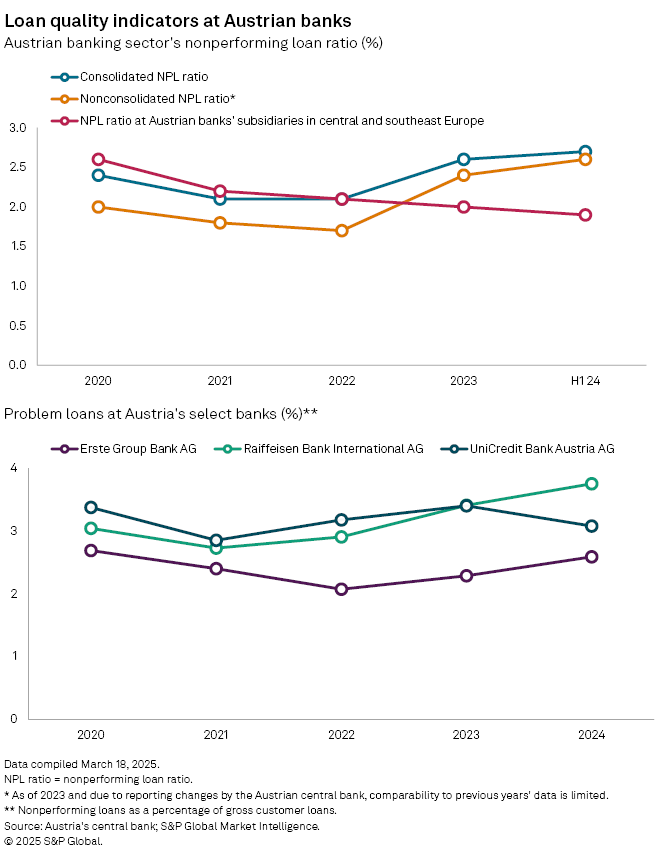
The consolidated nonperforming (NPL) ratio in the Austrian banking sector was 2.7% as of the first half of 2024, significantly higher than that for the central and southeast European units of Austrian banks, Austrian central bank data showed.
Both Erste and RBI reported year-over-year increases in their 2024 NPL ratios, while UniCredit Bank Austria's ratio declined. Erste executives attributed the increase to rising defaults in Austria, while asset quality in central and eastern Europe remained strong. The bank expects the NPL ratio for 2025 to remain around last year's level.
While further measures targeting the banking sector remain possible, the Austrian Federal Economic Chamber said it is optimistic about a "constructive dialogue" with the new government. "Our sector stands ready to engage with the government on strategies that balance fiscal needs with maintaining a robust and competitive banking system," Rudorfer said. Rudorfer added that the strong position of local banks would help them maintain lending and investment capacities, even in the face of increased taxation.