06 Feb, 2025
US Senate hearing reveals rift in bipartisan effort to address debanking

By Karin Rives
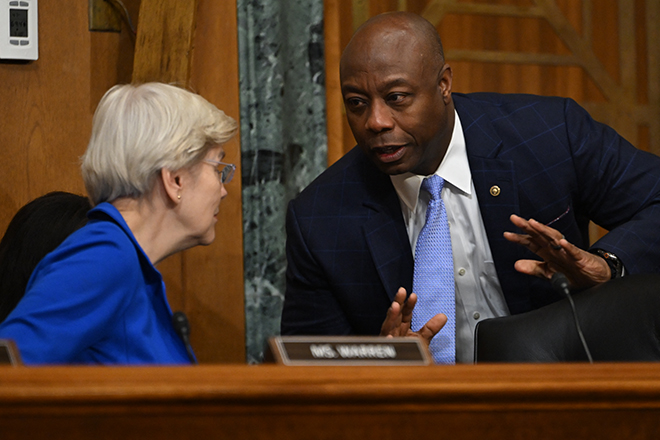
| US Sen. Elizabeth Warren (D-Mass.) and Senate Banking Committee Chairman Tim Scott (R-SC), seen here during a Jan. 16, 2025, hearing on the nomination for Secretary of Housing and Urban Development. |
In a rare show of unity, US Senators from both parties agreed for two hours and 48 minutes that discriminatory banking practices are a real challenge for American consumers and businesses.
How to address those debanking practices — and for whom — became a sticking point, however, as lawmakers and witnesses grappled with the issue during a Senate Banking, Housing and Urban Affairs Committee hearing Feb. 5. The hearing took place against the backdrop of the Trump administration's push to reshape federal agencies that oversee the banking industry.
Unfair lending has become a rallying cry for conservatives who allege that banks steered by federal regulators are systematically refusing to serve certain industries for ideological reasons. Biden-era policies seeking to control potential risks for federally insured banks engaged in cryptocurrency-related activities were of particular interest to Republican lawmakers during the hearing.
'Not comfortable with our crypto clients'
Among Republican witnesses was Nathan McCauley, co-founder and CEO of Anchorage Digital Bank NA, the country's only federally chartered cryptocurrency bank. McCauley testified that his company's corporate bank account was unexpectedly shut down in 2023.
"They told us they were closing our account in 30 days because they were not comfortable with our crypto clients and their transactions," McCauley testified. "They refused to provide any further explanation or allow us to speak with the risk management team."
A year earlier, the crypto bank had entered into a consent agreement with the US Office of the Comptroller of the Currency after regulators determined the bank violated federal anti-money laundering laws by failing to implement a compliance program.
"This hearing is just the beginning," said Sen. Tim Scott (R-SC), who chairs the committee that held the hearing. "We are here to shine a bright light on these unacceptable practices and to hold those responsible accountable."
12,000 consumer complaints in 3 years
Democratic senators emphasized that the impact of debanking falls primarily on financially struggling consumers whose accounts are overdrawn.
A review of the federal Consumer Financial Protection Bureau (CFPB) complaint database over the past three years yielded 11,955 complaints from people who could not open bank accounts or had their accounts wrongly closed, Sen. Elizabeth Warren (D-Mass.) told lawmakers.
The CFPB is the main agency working to stop unfair debanking and has five rules in place or in progress to address overdraft fee practices or religious discrimination, Warren said, adding that such efforts may now be at risk.
Treasury Secretary Scott Bessent was named acting director of the CFPB on Feb. 1.
"Scott Bessent halted all CFPB rulemaking, enforcement investigations and litigation against financial institutions that are breaking the law — including the banks that are wrongfully debanking their customers," Warren said. "The freeze Secretary Bessent put on the CFPB means more Americans across this country will be unfairly debanked."
The congressional interest in debanking comes after several GOP-led states enacted laws prohibiting banks from denying services to customers based on political opinions or religious beliefs.
Banks want necessary clarity to comply
Legislation that targets debanking rules out factors that are not "quantitative, impartial and risk-based," per a 2023 Florida law. This is akin to state laws passed in recent years to erase environmental, social and governance criteria from investment decisions.
Florida's House Bill 3 targeted "government and corporate activism," but lawmakers offered little clarity for banks seeking to implement the law. Several other states have since enacted similar laws.
The financial industry is closely monitoring legislative and regulatory efforts to address debanking, said Marina Olman-Pal, an attorney with Greenberg Traurig and co-chair of the firm's financial regulatory and compliance practice.
"Banks are highly regulated and are expected to operate in a way that ensures their safety and soundness," Olman-Pal said in an interview. "They are very compliance-driven and compliance-focused. So when these new laws come up, banks want to make sure they have the clarity they need to be prepared to comply."
On Feb. 5, Sen. Kevin Cramer (R-ND) reintroduced his Fair Access to Banking Act, which would fine banks up to $10,000 and potentially terminate them for violating the law. The proposed law comes in response to US financial institutions "increasingly using their economic standing to categorically discriminate against legal industries and conservatives," Cramer's office said in a news release.
As an example, the statement cited Citigroup's 2018 policy to withhold project-related financing for coal plants, as well as a decision by other banks to halt loans and credit for oil and gas drilling in the Arctic National Wildlife Refuge.