03 Feb, 2025
US consumers embark on spending spree ahead of Trump tariffs

By Brian Scheid
As the full impact of President Trump's sweeping tariffs on goods from Canada, Mexico and China unfolds, new data suggests US consumers have been prepping for this trade war for months.
Durable goods consumption jumped 12.1% at a seasonally adjusted annual rate in the fourth quarter of 2024, the highest growth in more than two years, according to the latest US government data released Jan. 30. That accounted for more than one-third of the 2.3% growth in US real GDP, an inflation-adjusted measure of the total value of all goods and services produced in the American economy.
After Trump was elected in November 2024, Americans went on a spending spree for televisions, cars, computers, phones and other durable goods, new government data shows. While it is difficult to determine exactly why consumer spending spiked in one broad category, many of the biggest jumps were in items that were "tariffable," said Dean Baker, a senior economist at the Center for Economic and Policy Research. These include a 13.9% increase in motor vehicle sales, a 19.7% increase in recreational vehicle sales, a 20.8% rise in information processing equipment sales and a 24.3% jump in phone sales, Baker said.
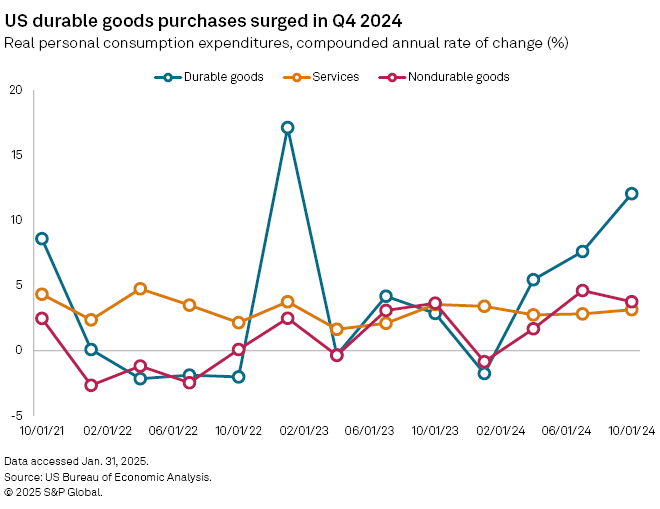
"These are all extraordinary increases," Baker said. "We have had a good economy with a rising stock market and healthy real wage growth but that is not something that just happened in the fourth quarter."
Trump on Feb. 3 said a previously announced 25% tariff on all goods imported from Canada and Mexico, with some carve-outs for Canadian energy and oil exports that would be taxed at 10%, would be delayed by a month. The delay came just two days after the administration announced the duties and did not affect an additional 10% tariff on all imports from China.
With memories of how Trump's previous trade wars played out, US consumers likely bought "big ticket" items in late 2024 in anticipation of potential tariff-related price hikes, said James Knightley, chief international economist with ING.
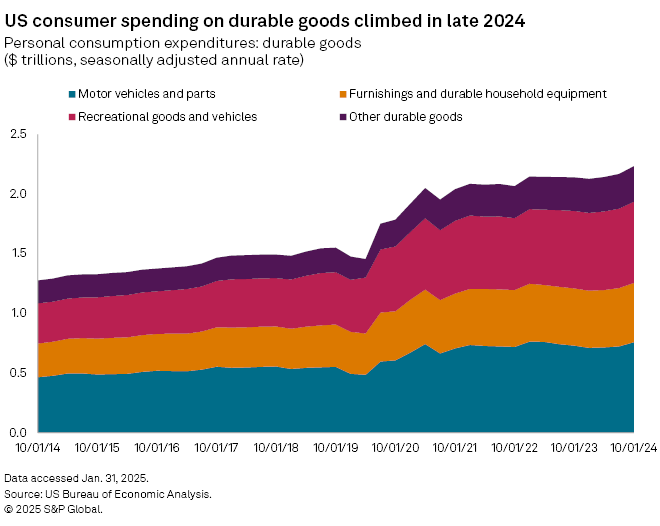
Sara Mitchell was one of these consumers. Mitchell, a political science professor at the University of Iowa, said she bought an HP Envy laptop for about $900 before the end of 2024 in anticipation that tariffs, particularly new tariffs on China, would significantly increase the cost of that laptop.
"People have many misperceptions about tariffs, especially who pays the cost," Mitchell said. "If the US puts a 50% tariff on Chinese imports into the US, the company buying goods from China ... must pay the tariff to the US government to receive the good at the ports. This cost is then passed along to consumers."
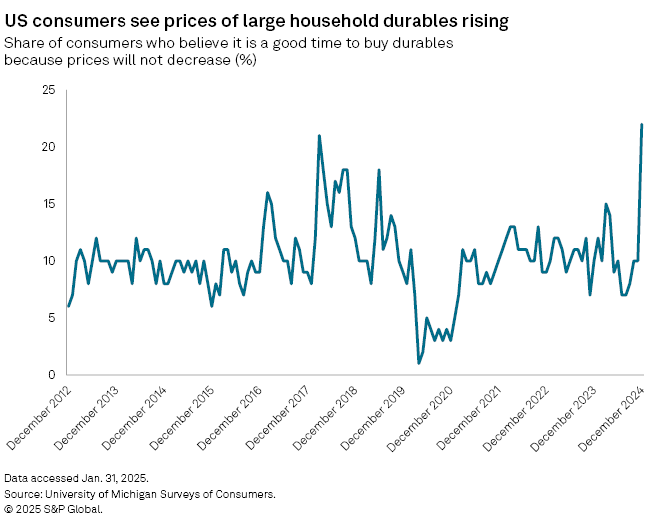
The latest University of Michigan Surveys of Consumers from December 2024 found that 22% of consumers who thought it was a good time to buy large household durable goods said prices will not come down and are likely going higher. This is up from 8% in September.
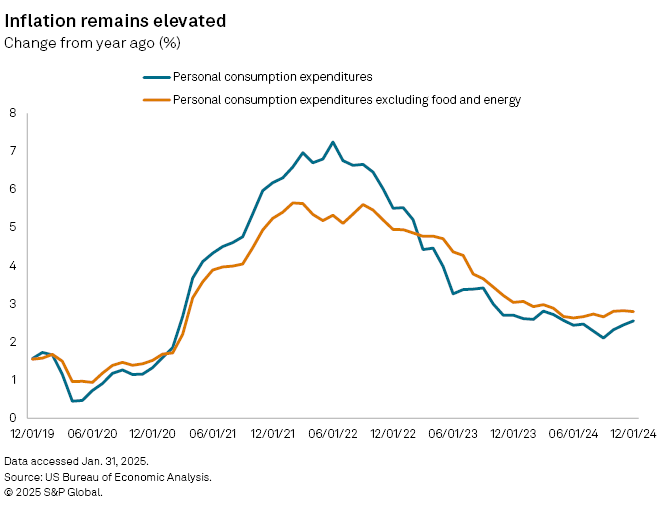
The latest tariffs arrive as inflation remains stubbornly elevated above the Federal Reserve's 2% goal. The Fed's preferred inflation measure — personal consumption expenditures excluding volatile energy and food prices — was at 2.8% for the last three months of 2024, after falling to 2.6% in June. Tariffs are expected to boost inflation further.
The tariff threats also impacted retailers and manufacturers. Imports surged and exports weakened at the end of 2024 as there appeared to be an attempt to bring in products ahead of the implementation of these import taxes, Knightley with ING said.
The US imported $122.1 billion more in goods than it exported in December 2024, the widest such gap since the government began tracking this data in the early 1990s, according to the latest advance estimates by the US Census Bureau.
The tariff threat likely boosted consumer spending late in the 2024 fourth quarter and possibly continued into early 2025, but it will weaken as the year goes on, Knightley said.
"Basically, it doesn't generate new spending, just pulls forward consumption that would have happened at a later date," Knightley said.