26 Feb, 2025
US banks set to jump back into digital asset space as regulatory stance softens

By Alex Graf
US banks are expected to surge back into the digital asset space once the federal government establishes clear regulatory guidelines around stablecoins and cryptocurrency.
Under former President Joe Biden, federal regulators adopted a cautionary stance regarding bank industry engagement with digital assets that led some banks to pull back from the space. Republicans, along with the cryptocurrency industry, have claimed the previous administration's policy was a concerted effort to deter banks from offering crypto-related services. Now that President Donald Trump is back in office with Republican majorities in Congress, however, policymakers in Washington are moving to create a regulatory framework that is more supportive of digital asset activities, which could entice banks to move back into the space, experts said in interviews with S&P Global Market Intelligence.
More formalized guidance around digital assets will serve as a "trigger" for banks to move back into the space, said Chris Daniel, a partner at Paul Hastings who specializes in payments and cryptocurrency.
Similarly, Alston & Bird partner Patrick Hanchey said he expects to see more banks offering loans and custody services to digital asset companies, which have been "almost nonexistent" over the past four years.
"Once there's clarity in what the world is going to look like from a regulatory standpoint, I would expect significantly more participants to jump into the fray for sure," Hanchey said.
Since Trump took office in January, federal regulators, the White House and members of Congress from both major political parties have moved quickly to chart out the rules of the road for digital assets. On Jan. 21, for example, acting Federal Deposit Insurance Corp. Chairman Travis Hill said the agency will adopt a more open-minded approach to digital assets, and the SEC announced a new task force to develop a regulatory framework for cryptocurrency assets. Two days later, Trump issued an executive order establishing a new working group to propose regulations around digital assets and consider the creation of a national digital asset stockpile.
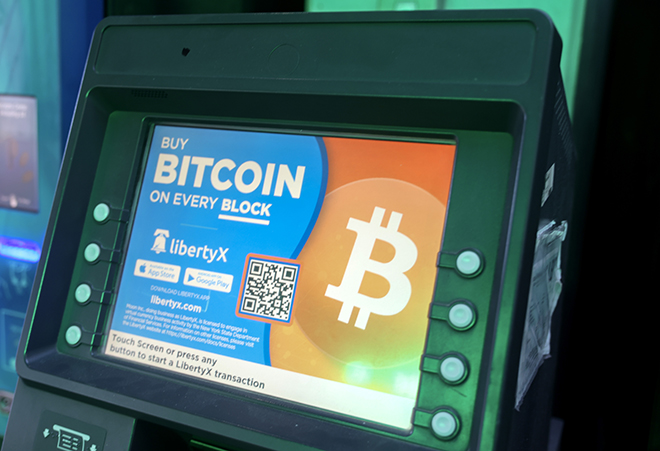
A bitcoin ATM in Miami.
Source: Joe Raedle/Getty Images News via Getty Images.
The financial services industry has encouraged the Trump administration's push for digital asset regulation. On Feb. 20, the American Bankers Association, the Bank Policy Institute and other leading financial services trade associations said the policies of federal banking regulators in recent years have hindered banks' ability to engage with digital assets and that they "strongly support" the goals of the president's working group. One bank with existing cryptocurrency projects, Customers Bancorp Inc., expects the Trump administration's support for cryptocurrency to provide tailwinds for the company.
Having a regulatory framework in place could give banks more confidence that their risk management practices are in line with regulatory priorities, Customers Bancorp President Sam Sidhu said in an interview.
"Conversations are taking place in boardrooms and on Capitol Hill on ways to integrate digital assets into the financial market structure of the country in a strategic way," Sidhu said. "It's really going to help provide a tremendous amount of clarity and structure."
Most recently, lawmakers from both parties in the House of Representatives and the Senate floated legislation in February to regulate stablecoins, a type of cryptocurrency meant to maintain a stable value relative to an external asset like a currency or commodity. The prospective bills would establish legal methods for banks to launch stablecoins with varying degrees of oversight from states and the federal government.
The announcements from the White House, regulators and members of Congress demonstrate "robust" support for digital asset legislation and mark a dramatic shift from the Biden administration, Compass Point analyst Ed Groshans wrote in a Feb. 14 research note.
"Our odds are 75% that a stablecoin bill becomes law in the 119th Congress and better than 60% that a digital market structure bill becomes law," Groshans wrote.
The House passed one such market structure bill — the Financial Innovation and Technology for the 21st Century Act (FIT 21) — with bipartisan support in 2024. While the legislation did not pass in the Senate, it would have clarified the SEC's jurisdiction and provided the Commodity Futures Trading Commission with new jurisdiction over digital assets.
The House Financial Services Committee plans to pick up FIT 21 again in the new Congress, and members are hopeful that the Senate will pass it this time with a Republican majority now controlling the chamber, committee whip Rep. Mike Haridopolos (R-Fla.) said in a recent interview with Market Intelligence.
"Hopefully, the Senate will take it up with the same aggressiveness as we're looking to do in the House," Haridopolos said.