03 Dec, 2025
Trump administration seeks to roll back vehicle efficiency standards
By Karin Rives and Zack Hale
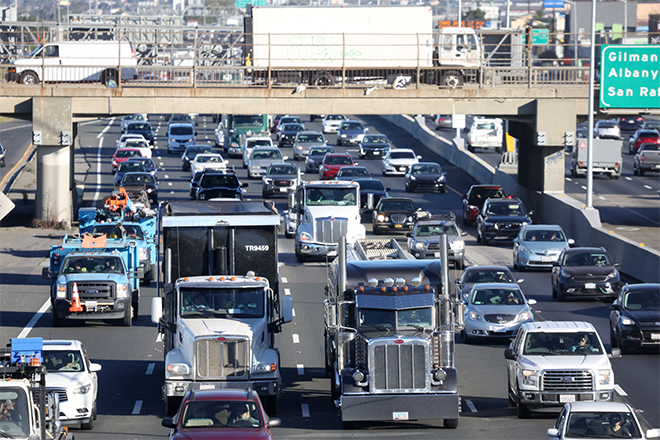
| A congested highway, above. The Trump administration is "resetting" fuel economy standards for vehicles. Source: Justin Sullivan/Getty Images News via Getty Images |
The Trump administration is planning to roll back fuel-economy standards for cars and trucks, a decision that could benefit US oil producers and refineries but result in higher costs for drivers, observers said.
Under the proposed rulemaking, the industry fleetwide average for model 2022 to 2031 light-duty vehicles would be 34.5 miles per gallon by 2031, the US Transportation Department's National Highway Traffic Safety Administration (NHTSA) estimated.
President Donald Trump announced the proposed repeal at a Dec. 3 news conference in the Oval Office, flanked by executives from Ford Motor Co., General Motors Co. and Stellantis NV, agency heads and Republican members of Congress.
Rolling back the corporate average fuel economy (CAFE) program, as well as fuel efficiency requirements for commercial medium- and heavy-duty vehicles, would give consumers more choice and shave $1,000 off the price of a new car, Trump said.
"They were anti-economy," the president said, referring to more stringent standards adopted in 2024 by the Biden administration. "These policies forced automakers to build cars using expensive technologies that drove up costs, drove up prices, made the car much worse."
NHTSA in 2012 established passenger car and light truck CAFE standards for model years 2017–2021 that the agency expected would translate to a combined fleet-wide average fuel economy of 40.3 miles per gallon to 41 miles per gallon for model year 2021 vehicles.
Consumer costs in focus
The 2024 CAFE standards required fleetwide passenger cars for model years 2027–2031 to reach 50.4 miles per gallon by 2031, which NHTSA said would save drivers an estimated $600 in gasoline costs over the lifetime of their vehicles.
New standards for heavy-duty pickup trucks and vans for model years 2030–2035 were set to rise to 35 mpg, saving those drivers $700 in fuel costs, the Transportation Department estimated at the time.
The Trump administration, calling its Dec. 3 proposal a "resetting" of the CAFE standards, said the Biden administration standards were unrealistic to meet with conventional vehicles and acted as a "mandate" for electric vehicles. They also claimed the Biden administration standards were illegal.
The Republican-backed reconciliation legislation enacted in July repealed the $7,500 tax credit for new EV purchases as of Oct. 1, resulting in record third-quarter EV sales as American consumers rushed to claim the federal subsidies.
At the White House, carmakers and dealers said less-stringent fuel-economy requirements will help US families buy better cars.
The decision to weaken US efficiency requirements for cars and trucks was expected. The Trump administration in June said it would no longer enforce existing fuel-economy standards as it prepared to formally repeal the CAFE program and fuel efficiency requirements for commercial medium- and heavy-duty vehicles.
Congress established the federal fuel economy standards in 1975 in response to the 1973 oil crisis, and those standards have since been gradually strengthened.
"Rolling back federal fuel economy standards will raise transportation costs for businesses and consumers, deepening the affordability crisis already felt across the country," Zach Friedman, senior director for federal policy with the investor advocacy group Ceres, said in an email. "Strong standards do more than save money at the pump — they are a key driver of private investment in domestic auto manufacturing, onshoring critical mineral supply chains and creating good jobs in communities across the country."
The new regulation, when finalized, is certain to be challenged in court.
EV sales declining
The proposal to significantly weaken fuel efficiency for cars and trucks comes as manufacturers and dealers struggle with declining electric vehicle sales.
Ford reported a 61% drop in all-electric vehicle sales last month compared to November 2024, with just 4,247 EVs sold. Hyundai Motor Co. reported a 55% year-over-year drop for its two top-selling EV models in November.
"Sales of EVs and plug-in hybrids are now collapsing after tax credits expired," Cox Automotive Senior Economist Charlie Chesbrough said in the company's latest market forecast.
Trump, in his Oval Office remarks, touted a provision in the Republican budget legislation that allows a tax deduction of up to $10,000 for interest on auto loans through 2028. The president also pointed to major investment announcements from US automakers in the wake of his 25% tariffs on imported passenger vehicles.
Ford in August said it planned to invest $5 billion to expand and retool its Louisville Assembly Plant in Kentucky and BlueOval Battery Park in Michigan. In October, Stellantis announced plans to invest $13 billion to expand its US production capacity by 50% at plants in Illinois, Indiana, Michigan and Ohio.
More car emissions
The Dec. 3 announcement follows a string of similar policy changes targeting car efficiencies and electric vehicle policies under Trump.
Since January, the administration has proposed to roll back tailpipe emission rules in conjunction with a repeal of the 2009 greenhouse gas endangerment finding that underpins all federal climate policies. It also canceled fines for automakers that fail to meet CAFE standards, and pushed Congress to end tax credits that offered consumers $7,500 in federal tax credits toward electric car purchases.
Rescinding all vehicle GHG standards, which are closely aligned with federal fuel economy rules, would increase US CO2 emissions by 9.1 billion metric tons to 17.9 billion metric tons through 2055, according to the Environmental Defense Fund. That would be the rough equivalent of two to four years of economywide US GHG emissions based on 2024 levels.
The transportation sector, led by passenger vehicles, is the country's largest source of climate-warming emissions, according to the US Environmental Protection Agency.