17 Dec, 2025
More Americans find only part-time work as job market falters

By Brian Scheid
The number of Americans working part-time jobs for economic reasons has surged to the highest level since early 2021, indicating that employers may be delaying an inevitable wave of layoffs.
Nearly 5.5 million Americans were working part time for economic reasons in November, a 23% jump from a year earlier and the highest level since March 2021, when the economy was still reeling from the COVID-19 pandemic, according to Bureau of Labor Statistics data released Dec. 16. The designation means these workers would have preferred full-time work but had their hours reduced by their employers or were unable to find full-time jobs.
"Usually, employers turn to cutting hours before resorting to layoffs as laying off workers is more difficult than temporarily cutting hours in the hopes of business rebounding," said Daniel Zhao, chief economist at Glassdoor. "After the labor shortages era, businesses may also be a little more hesitant to turn to layoffs compared to past business cycles, but there's a limit to how much this labor hoarding instinct can restrain layoffs when the rubber hits the road."
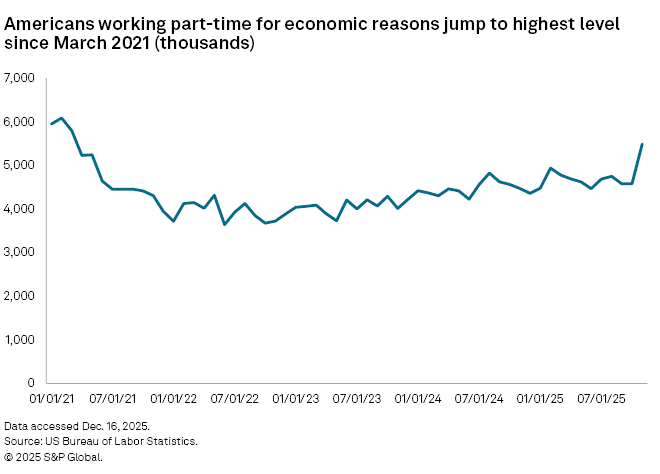
In November, there were 29.5 million Americans employed and classified as usually working part time, accounting for about 18.5% of the total domestic workforce. This is the largest share of part-time workers in the workforce since March 2018.
"Employers want less labor and they're increasing use of part-time workers and reducing full-time, cutting hours instead of cutting staff," said Aaron Sojourner, a labor economist and senior researcher at the W.E. Upjohn Institute for Employment Research.
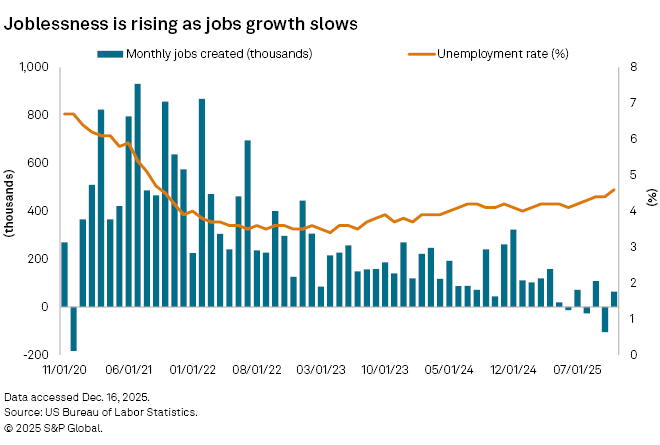
The increasing number of Americans working part time for economic reasons comes amid slowing job growth and rising unemployment. Overall unemployment jumped to 4.6% in November from 4.4% in September, and the highest rate of US joblessness since September 2021. Much of the jobs data for October will not be released due to the 43-day federal government shutdown that began Oct. 1.
While unemployment is rising, the unemployment rate among reentrants to the labor force climbed to 1.5% in November, matching the highest level in a decade. The labor force participation rate — the measure of workers either employed or actively looking for work — increased to 62.5%, just 30 basis points below its highest point since the pandemic.
"Overall, this shows that labor demand is slowing more than labor supply is slowing from immigration," said Preston Mui, a senior economist at Employ America. "The net result is an increase in unemployment along the margins of the labor force."
These margins include reentrants to the workforce, younger workers — who have seen a spike in joblessness — and those forced to work part time due to limited to no full-time options, according to Mui.
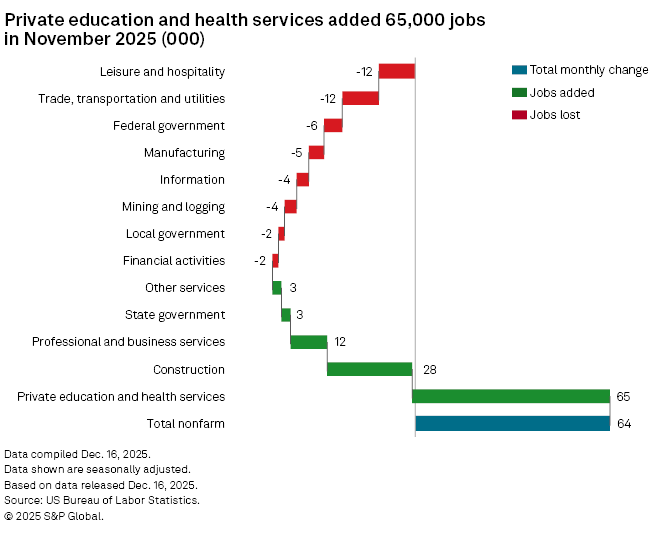
The Federal Reserve's Beige Book, a summary of economic conditions throughout the US, stated that even though there was an uptick in announced layoffs, firms in many districts were limiting head counts by instituting hiring freezes, hiring only replacements for departing workers and through attrition.
"In addition, several employers adjusted hours worked to accommodate higher or lower than expected business volume instead of adjusting the number of employees," according to the latest Beige Book, which was released Nov. 26.
This suggests that business owners may be wary of launching a costly process of laying off staff and instead are choosing to cut hours and hope that economic conditions will improve in 2026 when they can return these employees to full-time status," said James Knightley, chief international economist with ING.
"It is a hoarding argument," Knightley said. "Having gone through the pandemic where we saw mass layoffs with companies then having to dramatically rehire at much higher cost in 2022, they don't want to experience that again if it can be avoided."
While the data showing the rise in part-time workers should be viewed cautiously, considering the challenges caused by the government shutdown and the volatility of the survey, it will take a significant rebound in the job market to meaningfully reverse this trend, Zhao with Glassdoor said.