02 Dec, 2025
Investor comfort key to unlocking insurance-linked securities growth in Asia

By RJ Dumaual
Investors need to become more familiar with insurance-linked securities for the asset class to gain more traction in Asia.
While the insurance-linked securities (ILS) market in Asia is still "nascent," the Monetary Authority of Singapore (MAS) is planning a new ILS grant scheme to run from January 2026 to December 2028.
Perks for new issuances of property catastrophe bonds include a grant equivalent to 70% of funding, capped at S$1 million, of up-front issuance costs if the issuance covers any proportion of risks originating in Asia-Pacific. Grants cover 50% of funding, capped at S$1 million, of up-front issuance costs if the issuance does not cover any Asia-Pacific risks. A 30% grant, capped at S$500,000, of up-front issuance costs is available for ILS renewals.
The scheme applies to issuances covering any form of risk, including natural catastrophes, longevity, mortality, operational risks and cyberrisks.
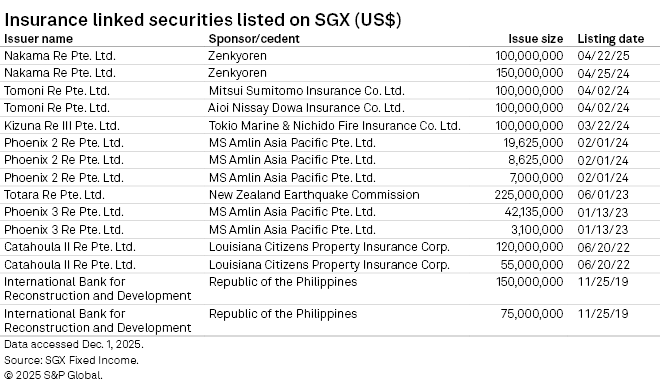
Exchange operator Singapore Exchange Ltd. (SGX) already hosts a number of insurance-linked securities. Japanese nonlife insurers Mitsui Sumitomo Insurance Co. Ltd., Aioi Nissay Dowa Insurance Co. Ltd. and Tokio Marine & Nichido Fire Insurance Co. Ltd. each sponsored catastrophe bond issuances of $100 million in 2024.
National Mutual Insurance Federation of Agricultural Cooperatives, also known as Zenkyoren, sponsored catastrophe bond issuances by Nakama Re Pte. Ltd. of $150 million in 2024 and $100 million earlier this year. Louisiana Citizens Property Insurance Corp., the New Zealand Earthquake Commission and the International Bank for Reconstruction & Development have also sponsored catastrophe bond issuances of more than $100 million listed on SGX.
However, while ILS has been readily available globally for many years, it remains a relatively new asset class in Asia, according to Soeren Soltysiak, Asia CEO of reinsurance solutions at Aon PLC.
"First and foremost, I think it's about education," Soltysiak said.
Regulatory push
Although the MAS ILS grant scheme is generous, it does not address the "stickiness to make customers come back," said Steve Tunstall, general secretary of the Pan-Asia Risk and Insurance Management Association. There are significant natural catastrophe exposures in Asia, given that many of its largest cities are coastal, Tunstall said in an interview. The insurance industry needs to work with governments to cover this risk, he added.
There are many "sophisticated" multiline reinsurance vehicles in Singapore, but most are "fairly vanilla," and it is up to the MAS to develop this area, Tunstall said.
"Capacity remains concentrated, with slightly over half of overall direct investor capacity located in North America and most of the remainder in Europe, with a limited amount in Asia," according to the report.
"It's been around for over 25 years and has a very proven track record, so it's not something new as such," Soltysiak said. "It's just getting people comfortable around how to implement it in their portfolios."
Transferring new risks, such as cyber to financial markets, requires a critical mass. Cyber exposure in Asia is still not big enough to securitize and put into a catastrophe bond, Soltysiak said.
"I think the focus for the next couple of years will be mainly around the natural catastrophe side because that's a more natural use case for it," the Aon executive added.