24 Dec, 2025
Building electrification policy continued to adapt to gas ban obstacles in 2025


|
Climate activists kept the pressure on leaders to decarbonize buildings in 2025, even as some Democratic politicians backed away from electrification policies over affordability and electric grid concerns. |
The battle over natural gas bans remained highly kinetic in 2025, as building electrification advocates pressed new strategies against the backdrop of expanding legal challenges and a sea change in federal policy.
The year largely built on the dominant trend in 2024: Advocates evolved building electrification strategies after a 2023 court decision made it more difficult to explicitly restrict gas use. Policymakers explored how to limit gas system expansion, develop geothermal alternatives to gas service, and encourage — but not mandate — electric heating.
Still, threats of additional litigation limited the options available to policymakers and building code officials. And at the federal level, the Trump administration and congressional Republicans have worked to dismantle former President Joe Biden's wide-ranging efforts to help states decarbonize buildings.
Consequently, cities and states were once again driving momentum, including through multi-state collaboratives to advance electric heat pump adoption, said Matt Casale, the Building Decarbonization Coalition's managing director of states and regions. Some participating states like Maryland are developing overlapping policies that can drive electrification, he said.
"2026, I think, is going to be a building year," Casale told Platts, part of S&P Global Energy. "Let's start to get the pieces in place to get this right so that we can put these long-term plans into place."
Regulators set the stage to phase down gas use
One trend that gathered momentum in 2025 was the launch of future of gas proceedings by state utility regulators. Commissions in Maryland and Minnesota launched long-anticipated investigations, while Maine also got the process underway to explore how gas utilities can adapt their business models to align with state climate goals.
Future of gas reviews and their successor proceedings continued in other states, including California, where regulators are exploring pathways to neighborhood-scale electrification. Gas utilities continued implementing clean heat plans in Colorado and were developing climate compliance plans in Massachusetts. In Illinois, stakeholders identified potential pilot projects and proposed policy changes to decarbonize the gas utility sector.
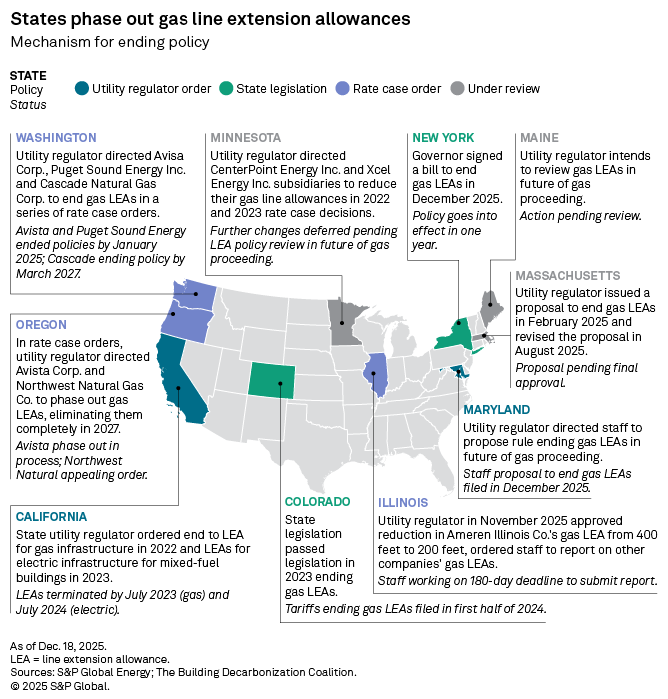
A growing number of regulators also took action to end line extension allowances for gas utilities, a long-standing policy that encourages system expansion by lowering the cost of joining the gas grid.
The Maryland Public Service Commission ended the policy in its future of gas proceeding, and regulators in several other states proposed the change or will consider it. Commissioners in Illinois, Oregon and Washington continued to phase out line extension allowances through rate cases. New York legislators passed a law to end the policy in June and Gov. Kathy Hochul (D) signed the bill on Dec. 19.
Lawmakers and regulators additionally continued to explore thermal energy networks as an alternative to gas distribution service. These networks tap geothermal resources to heat and cool buildings outfitted with electric-powered ground-source heat pumps on a shared underground loop.
Since 2021, legislation has passed in 13 states to facilitate development of the networks, according to the Building Decarbonization Coalition. In 2025, legislation passed in Connecticut, Illinois, Maine, Texas and Washington, the group reported.
The Illinois legislation allocated up to $20 million for thermal energy network pilot projects. About two dozen similar pilots led by utilities are advancing across eight states, according to the coalition.
States develop policies to work within legal constraints
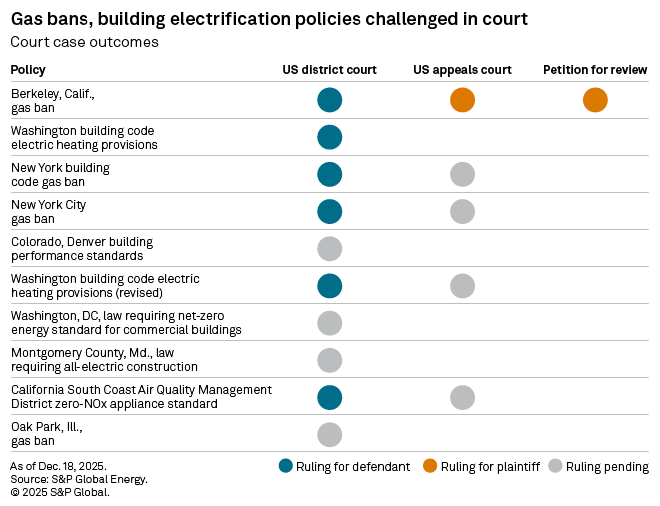
Policies to restrict gas use in buildings have faced legal risk ever since a US appeals court ruled in 2023 that Berkeley, California's first-in-the-nation gas ban conflicted with federal law. That decision created a chilling effect and spurred challenges to decarbonization policies across the US.
In 2025, US district courts upheld the policies in Washington, in New York City and state, and in California's South Coast Air Quality Management District. Gas ban opponents have appealed those decisions, and district court challenges to policies in Colorado, Illinois, Maryland and Washington, DC, are still playing out.
Still, cities and states continued to develop strategies to discourage gas use in buildings, seeking to thread the needle after the landmark Berkeley decision, often by eschewing strict gas bans.
The updated California building energy code, which goes into effect in 2026, set the baseline for minimum energy efficiency in new construction in a way that strongly encourages builders to install electric heat pumps for both space and water conditioning.
In 2025, about 20 California communities also adopted additional measures to encourage electrification in existing buildings, according to the Sierra Club. That included the AC2HP policy, which encourages property owners to install electric heat pumps when central air conditioning units burn out, allowing them to relegate gas furnaces to backup. Washington code officials are considering a similar policy in their next residential and commercial building code updates.
The AC2HP policy was "the big win" for the West Coast building electrification campaign, said Dylan Plummer, a campaign adviser for Sierra Club.
In Massachusetts, state legislation was advancing to double the number of towns and cities authorized to pilot gas bans in new construction, bringing the total to 20. Many communities have adopted stretch codes that encourage building electrification, and Massachusetts utilities in November introduced residential rates that support electric heat pump use in the winter.
Maryland continued to develop a clean heat standard and zero-NOx standard, which would effectively ban the sale of gas appliances based on air-quality regulation. At the local level, Montgomery County, Maryland, plans to implement an all-electric construction code for new residential buildings at the end of 2026.
Some policymakers back away from building decarbonization
Even as these efforts advanced, some policymakers delayed marquee building decarbonization policies in 2025, often amid concerns over housing affordability and electric grid reliability.
New York reached an agreement to indefinitely delay the state's all-electric construction code until a court challenge is resolved. Prior to striking the deal, Hochul faced pressure from moderate Democrats to pause the policy before it went into effect in 2026.
In Washington, DC, Mayor Muriel Bowser proposed pausing implementation of the district's building energy performance standard and pushing back a deadline to issue a net-zero energy standard for new commercial construction by the end of 2026. The proposals were part of the mayor's platform for "cutting red tape" and facilitating housing development.
However, district lawmakers rebuffed the proposal, and the deadline remained in place. Bowser's administration has yet to approve the last update to construction codes, which include an all-electric requirement for new residential buildings.
The Vermont General Assembly declined to implement a clean heat standard developed by the state's Public Utility Commission (PUC), which would have required fossil fuel distributors to progressively reduce their greenhouse gas emissions through a credits-based system.
Republicans campaigned against the policy in 2024 elections, flipping more than two dozen seats, including one held by Christopher Bray, who spearheaded the clean heat standard. Prior to the election, the PUC itself said the state should not implement the policy, partly because it would be very expensive for Vermont to establish a market for clean heat credits itself.
Democrats do not have plans to revive the policy unless another state creates the administrative structure to implement it, Sen. Anne Watson, who succeeded Bray as chair of the Senate Natural Resources and Energy Committee, told Platts.
'Affordability' is the key word
However, the Building Decarbonization Coalition's Casale stressed that many regulators were reconsidering investment in gas infrastructure and expensive pipeline replacement programs for affordability and equity reasons. As more consumers understand that infrastructure maintenance drives their utility bills, states could face pressure to rein in that investment.
"They're looking for ways to reduce costs for people, and to do it in a way that puts us on the path not only towards decarbonization because we need to for climate and health … but also because that's the economically sound path for our energy future," Casale said.