10 Dec, 2025
Asian Insurance Forum: AI adoption demands strong public-private collaboration

The insurance industry and regulators must collaborate to strike a balance between innovation and regulation as artificial intelligence technologies rapidly evolve.
AI enhances productivity, boosts social welfare and contributes to overall growth, National Financial Regulatory Administration Vice Minister Xiao Yuanqi said during a Dec. 8 presentation at the Asian Insurance Forum 2025. The Chinese vice minister said AI unlocks potential, lowers costs and increases efficiency, a sentiment echoed by Romain Paserot, deputy secretary general and head of capital and financial stability at the International Association of Insurance Supervisors (IAIS).
Insurance companies have been incorporating AI into their processes. If deployed effectively, AI can drive growth, foster financial inclusion, cut costs and provide tailored solutions for underserved populations, Paserot said.
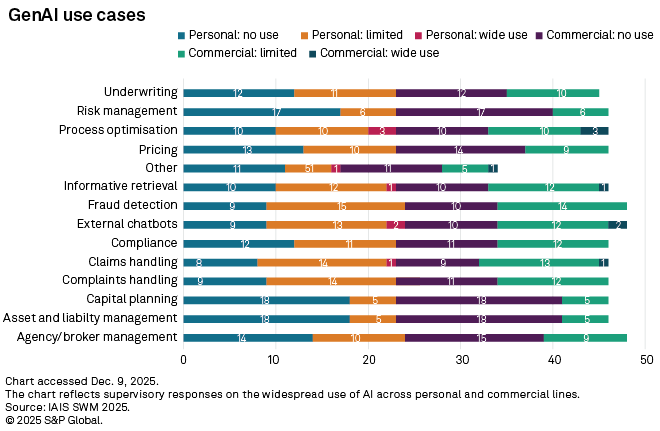
AI technologies could boost policyholder retention through personalized engagement, lower costs through more efficient policy administration and claims management, and improve risk selection and pricing, according to the IAIS' latest global market insurance report. A survey of supervisors on insurers' adoption of generative AI found that the leading use cases for the technology include claims handling, external chatbots, fraud detection, process optimization, complaints handling and information retrieval.
Balancing the risks
Adopting new technologies, however, introduces new risks. AI can also introduce unlawful bias or discrimination, and the growing reliance on personal data in its processes raises significant privacy and security concerns, according to Paserot. Unpredictable outcomes of certain AI systems in dynamic environments could also threaten financial soundness and stability.
To foster innovation and safeguard consumer interests, regulators and the insurance industry must collaborate, forum participants said. Lucy Wong, adviser at the BIS Innovation Hub Hong Kong Centre, noted the importance of a safe environment for public-private collaboration. Wong cited the innovation hub as an example of an initiative that supports projects enabling experts to share their knowledge and technical expertise and for the public to gain insights into new technologies.
Rodrigo Lima, Microsoft Asia president, expressed support for open discussion between the private and public sectors on AI adoption but also said the proper tools are necessary to understand and respond to new technologies.
"I do believe that regulation is important, not to a point where we'll slow down innovation," Lima said.
In the early stages of adopting new technologies, appropriate regulation can facilitate trust and understanding, said Kar Yan Tam, chair professor at The Hong Kong University of Science and Technology. Once trust is established, regulators may consider loosening regulations to allow the market to operate more freely, Tam said.
Change management
As AI adoption grows, regulators must keep up by understanding new technologies, and organizations must prepare all employees for the change at all levels.
Regulators need to gain a deep understanding of AI to make informed policy decisions and adapt by acquiring new skills, Wong said. Talent development and upskilling in both the public and private sectors are crucial to effectively regulate AI.
Tam said training and education are essential across all levels of an organization. While entry-level employees may need technical skills, senior management should understand AI's potential and future trajectory to make informed investment decisions.
For AIA Group Ltd., the goal of adopting new technologies is not to eliminate jobs but to redirect focus from repetitive tasks to more meaningful work, according to Biswa Misra, the insurer's group chief technology and life operations officer. The adoption of AI will lead to current roles evolving, which will require effective change management and upskilling.
"We have to create an environment wherein learning is allowed. Learn from things that work. Let go of the things that don't work, but take the learnings and go for the next set of things that you're looking at. It's a continuous process," Misra said.