


12 Nov, 2025
Virtual power plant providers bullish on outlook as US power demand rises

Companies continue to expand their virtual power plants and flexible loads to help meet the needs of the grid as energy demand increases.
A virtual power plant (VPP) often involves smart thermostats, rooftop solar and on-site battery storage, but it can also include heat pumps, electric vehicles and other distributed energy resources. Aggregators orchestrate these resources using software to help support grid reliability during peak demand by reducing energy consumption or dispatching power.
Several US companies have recently boosted their VPP or demand response activities, reporting increased enrollments and energy delivered.
VPP platform CPower Inc. on Nov. 3 said its commercial and industrial customers delivered approximately 38 GWh of load relief to the grid from January through September, which is a 137% increase from the 16 GWh delivered in all of 2024. CPower has 6.7 GW of capacity across approximately 23,000 sites.
That jump was "driven really on the weather events that we've seen over the course of the summer in PJM and ISO New England," CPower CEO Michael Smith told Platts, part of S&P Global Commodity Insights. "It demonstrates the importance of demand response in the energy transition, providing resources to grid operators, whether they be utilities or [regional transmission organizations], and attempting to balance the grid in some pretty challenging circumstances."
Meanwhile, SolarEdge Technologies Inc. on Oct. 29 reported more than 500 MWh of residential battery storage enrolled in VPP programs across 16 states and Puerto Rico.
"It's clear that utilities and electricity markets and other kinds of electricity providers are … really starting to see the value of battery programs," Tamara Sinensky, senior manager of grid services product in North America at SolarEdge, told Platts.
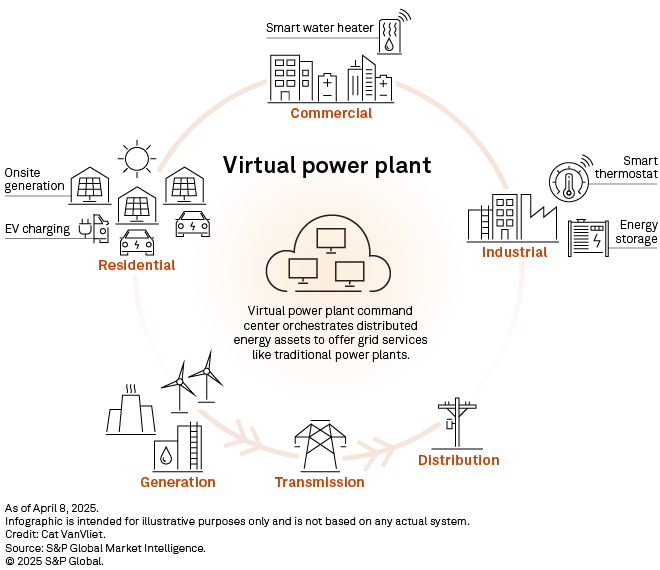
VPP programs can benefit both customers and the broader power grid.
"It helps ensure the grid stability," said Marty Rogers, SolarEdge's general manager of North America. "It helps shift demand when you need the demand to be shifted. It's on call for the utilities. It can also help with their frequency problems. So, there's a huge incentive for the utilities to go bring this forward, in particular, as the demand goes up."
Demand response can reduce the need to make grid upgrades or rely on peaker plants.
"The main benefit traditionally for demand response is reducing the need for peaker power plants, which are very expensive to operate," Sinensky said. "The hope is to replace those expensive peaker plants with assets like thermostats, EV chargers, solar and storage that are already deployed."
Another benefit comes from transmission and distribution deferral.
"The aging infrastructure, we don't want to have to go to ratepayers and make them pay increased rates to try and replace all this if we can perhaps supplement the problem with those distributed assets," Sinensky said.
For homeowners, the benefits include financial incentives and the ability to use batteries as backup power during a blackout. More than 40% of SolarEdge sites with a battery in the US participate in incentive programs to support grid stability during peak demand.
'Having a moment'
While SolarEdge uses battery storage, CPower has focused on flexible loads, such as industrial customers changing their operating parameters or users reducing lighting levels and use of air conditioning.
Both CPower and SolarEdge said participation and interest in VPPs is growing as energy demand increases, driven by a surge in AI and data centers, domestic manufacturing and increasing electrification.
"VPPs are having a moment right now," CPower's Smith said. "There's more interest in this asset class to help control the grid. There's more customer interest in participating, more participants in the market, and so it's a hugely important piece of the energy transition."
Smith is unsure how the US grid can accommodate surging demand without virtual power plants.
"You definitely see increased enthusiasm with the utilities," added SolarEdge's Rogers, pointing to rising electric rates and evolving business models that will help to scale up VPPs.
"Electricity rates are going to help it scale one way or the other," he said. "I think the ease of deployment is going to help it scale ... the shift we see towards the TPOs [third-party ownership] this year will also help it scale."
Sunrun Inc., which supplies home solar and storage systems under a TPO-focused business model, is also seeing progress on VPPs, which it prefers to call "distributed power plants."
Sunrun expects to have over 10 GWh of dispatchable capacity online by the end of 2028, up from 3.7 GWh at the end of the third quarter, CEO Mary Powell said on the company's Nov. 6 earnings call.
"We're feeling very bullish about this opportunity as a distributed power plant provider," Powell said.
Sunrun has over 217,000 storage systems installed and dispatching power as part of 17 programs.