


26 Nov, 2025
State utility regulators throw support behind natural gas systems growth

State utility commissioners called on federal policymakers to back continued investment in natural gas and related infrastructure development, offering support for the fuel even amid criticism from environmental groups.
The National Association of Regulatory Utility Commissioners (NARUC) board of directors approved three gas committee resolutions at the organization's annual meeting in Seattle.
The first resolution, GS-1, describes natural gas as having a foundational role in the energy future of the US. The other two focus on permitting reform efforts and certainty for infrastructure development.
Kim Drexler, a commissioner on the Delaware Public Service Commission and a member of the NARUC gas committee, said in an interview that these are the first resolutions from the committee with "real teeth." Each of the resolutions calls on Congress or federal regulators to take concrete steps to support the role of gas in energy systems.
GS-1, sponsored by NARUC President Tricia Pridemore, indicates that the organization "supports the continued investment in energy infrastructure including natural gas, that will be necessary to keep energy costs affordable while meeting growing demands in the years ahead," according to the substantive resolutions written documentation.
Pridemore's resolution highlighted gas use in the US — noting that roughly 60% of households use natural gas for home heating, water heating and cooking — as well as rising electricity demand, with gas-fired generation providing over 43% of the power supply in 2023. Gas is "well-suited as a baseload resource that can support the affordability, reliability, and resource adequacy of the electric system," the resolution said.
"An energy future without natural gas disproportionately harms low-income communities," the resolution added, citing a 2025 Progressive Policy Institute report.
The board submitted this resolution in July at the association's summer policy summit in Boston.
The American Gas Association (AGA) welcomed the resolutions.
"NARUC's decision to recognize natural gas as a foundational part of America's dependable energy future, urge permitting reform to expand natural gas pipeline infrastructure and promote greater certainty and durability for permitted energy projects is a laudable step towards advancing our shared energy priorities," Dan Lapato, AGA vice president of planning, said in an emailed statement.
"The resolutions serve as a strategic road map for policymakers to address many of the problems facing our broken permitting process," Lapato added.
Opposing views
James Van Nostrand, policy director of the Future of Heat Initiative, challenged the first resolution's take on affordability. Van Nostrand specifically highlighted the costs associated with building and maintaining natural gas infrastructure as a key factor to consider in long-term planning for energy systems.
"It's investment at the distribution level that's causing natural gas [bills] to increase regardless of what the price of the natural gas commodity itself is," Van Nostrand said.
Van Nostrand, former chair of the Massachusetts Department of Public Utilities, also noted that in some areas, gas usage is decreasing as people replace their gas furnaces with electric heat pumps. Gas-to-electric switching concentrates gas system costs among fewer customers and runs the risk of stranded assets.
In 2024, 42% of US households said electricity was their main space heating fuel, according to a US Energy Information Administration analysis of annual estimates from the US Census Bureau's American Community Survey. That share was up from 35% in 2010. About 47% of US households used natural gas as their main heating fuel in 2024, down slightly from 49% in 2010, according to the EIA.
The Sierra Club expressed disappointment in the gas-supportive resolutions NARUC approved.
"We urge NARUC to re-evaluate their call and lead preparing utility commissioners throughout the country to foster a resilient, reliable grid and lower energy prices for Americans," Patrick Drupp, Sierra Club climate policy director, told Platts, part of S&P Global Energy. "The only way to accomplish that is through abundant, clean renewable and storage expansion."
Drupp emphasized the commodity's price volatility and expressed concern about reliability in some extreme weather conditions. For instance, a December 2022 severe winter storm in the Southeast resulted in approximately 90,500 MW of expected capacity becoming unavailable during the worst part of the storm. Natural gas-fired generating units accounted for 47% of outages during the December 2022 storm as fuel supplies plummeted.
Energy infrastructure focus
The other gas resolutions, GS-2 and GS-3, focused on expanding energy infrastructure.
GS-2 urges Congress to reform permitting to expand interstate natural gas pipeline infrastructure. This resolution works in tandem with one passed at the Summer Policy Summit, which recommended that "states and organized power markets evaluate investments in expanding pipeline capacity and all types of gas storage to improve natural gas delivery," according to NARUC.
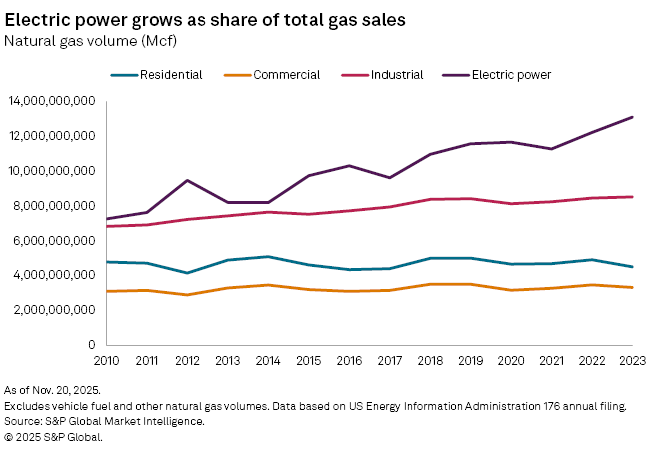
Van Nostrand said growth in natural gas consumption can be attributed more to its use in generating electricity than to a rise in its use for heating buildings and homes.
More than 44% of total retail gas sales in 2023 were used for power generation, according to S&P Global Market Intelligence data based on EIA 176 annual filings.
Nick Myers, vice chairman of the Arizona Corporation Commission, sponsored GS-2 and said additional infrastructure is necessary to support the rising demand in power, which he mainly attributes to large industrial and data center power needs in Arizona. Myers hopes the resolution can aid in speeding up the judicial reform process for projects and making changes to the National Environmental Policy Act (NEPA).
"NEPA has become a kind of overburdened headache that I think has a lot of room for improvement," Myers said. He also said this resolution works well with the third one, as an improved infrastructure permitting process will allow for more grid reliability.
GS-3 focuses on certainty and durability for permitted energy infrastructure, advising the streamlining of the legislative permitting process to avoid economic and supply disruptions to consumers. The board approved this resolution unanimously.
"The cancellation of fully permitted energy projects could lead investors to decide not to finance critical projects in the future or to require higher returns to account for this risk, either of which would place a larger financial burden on American homes and businesses," the resolution states.
Drexler, the sponsor of this resolution, said it addresses the need for consistency in the regulatory process to scale up all infrastructure, not just for natural gas but also nuclear, renewables and electricity.
"We all have goals," Drexler said. "All of our states have these significant renewable energy goals, and we need consistency and reliability to be able to do that."
Uncertainty in infrastructure development can lead to unbuilt energy projects and energy price increases being passed on to consumers. Wind projects in New Jersey and Maryland have already faced cancellations, and the Leading Light Wind project was the most recent of three major New Jersey offshore energy projects canceled.
"The importance of some consensus on the regulatory process being a smooth process, I think, is a good [resolution]," Drexler said. "Where do these resolutions go? That's my question. What ultimately happens? I don't know, but I think it's important to speak out about it."