27 Nov, 2025
Bank of America, ICBC required to keep higher capital buffers in 2025 G-SIB list

By Yuvraj Singh
Bank of America Corp. and Industrial and Commercial Bank of China Ltd. moved up in the 2025 list of global systemically important banks published by the Financial Stability Board.
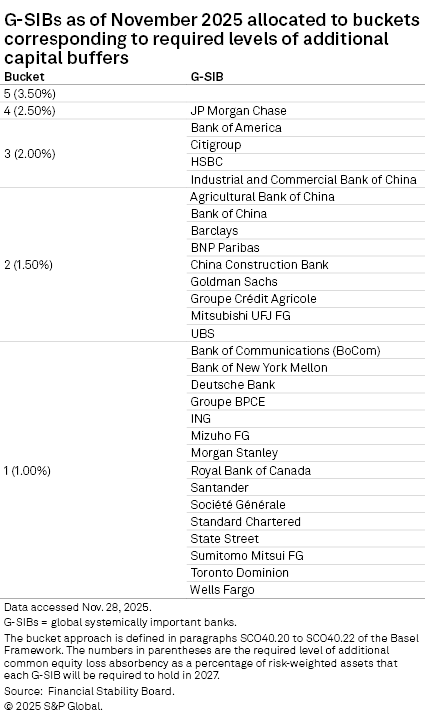
The two banks moved to bucket 3, which requires them to hold an additional 2% capital, according to a Nov. 27 press statement. Both lenders were in bucket 2, which required a 1.5% capital buffer, in the list of global systemically important banks (G-SIBs) published in 2024.
Deutsche Bank AG moved down to bucket 1 from bucket 2, which corresponds to a lower 1% capital buffer. The 2025 list retained all 29 banks from the previous year. Apart from the three lenders, all others retained their positions in the five buckets.
The changes "largely reflect the effects of changes in the complexity of banks' underlying activities," the Financial Stability Board (FSB) said.
The G-SIB list is released annually by the FSB in consultation with the Basel Committee on Banking Supervision and national authorities and has been published since 2011. It identifies large, globally active banks whose failure would pose a significant risk to the international financial system.
Buffer requirement
Updated every November, the G-SIB list uses data from the end of the preceding year to determine which banks must hold higher capital buffers to absorb potential losses. The additional capital depends on the bucket to which each lender is assigned.
No bank was assigned to bucket 5, which requires the highest buffer of 3.5%. JPMorgan Chase & Co. is the only bank in bucket 4, which comes with a 3% capital buffer. Bank of America and Industrial and Commercial Bank of China joined peers, such as Citigroup Inc. and HSBC Holdings PLC, in bucket 3.
Bucket 2 comprised nine banks, including Agricultural Bank of China Ltd., Barclays PLC, BNP Paribas SA, Goldman Sachs Group Inc., Crédit Agricole SA, Mitsubishi UFJ Financial Group Inc., UBS Group AG and China Construction Bank Corp.
Bucket 1, with the lowest buffer of 1%, includes 15 banks. US-based lenders dominate the list with seven entries, followed by mainland China, with five banks. China's four megabanks, the largest lenders in the world by assets, were classified among the most systemically important banks globally.
All three Japanese megabanks — Mitsubishi UFJ Financial Group, Mizuho Financial Group Inc. and Sumitomo Mitsui Financial Group Inc. — are included in the G-SIB list.
The capital buffer requirements set by the 2025 list will be effective Jan. 1, 2027, the FSB said.