


13 Oct, 2025
US labor supply shift aiding balance, casting doubt on job market weakening

By Brian Scheid
A key measure of US employment balance has been substantially recalibrated recently, throwing fresh doubt on the perception that the labor market weakening will require the US Federal Reserve to lower interest rates.
The breakeven rate for the labor market has been revised significantly lower by several sources, dropping to tens of thousands of jobs each month from hundreds of thousands just two years ago. The rate measures how many new jobs are needed each month to counter changes to the overall size of the labor force and keep the unemployment rate steady.
US job growth has slowed dramatically in recent months, falling nearly in line with estimates of the breakeven rate, an indication that fears of rising joblessness and a dearth of employment opportunities may have been overstated.
Yet the current federal government shutdown means the Fed is nearing its next rate decision without fresh data on the state of the labor market. That means its decision will be heavily influenced by the perceived state of the jobs market and ultimately incomplete.
"It's like flying through a fog bank while trying to land a plane,” said Daniel Zhao, chief economist at Glassdoor.
Breakeven rate
Estimates of the breakeven rate vary but generally show a significant drop.
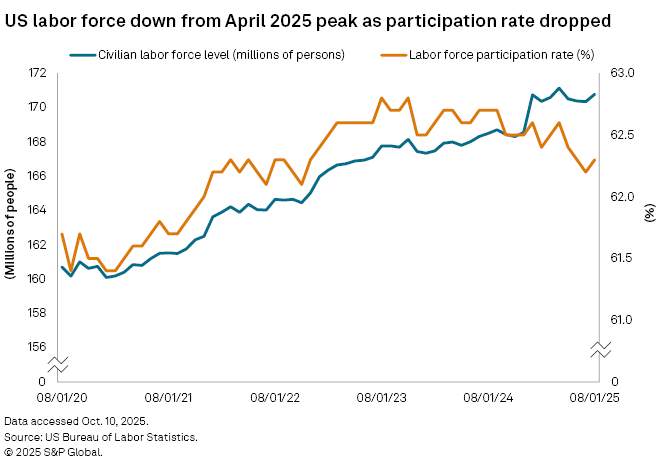
One such calculation by Anton Cheremukhin, a principal research economist at the Federal Reserve Bank of Dallas, estimates the breakeven rate has fallen close to 30,000, down from 250,000 in mid-2023. Roughly half of that decline is due to the slowdown in population growth, the other half by the slowdown in the labor force participation rate.
Cheremukhin calculates this breakeven number by combining estimates of population growth, which has been volatile due to the recent decline in immigration flows; changes in the labor force participation rate, which has trended lower due to an aging US population; and accounting for the shifting ratios between population measures.
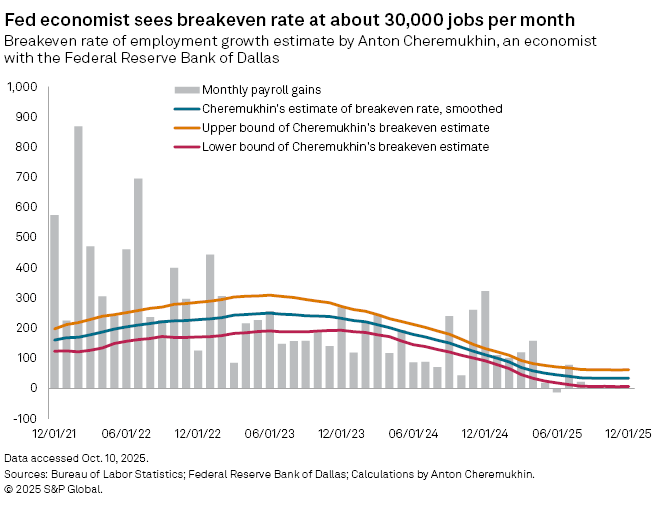
"To keep the unemployment rate stable, the growth rate of employment must equal the growth rate of the labor force," Cheremukhin wrote in an Oct. 9 post. "Knowing the level of employment, we can easily translate this break-even growth rate into a break-even number of net new jobs."
This is below the 70,000 jobs per month breakeven rate that economists at Goldman Sachs estimate the US jobs market is currently at, but the rate is anticipated to drop to 50,000 to 60,000 over the next year, according to Manuel Abecasis, a Goldman economist.
"These things are uncertain, and I think risks to our estimates skew to the downside because of immigration enforcement and because labor force participation has declined a bit more than usual this year," Abecasis wrote in an email.
Guy Berger, a senior fellow at the Burning Glass Institute, meanwhile, puts the breakeven rate at about 50,000 per month, but said the number is difficult to determine with lags in government population estimates, which will likely be worsened due to the shutdown.
Fed Focus
In its August jobs report, the last employment numbers released before the shutdown, the Bureau of Labor Statistics revised its June payroll numbers down by 27,000, from a gain of 14,000 jobs that month to a loss of 13,000 jobs. On Sept. 9, the BLS benchmark revisions showed that US employers added about 850,000 jobs in the 12 months through March 2025, about 911,000 fewer jobs than previously reported over that stretch.
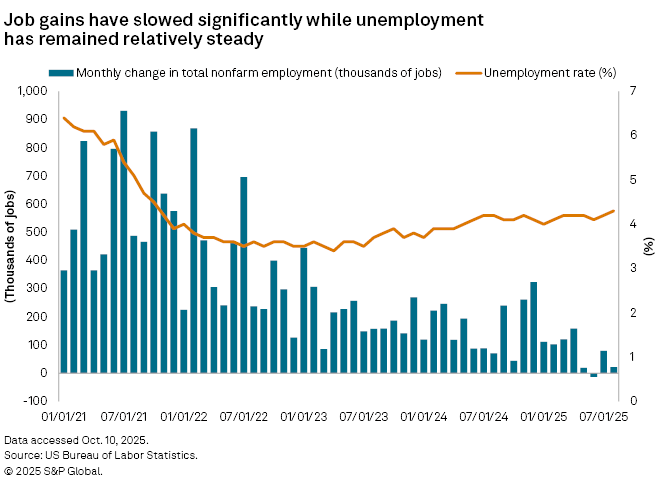
Through the first eight months of 2025, there have been 598,000 jobs added, or an average of less than 75,000 per month. This is a clear slowdown from 143,000 jobs per month on average during the first eight months of 2024 and 230,000 per month in the same period in 2023.
The Fed on Sept. 17 cut interest rates by 25 basis points, its first rate change of 2025 and the expected start of a new cycle of cuts. Some Fed officials saw the recent changes to jobs data as "indicating that labor market condition had been softening for longer than was previously reported," according to the minutes of the Fed's September meeting, released Oct. 8.
Stalled growth
While the government's September jobs report has been delayed indefinitely by the shutdown, private sector estimates show that job growth continued to slow last month.
Carlyle Group, a private equity company, estimated that US employers added just 17,000 jobs in September, a steep drop from the 240,000 the BLS said were added in September 2024. ADP, a payroll processing company, estimated that the US lost 32,000 private sector jobs in September, down from a loss of 3,000 jobs in August. Revelio Labs, a labor analytics company, estimated that the US added 60,000 jobs in September, but said BLS likely would have reported a gain of 32,000 jobs on the month if the report had not been delayed.
Still, by focusing on monthly employment gains or losses as indicative of the condition of the overall economy, economists fear that the Fed could be basing rate moves on the wrong metrics.
The US economy grew at an estimated rate of 3.8% in the second quarter of 2025, and the Atlanta Fed estimates GDP growth will again be 3.8% in the third quarter. This does not fit the argument that the jobs market is weakening and dragging down the economy with it, said Torsten Slok, chief economist at Apollo.
"It is simply not consistent," Slok said. "I worry that [the Fed is] misdiagnosing the labor market."
Immigration impact
The value of employment growth as an indication of the health of the economy has been diminished by the impact of labor supply growth fluctuations, said Berger with the Burning Glass Institute.
The fluctuations are almost entirely due to shifts in immigration flows, which have slowed significantly due to the Trump administration's crackdown, but also due to the aging of the US population.
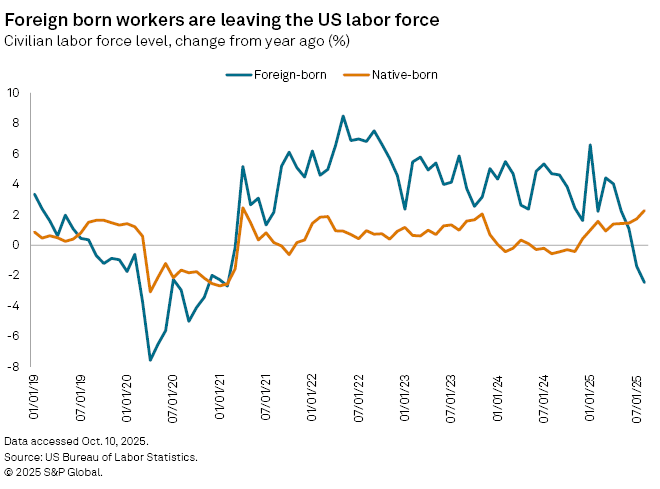
These sizable changes to labor supply have altered the role of monthly job gains, or job losses, as measures of the economy's health.
"We're used to thinking of the health of the economy as 'strong employment gains, good' and 'weak, or even negative, employment gains, bad,'" Berger said. "But this is highly dependent on the underlying pace of labor supply growth."