30 Oct, 2025
'Power-flexible' AI data center unveiled in Virginia, touted as template

A next-generation data center under construction in Manassas, Virginia, is being touted as a template for flexible artificial intelligence infrastructure that supports power grid reliability and affordability instead of adding stress and cost.
NVIDIA Corp., Emerald AI Inc., Digital Realty Trust Inc., PJM Interconnection LLC and the Electric Power Research Institute (EPRI) unveiled the 96-MW data center on Oct. 29. Dubbed the Aurora AI Factory, it is scheduled to open in the first half of 2026.
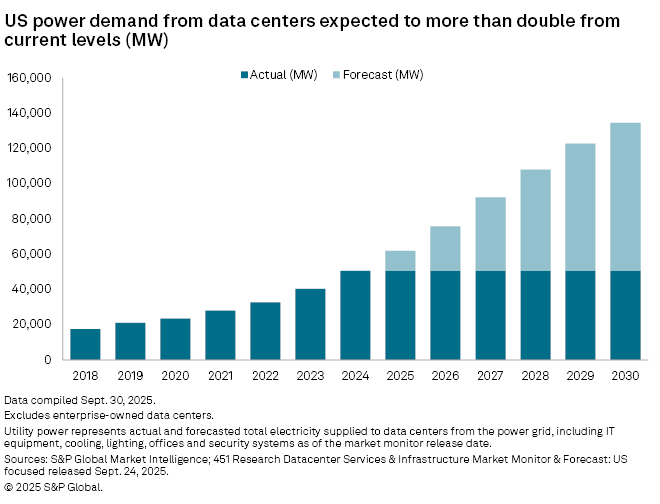
The project comes amid forecasts of steeply rising demand for power from data centers in the US and as states and utilities explore new strategies to accommodate them.
"I think this will change the face of the AI revolution," said Varun Sivaram, founder and CEO of software upstart Emerald AI, a portfolio company of NVIDIA's venture capital arm NVentures LLC.
Such "power-flexible" AI infrastructure is poised to become "a community's best friend and a grid's best friend, and states and regions will start competing to get more ... rather than scaring them off," Sivaram said in an interview.
The Aurora facility, being built by Digital Realty, is designed with Emerald AI and NVIDIA technology to orchestrate AI computing workloads with the needs of the grid, providing relief during periods of peak demand.
"As the world's demand for AI compute grows, infrastructure innovation must evolve with it," Chris Sharp, chief technology officer at Digital Realty, said in a statement. Sharp described the project and Emerald AI's innovations as "a valuable opportunity to explore how flexible power management can support both our customers' growth and the broader energy ecosystem."
Along with adding on-site power systems, making data centers more flexible could help to overcome power system constraints in the US, which is "one of the key challenges for AI in the US," said Kelly Morgan, leader of the data center services and infrastructure team at S&P Global Commodity Insights' 451 Research group.
Designing data centers to reduce load when the grid is under strain "could unlock a lot of the power needed, as the reason the grid is constrained is because of those times it needs to meet peak demand," Morgan said. "Data centers can theoretically help with that by reducing their demand at those times, but have not been inclined to do that because it is tricky and a little risky for them to either curtail load or go onto their backup power systems."
'Massive distributed asset'
The Aurora project will undergo testing as part of EPRI's DC Flex initiative, launched last year, which will probe the data center's ability to ramp down power use to support the grid while still maintaining critical AI training and inference workloads.
"Computational flexibility provides the ability for data centers to dynamically adjust workloads in response to grid conditions, and could play a role ensuring reliable and affordable power for all," said David Porter, EPRI's vice president of electrification and sustainable energy strategy.
Sivaram highlighted PJM as a key participant "because you want to make sure that the behavior that we can demonstrate at this facility meets the needs of the grid."
Aurora builds on two prior flexible field trials involving Emerald AI, including a DC Flex demonstration in Arizona with NVIDIA, Oracle Corp. and utility Salt River Project. Emerald AI also plans to perform a demonstration later this year in the UK together with NVIDIA and National Grid PLC, which is another strategic investor.
Ultimately, Sivaram envisions a fleet of facilities like the Aurora facility working together.
"The ability to optimize across a fleet of multiple AI factories is the logical next step beyond the initial field trials we've done, and we actually have it on our road map," Sivaram said. "Our next commercial demonstration will showcase moving AI workloads in between different sites ... already data centers are networked together and we have an opportunity to utilize them as a massive distributed asset."