05 Oct, 2025
India's private sector banks lose luster amid Trump tariffs
By Gaurav Raghuvanshi and Uneeb Asim
India's private sector banks slipped in market capitalization during the July–September quarter, underperforming their government-owned peers as trade uncertainties dragged on market sentiment.
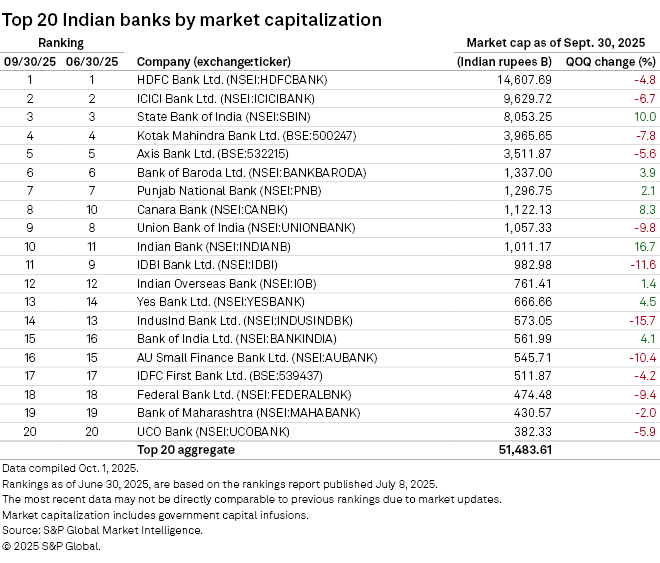
HDFC Bank Ltd. shed 4.8% in market cap during the third quarter, while ICICI Bank Ltd. dropped 6.7%, according to S&P Global Market Intelligence data. Both the private sector lenders posted market cap gains in the April–June quarter, buoyed by rate cuts and high liquidity in the banking system. Other private sector lenders, such as Kotak Mahindra Bank Ltd. and Axis Bank Ltd., also posted declines in market cap in the third quarter compared to the previous three months, the data shows.
Still, the top seven lenders maintained their market cap rankings in the Indian market.
Trump effect
Investors in Indian equities were rattled by US President Donald Trump's announcement in August of 50% tariffs on most imports from India. Private sector lenders, with relatively higher exposure to corporate lending, fared worse than their state-owned peers. The government-owned banks have a greater share of retail loans, especially in smaller Indian cities where local factors such as agricultural output and rural demand play a bigger role than external trade.
The tariffs on India are among the highest for key trading partners of the US. Exporters have been scrambling for newer markets, while trade negotiators are in touch for a US-India deal. India's exports are likely to take a hit, though India is expected to remain the world's fastest-growing major economy for some years.
"We see a strong credit cycle recovery over the next two to three years, primarily led by retail, albeit with improved growth from wholesale too," Emkay Global analysts wrote in an Oct. 3 note. After a moderation in recent months, Emkay expects aggregate loan growth to accelerate to about 11% in the fiscal year ending March 31, 2026.
The Indian government slashed the domestic Goods and Services Tax (GST) rates on Sept. 20 and expects the economy to get a boost from the upcoming festive demand and a normal rainy season that will support rural income. The Reserve Bank of India (RBI) on Oct. 1 raised its GDP estimate for the current fiscal year ending in March 2026 to 6.8% from 6.5%.
The central bank kept its benchmark interest rates unchanged, though many economists expect it to cut rates further after two reductions in the first half of 2025.
Resilient state banks
The RBI's rate-setting panel noted that the "growth outlook remains resilient, supported by domestic drivers, despite weak external demand. It is likely to get further support from a favorable monsoon, lower inflation, monetary easing and the salubrious impact of recent GST reforms," according to a statement on Oct. 1.
State Bank of India, India's largest bank by assets, added 10% in market cap in the third quarter. Among its public sector peers, Bank of Baroda Ltd. gained 3.9% and Punjab National Bank added 2.1%. Bengaluru-headquartered Canara Bank gained 8.3%, now ranking eighth among India's biggest lenders by market cap, up from 10th three months earlier.
Chennai-based Indian Bank posted a 16.7% increase in market cap in the third quarter, the highest among the top 20 Indian lenders ranked by market cap.
Private sector lender IndusInd Bank Ltd. was the worst performer in the third quarter, shedding 15.7% of its market cap and slipping one rung to the 14th position. The Mumbai-based lender disclosed a series of accounting lapses earlier in 2025. Estimates in June by Visible Alpha, a part of S&P Global Market Intelligence, showed that the private sector lender may take two years to recover its earnings after a series of lapses in its derivatives trades, used to hedge foreign currency exposure, led to losses.
IDBI Bank Ltd. shed 11.6% of its market cap, slipping to 11th place from ninth. The Indian government and state-owned insurer Life Insurance Corp. of India plan to sell a combined 60.7% stake in IDBI Bank, with bids expected to be called by December, according to local media reports.
Overall, 12 of the 20 banks on the list lost market cap in the third quarter, compared with only two in the previous three-month period.