22 Oct, 2025
Dandelion Energy launches 1st geothermal leasing program for homebuilders

|
Dandelion Energy Inc. has pivoted to working with production homebuilders, a strategy that could help geothermal installations scale in combination with new leasing models. |
Dandelion Energy Inc. has launched the nation's first leasing program for geothermal heating and cooling systems, a move that aims to accelerate the adoption of the high-efficiency equipment among production homebuilders and homeowners.
The launch, announced Oct. 22, followed a recent change to federal policy, which, for the first time, allows leasing of geothermal systems subsidized by commercial energy tax credits. Dandelion moved swiftly to build a leasing program around that change, which was included in Republicans' US budget reconciliation legislation.
"That bill removed a lot of clean energy incentives, but one of the bright lights for clean energy in the bill was around geothermal," Dandelion CEO Dan Yates told Platts, part of S&P Global Commodity Insights.
According to the company, leasing will remove one of the biggest barriers to uptake: the up-front cost of the underground loops that tap geothermal resources and the ground-source heat pumps that provide indoor heating and cooling.
The policy change complements Dandelion's recent pivot from retrofitting single homes to working with production homebuilders to install single-loop geothermal systems in dozens of new residences at a time. The company's hope is that the ability to lease the systems will make geothermal heating and cooling attractive to even more homebuilders, helping to achieve scale.
Dandelion rolls out leasing
Dandelion will launch the leasing program for homebuilders in 15 states that offer strong incentives for geothermal installations, as well as Washington, DC. Those states are Connecticut, Delaware, Illinois, Indiana, Kentucky, Maryland, Michigan, New Jersey, New York, North Carolina, Ohio, Pennsylvania, Tennessee, Virginia and West Virginia.
Dandelion will work with lease partner Upstream Lease by CSG, which will harvest the Section 48 federal commercial investment tax credit — worth 30% to 50% of the project cost — and any other state, local or utility incentives. The arrangement means homebuilders will not incur additional costs to install geothermal systems, Yates said.
Homeowners will pay the 20-year lease on the equipment, with monthly installments costing about $10-$40 in some developments that Dandelion has assessed. The energy savings that geothermal systems deliver will more than offset those monthly lease fees, Yates said.
Dandelion will also offer leasing to retrofit customers in New York and Connecticut. The company anticipated that monthly payments would be $200-$300. That is comparable to the costs to homeowners under the federal 25D clean energy tax credit for consumers, which will sunset at the end of the year due to changes in the budget bill, the company said.
Carrots and sticks prompt pivot
The termination of the 25D tax credit was a blow to the geothermal industry. However, the incentive did not drive meaningful geothermal installations by production homebuilders, since it required builders to shoulder the up-front costs and left homebuyers to file for the tax credit, Yates said.
When Dandelion spun out of Alphabet Inc.'s innovation lab, X, in 2017, homebuilders often viewed their product as a solution in search of a problem, Yates said. The builders were accustomed to installing gas appliances, which left Dandelion to focus on the business-to-consumer market serving individual homeowners.
However, Yates said that started to change in recent years as state and local policies prohibited gas use in new buildings or made installing fossil fuel equipment prohibitively expensive compared to electric heat pumps. At the same time, more states, cities and utilities were offering incentives that applied to geothermal systems.
"The cost to do gas was much higher and the cost to do geothermal was much lower because ... the carrot and stick mix had changed so much," Yates said.
Project efficiencies also drive shift
After Yates became CEO in 2023, Dandelion revisited the math on new housing development installations versus single retrofits. The analysis found that the full-system costs would be roughly 40% lower than the costs in the direct-to-consumer market due to modifications associated with retrofits.
Dandelion now expects that working with production builders will be its dominant revenue stream. Yates anticipated it would be three times as big as Dandelion's business-to-consumer revenue stream in 2026.
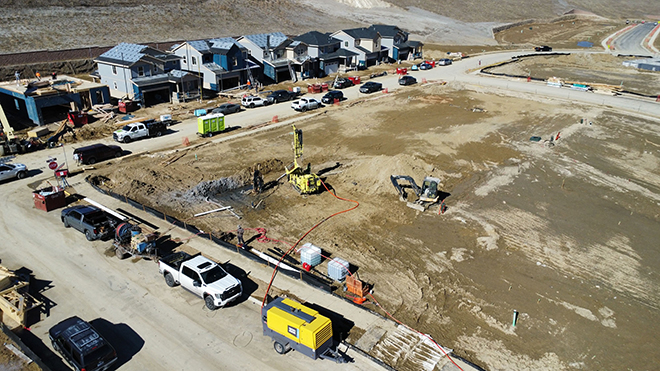
In April, Dandelion announced that Lennar Corp. would integrate its technology into more than 1,500 homes across 14 communities in Colorado, one of the largest deployments of geothermal heating and cooling systems in the US.
"We've become vastly a production builder partner company," Yates said. "We realized that we were going to have tremendous cost efficiencies, which was going to further accelerate the business case for these builders."