28 Oct, 2025
China's rare earths export delay gives US time to reshape mineral supply chains

| Chinese President Xi Jinping and US President Donald Trump attend a welcoming ceremony on Nov. 9, 2017, in Beijing. Source: Thomas Peter-Pool/Getty Images. |
China's
The delay was announced Oct. 26 by US Treasury Secretary Scott Bessent as part of a tentative US-China trade framework. The move follows China's Oct. 9 announcement of its most restrictive rare earths export measures to date. The country's increasingly stringent restrictions had sparked concerns across defense and electric vehicle manufacturing sectors that depend heavily on these materials for equipment, computer chips, and automotive applications.
"An agreement to postpone China's strict October measures is not necessarily a green light, and China is likely to implement the delay strategically and in its self-interest, particularly as the US will be using the time to strengthen its domestic rare earth supply chain and advance diversification through new minerals deals," Mahnaz Khan, vice president of policy and critical supply chains at Silverado Policy Accelerator, told Platts.
The US is
Strategic positioning
China remains dominant in the mining and processing of rare earths and has increasingly leveraged that position amid rising geopolitical tensions with the US. After restricting exports of certain processed rare earths and magnets in April, Beijing agreed in June to accelerate "rare earth-related export applications."
However, since June, only rare earth magnet exports to the US have resumed.
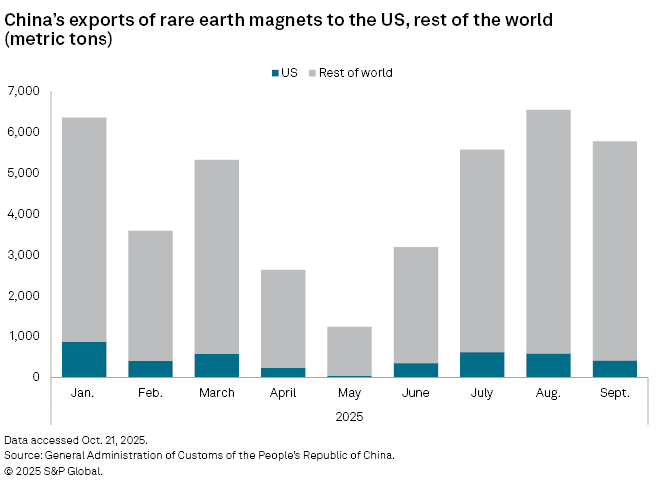
Chinese customs data show permanent magnet exports recovered from May and June lows, but dropped ahead of the Oct. 9 announcement. China's rare earth magnet exports to the US fell 28.7% month-over-month in September to 420 metric tons and have declined more than 50% since the start of the year.
Industry experts described the postponement as highlighting rather than alleviating supply chain vulnerabilities.
"Any short-term loosening of rare-earth controls isn't relief; it's a red alert. In fact, this potential temporary measure only underscores China's weaponization of rare-earth exports and our vulnerability," Pini Althaus, managing partner at Cove Capital, told Platts.
Cove Capital operates and invests in mining projects in Australia and Central Asia.
The delay highlights the long timeline required to establish alternative supply chains outside China. Experts warned that building mineral supply networks outside China will require substantial time and government subsidies. This places additional pressure on US policymakers to accelerate diversification efforts while the temporary reprieve remains in effect.
"Even though they talk about rapprochement and so on, the rivalry on the world stage between China and the US will continue very far into the future. What is said today regarding cooperative working out of a plan and what happens tomorrow with leaders that have been known to change their positions frequently cannot be a substitute for being critically mineral independent for the US," Harvey Kaye, chairman of US Critical Materials Corp., told Platts.