2 Jan, 2025
Ukraine grapples with de-risking energy investments as destruction continues

|
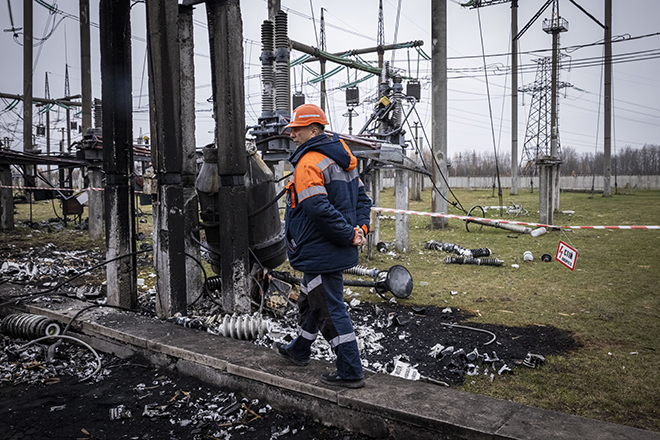
A worker walks by a high-voltage substation switchyard that has been destroyed by a missile strike in central Ukraine. |
Heading into its third winter of war, Ukraine is scrambling to keep the lights on while casting an eye on the energy system it hopes to build after the end of Russia's invasion.
While shelling was mostly concentrated on distribution systems in 2022 and 2023, Russian attacks have focused on power plants in 2024. Despite this, industry voices say it is not too soon to start talking about future investments.
"We need to think about investments now. We need to do that in a strategic way and not only repair what has been destroyed," said Georg Zachmann, scientific lead at Green Deal Ukraine, an initiative working on the reconstruction and transition of Ukraine's energy system. The group advises energy companies including state-owned transmission grid operator Ukrenergo NPC SE.
Repairing what has been destroyed is a constant struggle. Ukraine's largest private power generator, DTEK Holdings Ltd., has a long list of equipment donations, especially high-voltage kit. DTEK is owned by billionaire Rinat Akhmetov, Ukraine's wealthiest person.
Transformers, switchgears, circuit breakers, turbines and generators are being solicited from donors, chiefly the US and the European Union.
Manufacturers say transformers are already in short supply as European utilities scramble to build out their power grids to accommodate more renewables.
Some of the items on DTEK's list come with a long order backlog of six months to one year — time the Ukrainian grid does not have.
"The donors are helping a lot," said Oleksiy Povolotskiy, head of DTEK's recovery office. "The question is if this support is enough — unfortunately not."
Warehouses of stock are also depleted, and DTEK is focusing on refilling spare parts and equipment for repairs through the winter.
On Nov. 25, 2024, the company announced €107 million worth of donations in the form of equipment and building materials from the US government and the European Commission. US donations covered control systems and dozens of new transformers.
Because of the Soviet-era design of grid infrastructure, DTEK cannot use Western kit for many applications. Here, the company works with Eastern European and Baltic states to find equipment.
Billions of damage
DTEK produced a quarter of Ukraine's power before Russia's invasion. While more than 90% of its plants were destroyed earlier this year, the company's technicians have been able to fix more than half of these in the months since.
An assault on Dec. 1, 2024, was the 12th wave of missile and drone strikes targeting Ukrainian energy infrastructure since March, and the ninth direct attack on DTEK's power stations, the company said.
"The consequences of these attacks are very difficult for the energy system, as this year alone we have lost up to 9 GW of generating facilities. This is equivalent to the energy consumption of some European countries, such as the Netherlands," Ukrainian Energy Minister German Galushchenko said Dec. 2, 2024, at a UN event discussing Ukraine's energy infrastructure.
Damages to Ukraine's energy sector exceeded $56 billion when the Kyiv School of Economics last tallied the impact in August 2024. This included $16 billion in direct physical destruction and over $40 billion in indirect financial losses.
Ukraine produces 60% of its power from nuclear, and attacks on substations have threatened safe operations at the reactors.
"The risk of a nuclear accident is extremely high and real," Galushchenko said.
Residents are also navigating rolling power blackouts.
Insurance challenge
In a bid to boost the resilience of Ukraine's power system, the maximum electricity import capacity from the EU grid was raised from 1.7 GW to 2.1 GW on Dec. 1, 2024.
For the future, likely after the war has come to an end, Ukraine could be rebuilt with a decentralized renewables fleet, Povolotskiy said.
"We try to do our best not to focus only on the war," the executive said. Still, it is challenging to secure financing for new projects, with war insurance and guarantees to be factored into the calculations.
A complete restoration of Ukraine's energy sector under the build-back-better principle would require $50.5 billion in investments, according to the Kyiv School of Economics.
Private insurers largely ended war risk insurance when Russia invaded Ukraine in February 2022, and coverage is unlikely to return at least until the hot phase of the war is over.
Any infrastructure projects will likely have to rely on a support scheme from the World Bank's Multilateral Investment Guarantee Agency (MIGA) for insurance.
MIGA blends donor financing from the Support for Ukraine's Reconstruction and Economy Trust Fund with risk exposure on its own books to crowd in public and private reinsurance. MIGA expects the trust fund to reach $300 million.
Investors in a new-look Ukrainian energy market would need much more reassurance, however.
An initial pilot auction round for new renewables flopped earlier in December, with only one developer bidding. Military risks, and insufficient development of insurance mechanisms for such risks, played a major role in the no-show, as well as uncertainty regarding the financing mechanism of feed-in tariffs.
"The big risk is that you cannot trust the Ukrainian electricity market. This guaranteed buyer is not financially viable," Zachmann said.
One solution could be for international donors to team up with the Ukrainian state to set up guarantee funds that can underpin contract-for-difference programs at low strike prices, Zachmann said.
More air defenses
It remains hard to predict how the war in Ukraine will end.
Zachmann said there may be a gray area between peace and war for an undetermined amount of time, pointing to Russia's track record of creating unclear settlements in countries like Moldova and Georgia.
To allow Ukraine's energy system to recover and reduce physical risks, "the one big answer should be more air defenses," said Zachmann, who also works for European economics think tank Bruegel.
Investments into Ukraine's electricity systems cannot wait, Zachmann added. Part of the solution may be a deeper market coupling with the EU, with capacity auctioning systems not yet designed.
Some projects are progressing already. DTEK Renewables is planning a 650-MW onshore wind farm, Poltavska, in east-central Ukraine, which is set to begin construction this year.
When it comes to the companies developing new energy infrastructure on the ground, trailblazers will likely be those already active in the market, Zachmann said, adding that smaller players should also be given resources.
"Ukraine has great renewables potential," Zachmann said. "Whoever comes first might be able to secure the best sites. But whether that's enough..."