13 Jan, 2025
Three sustainability trends bankers must watch in 2025

Banks face an increasingly complex sustainability outlook in 2025 amid a global divergence in climate-related priorities.
Changing US politics have raised the prospect of legal action against banks that withdraw funding from fossil fuel providers and sparked an exodus from sustainable finance initiatives. In Europe, meanwhile, efforts to reach net-zero by 2050 are pressing ahead, with the European Banking Authority recently publishing its final guidelines on the management of environmental, social and governance risks, which will apply from January 2026.
While accelerating decarbonization would have environmental benefits, banks should ensure that funded companies begin their transition journeys while also maintaining profitability, said Pierre-Alexandre Moussa, head of climate, impact and sustainable/ESG investments solutions at TP ICAP (Europe).
Here are three key sustainability trends that will impact bankers this year.
Focus on Net-Zero Banking Alliance
The departure of several major US lenders from the Net-Zero Banking Alliance (NZBA) has raised questions about the effectiveness of the UN-convened group and other similar industrywide initiatives.
Former Bank of England Governor Mark Carney launched the alliance in 2021, with members committing to align their lending, investment and capital markets activities with net-zero greenhouse gas emissions by 2050.
The picture has since become less rosy. In December 2024, Wells Fargo & Co. withdrew from the NZBA, after facing litigation and political pressure from US states supportive of the fossil fuel industry. Texas Attorney General Ken Paxton took credit for the bank's departure from NZBA, saying it followed the state's review of the bank as a potential boycotter of energy companies, which is prohibited under Texas law.
Citigroup Inc., Bank of America Corp., Goldman Sachs Group Inc. and Morgan Stanley have also withdrawn from the alliance since late 2024.
Although climate-aligned banks reduce lending to high-carbon-emitting sectors by about 20%, there is no evidence of divestment by these lenders from these sectors, according to the European Central Bank's (ECB's) 2024 working paper on banks' voluntary climate commitments.
"Banks are not yet channeling sufficient funds to achieve net-zero emissions by 2050. Many institutions lack robust methodologies for their sustainable and green finance goals, making it challenging to evaluate their effectiveness," said Louisiana Salge, head of sustainability at sustainable investing wealth manager EQ Investors.
US, Trump and the fossil fuel threat
A key question around US climate-related policies is whether low-carbon technologies will receive continued or additional support under the incoming administration, according to the S&P Global online webinar "Beyond ESG with the outlook for climate-related policies post-US election," on Dec. 11, 2024.
The path to net-zero can be significantly affected by carbon capture and sequestration (CCS), which allows the use of fossil fuels while CO2 is sequestered, according to Roman Kramarchuk, head of climate markets and policy analytics at S&P Global Commodity Insights. Fossil fuels play a significant role even in low-carbon and net-zero scenarios where CCS is viable, Kramarchuk said during the webinar.
Outgoing President Joe Biden signed the Inflation Reduction Act into law in 2022. The Inflation Reduction Act represents the largest investment in climate and energy in American history, aiming to achieve environmental goals, including a net-zero economy by 2050.
The Inflation Reduction Act's energy and climate provisions appropriate about $11.7 billion for the Loan Programs Office (LPO), which provides loans and loan guarantees to deploy innovative clean energy, advanced transportation and tribal energy projects in the US. The LPO financed a $43.9 billion portfolio of innovative clean energy projects and advanced technology vehicle manufacturing facilities across the US as of September 2024.
Under the Inflation Reduction Act, the US government also implemented changes to Section 45Q Carbon Capture Tax Credit, which provides a performance-based tax credit for carbon management projects that capture carbon oxides. The Inflation Reduction Act increased the credit from $50 to $80 per ton of CO2 storage.
The promotion of fossil fuel development, which could follow the recent election of Trump as US president, would roll back the Biden administration's climate efforts.
"To crash inflation, we will quickly become energy independent ... I will approve new drilling, new pipelines, new refiners, new power plants, new reactors and we will slash the red tape," President-elect Donald Trump said during a campaign rally in Atlanta on Oct. 15, 2024.
Digital transformation and AI-powered tools
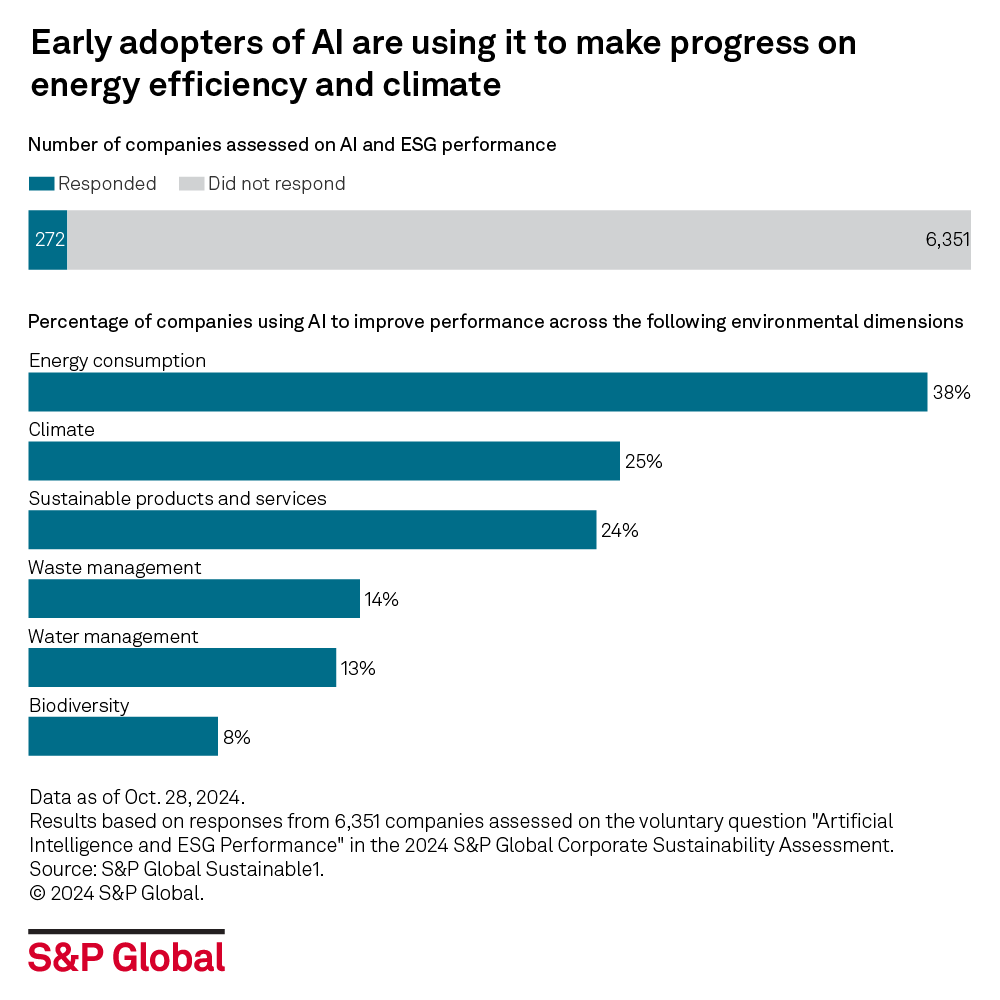
Sustainability reporting and performance measurement is increasingly leveraging technology and data analytics to ensure banks have the capability to deliver relevant reports.
AI methods focus on the initial stage of climate risk governance, enhancing climate-related financial risk assessments, according to a June 2024 study on AI and climate resilience governance published by the American iScience journal.
The findings indicate an emphasis on applying AI to climate risk assessments, particularly in hazard and exposure evaluation. They also highlight challenges, such as a lack of innovative approaches and tools to evaluate resilience and vulnerability, alongside the difficulty of simulating complex long-term changes.
AI and technology-driven sustainability solutions are central to how large banks will use these tools for ESG risk assessment, which includes social impact and financial inclusion, TP ICAP's Moussa said.
The ESG data and transformation team at BNP Paribas SA's corporate and institutional bank, for example, is drawing on AI to support corporate and investor clients in collecting particularly challenging data, such as Scope 3 emissions. Scope 3 refers to indirect emissions resulting from a company's activities but occurring from sources not owned or controlled by it.
Scope 3 is a key issue, as it represents 80% of the total emissions scope, said Moussa.