17 Dec, 2024
Younger US workers struggle for jobs as entry-level posts disappear
Joblessness among some of the youngest potential workers in the US has risen as high interest rates, elevated labor costs and advancements in artificial intelligence dampen hiring of recent college graduates in an otherwise strong employment market.
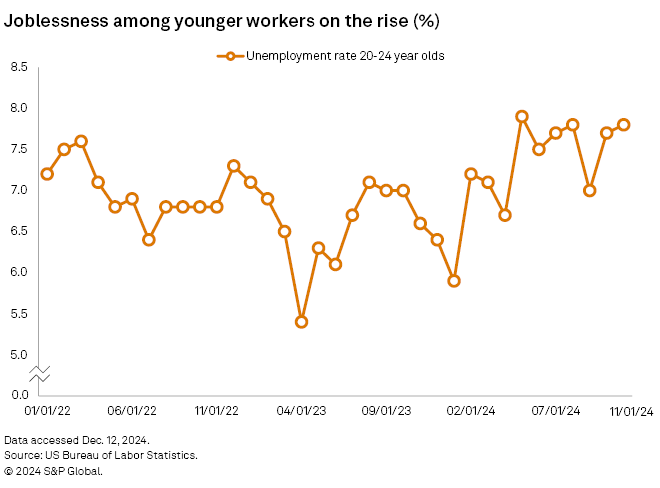
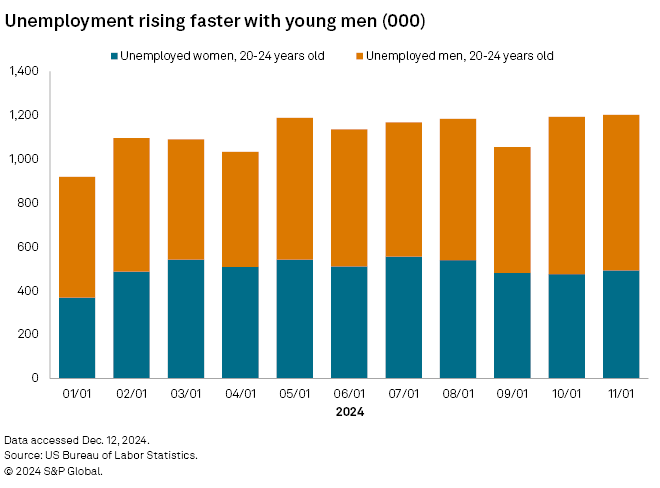
In November, 7.8% of Americans aged 20 to 24 were unemployed, near the highest in more than three years, according to the US Bureau of Labor Statistics. Joblessness was also more than double the 3.7% rate for prime-age workers between 25 and 54. The overall jobless rate was 4.2%.
Companies have become increasingly reluctant to hire younger workers as rising wages and still-elevated interest rates drive up costs and deter expansion. College graduates also face competition from AI as businesses look to automate tasks traditionally carried out by junior workers in areas such as engineering or computer coding.
"The disappearance of the entry-level job has made it very difficult for anyone to get a job out of college," said Thomas Simons, a senior economist at Jefferies.
'I'm either very far behind or very, very far behind'
Job availability, particularly at entry levels, has fallen partly because rapid increases in minimum wages have prompted some businesses to slow hiring and instead force existing workers to take on additional tasks without a boost in pay, Simons said. California, Washington and Washington, DC, have the highest minimum wage levels in the US at $16 or more per hour, according to the Economic Policy Institute.
Interest rates also remain close to 5%, even after cuts this year, because the Federal Reserve ramped up borrowing costs to fight high inflation. The rise in prices, coupled with high student loan balances, have helped to sour younger workers' views on the labor market, Simons said.
"The thinking is something to the effect of, 'I'm either very far behind or very, very far behind with some free time,'" he said.
AI adoption gains
AI is hurting graduate recruitment because technology can now replace entire entry-level roles rather than solving low-level engineering problems, such as ensuring that bolts on a manufacturing assembly line face the same direction, according to James O'Brien, a computer science and electrical engineering professor at the University of California, Berkeley.
Even star students, who companies would have fought to hire a few years ago, are struggling to find work, O'Brien said.
"Hiring is now changing," he said.
More than half of 367 professionals expect generative AI to have a moderate-to-significant impact on their organizations over the next five years, according to a survey conducted in September and October by S&P Global Market Intelligence 451 Research. Within a slightly larger group, more than a third of professionals considered the automation of repetitive tasks to be a primary driver for adopting GenAI technology.
Still, only about 16% of those surveyed by 451 said their organization was using GenAI, while another 29% said their company was not using the technology or had no plans to incorporate it.
'A tough jobs market'
The robust overall labor market also hides areas of weakness that are affecting young workers. Continuing jobless claims, for instance, have risen by more than 9% since early January, according to the Employment and Training Administration.
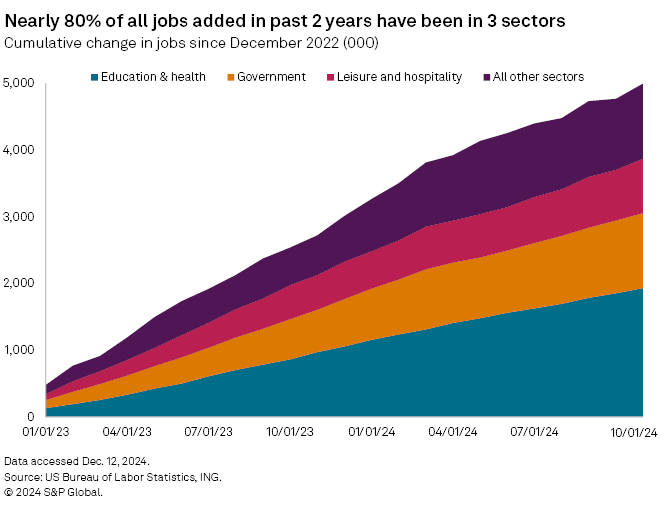
Job creation has also been heavily concentrated. Nearly 80% of all jobs added since the end of 2022 have been in only three sectors — leisure and hospitality, government, and private education and healthcare services.
"When I think of a vibrant and healthy US economy I would expect jobs to be added primarily in other sectors such as technology, construction, transport and logistics, financial services, and business services," said James Knightley, chief international economist with ING. "It's not surprising that young workers are thinking this is a tough jobs market."