2 Dec, 2024
US banks’ efficiency ratios decrease slightly in Q3
By Claire Lawson and Hussain Shah
After improving for two quarters, US banks' efficiency ratios flattened out in the third quarter.
The industry's aggregate efficiency ratio of 56.41% was just 1 basis point up from the second quarter and 80 basis points up from the third quarter of 2023, according to S&P Global Market Intelligence data.
The metric indicates the amount of overhead cost required to generate $1 of operating revenue and is derived by dividing noninterest expenses by the sum of net interest income and noninterest revenue. Lower percentages represent greater efficiency.
A drop in noninterest income and rising noninterest expenses tempered an increase in net interest income during the quarter, pushing efficiency ratios slightly up.
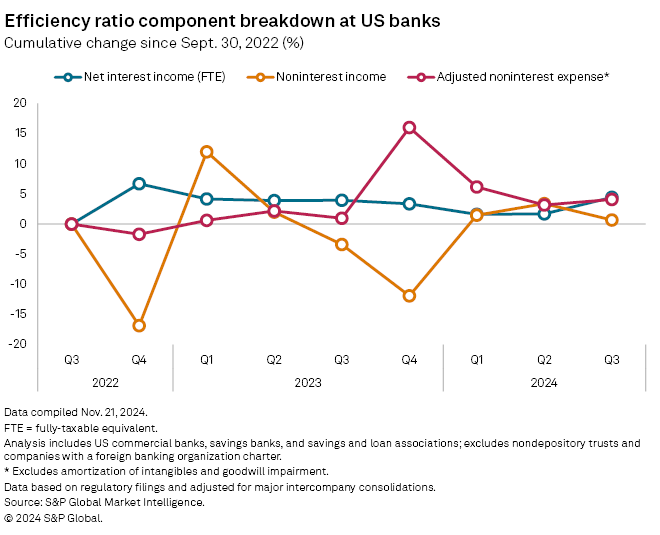
US banks' noninterest income fell to $77.26 billion from $79.35 billion a quarter earlier but remained higher than the $74.15 billion recorded in the prior-year quarter.
At the same time, noninterest expense rose slightly to $144.75 billion from $144.19 billion in the second quarter and $141.05 billion a year earlier.
Higher net interest income helped temper the impact of changes to noninterest expense and noninterest income, rising to $177.13 billion in the third quarter from $172.49 billion in the linked quarter.
Most bigger banks staying strong
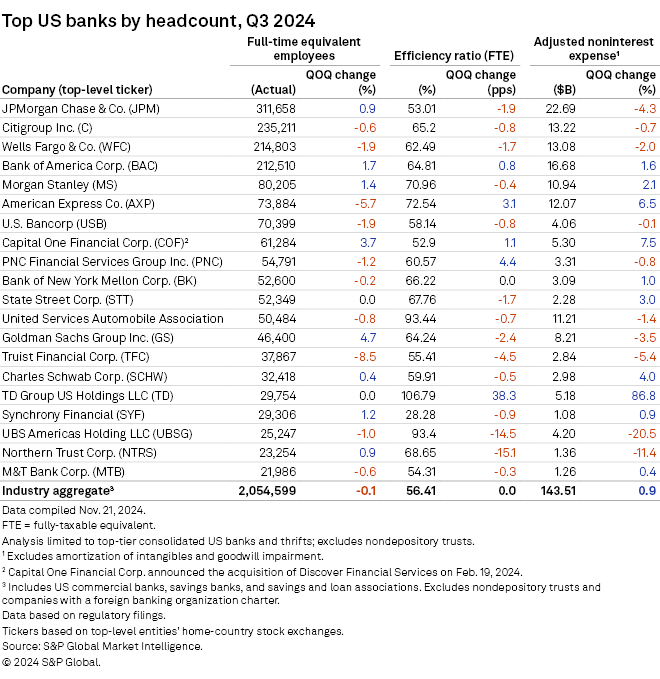
Bucking the industry trend, efficiency ratios improved for 14 of the top 20 banks by head count in the third quarter.
Northern Trust Corp. posted the largest improvement among the top 20 banks by head count, dropping 15.1 percentage points quarterly, with noninterest expense falling 11.4% during that time.
UBS Americas Holding LLC reported the second-biggest improvement with an efficiency ratio drop of 14.5 percentage points. Its noninterest expense shrunk 20.5% in the third quarter.
Toronto-Dominion Bank, however, worsened the most in the analysis, with an efficiency ratio up 38.3 percentage points from the second quarter to 106.79%. Its noninterest expense rose 86.8% in the third quarter. The company reported a $2.6 billion provision in anticipation of the potential resolution to its monthslong investigation by US regulators into its Bank Secrecy Act/anti-money laundering program during the quarter. Separately, it was fined $28 million over alleged illegal actions by the Consumer Financial Protection Bureau.
Head count shed
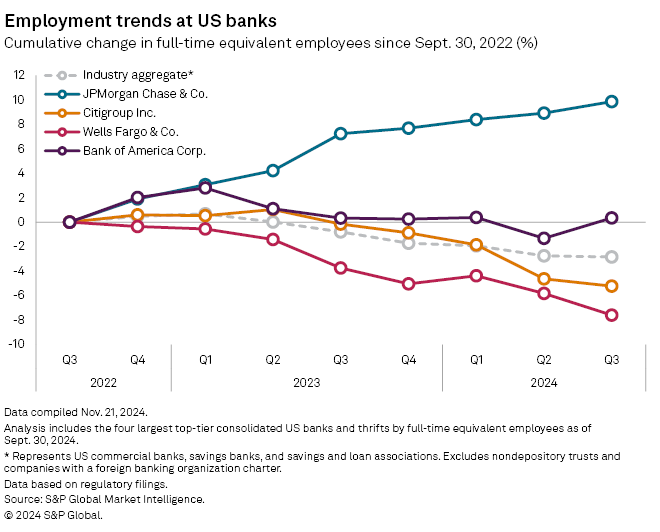
Industry aggregate head count dipped again, but less than in the prior quarter.
In aggregate, head count dropped 0.1% quarter over quarter for US banks: the sixth consecutive quarter of workforce cuts.
The Big Four US banks were split, as JPMorgan Chase & Co. and Bank of America Corp. added employees, and Citigroup Inc. and Wells Fargo & Co. posted staff reductions in the third quarter.
JPMorgan's head count rose 0.9% as Bank of America's rose a greater 1.7%. JPMorgan has hired quarterly continuously since the first quarter of 2022. The company's efficiency ratio improved, and its noninterest expense fell during the quarter.
Citigroup posted a head count reduction of 0.6%, and Wells Fargo dropped 1.9% quarter over quarter. Both companies have been shedding workers since the second quarter of 2023 in line with the industry aggregate.
Of the top 20 banks by employee head count, Truist Financial Corp. reduced its workforce the most, down 8.5% quarter over quarter.
Goldman Sachs Group Inc. hired the most in the analysis, with a total workforce increase of 4.7% from the second quarter.