


6 Dec, 2024
No-show no surprise in Danish offshore wind tender as players fail to see value
By Camilla Naschert and Alex Blackburne
|
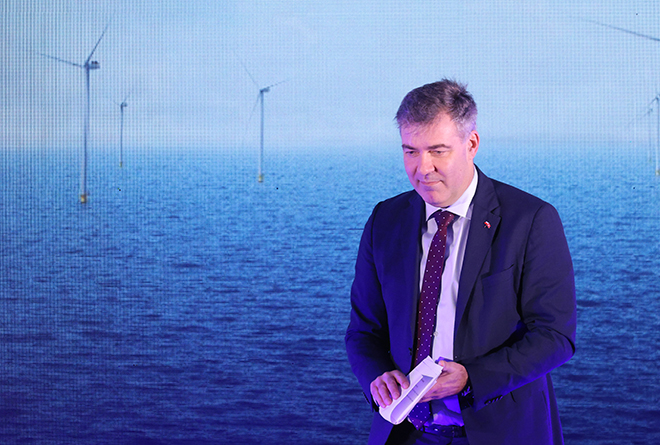
Danish Minister for Climate, Energy and Utilities Lars Aagaard said the absence of bids in the country's 3-GW offshore wind auction was "a very disappointing result." |
Denmark's inability to attract bidders to a 3-GW offshore wind auction was not wholly unexpected, with industry observers pointing to unfavorable investment conditions and a failure by lawmakers to adjust bidding parameters to the market's new realities.
No bids were submitted in the auction for the Nordsøen I A1, A2 and A3 sites in the North Sea, the Danish Energy Agency said Dec. 5.
Market participants said the Danish failure cannot be blamed solely on inflation, high capital expenditure costs and high cost of capital. Instead, developers did not bid because grid connection costs were not covered and no subsidy support was offered, Green Power Denmark said.
The setup made Denmark less attractive than offshore wind markets such as the UK, which offers fixed-price contracts for difference (CFDs) but requires developers to pay for the grid, and Germany and the Netherlands, which run subsidy-free auctions but have no grid costs.
Denmark also required bidders to factor in 20% minority ownership by the Danish state — a novel element that industry observers said caused unnecessary complexity.
In all, the auction design compounded the ongoing cost challenges to such an extent that the projects were not economically feasible despite being in wind-rich shallow waters, Green Power Denmark said.
"In Denmark, investors do not know whether they can sell the energy from the wind turbines at a reasonable price. It is too slow in electrifying heating and industrial processes. And there is still a great deal of uncertainty about whether it is possible to sell electricity in the form of hydrogen," said Kristian Jensen, CEO of Green Power Denmark.
With a population of about 6 million, power demand in Denmark is limited, and the country already derives nearly 70% of its electricity needs from wind and solar.
"Adding further large-scale renewables will lead to more times during which there is oversupply and hence low or even negative electricity prices," said Raya Peterson, global head of offshore wind advisory services at Denmark-headquartered engineering and consulting firm Ramboll. "For a fully merchant project, this has a negative impact on the business case, and there seems to not be enough demand for long-term corporate power purchase agreements in the market to mitigate this."
Fixing the auction design
With market players having raised concerns about the Danish auction for years, the no-show appears to have been a surprise only for the Danish government.
"This is a very disappointing result — and not at all what was expected when we entered into the offshore wind agreement," Denmark's Minister for Climate, Energy and Utilities Lars Aagaard said in a statement.
Circumstances for offshore wind in Europe have changed significantly in a relatively short time, including large price and interest rate increases, the minister added, noting that "there can be many explanations for today's result."
"Let me be clear. More offshore wind must be built in Denmark. That was the government's goal yesterday, and it is also the goal today," Aagaard said.
The minister has tasked the Danish Energy Agency with collecting market feedback for future auction rounds. To remedy a lack of market certainty, Denmark needs to review the price and risk allocation mechanisms in its auction design and improve export infrastructure, market players said. Tenders should also be serial with predictable build-out rates.
Aagaard said the failure "does not give grounds for optimism" ahead of a second 3-GW auction in Denmark next year for the Kattegat, Kriegers Flak II and Hesselø sites. That tender is approaching fast, with bids due on April 5, 2025.
"Time to change anything substantial (i.e., going back to a CFD) is probably limited," Ramboll's Peterson said. "[Danish] regulators may need to consider postponing it."
Learning from failures
The Danish auction result dampens what is otherwise a banner year for offshore wind auctions in Europe. Some 19.1 GW of capacity has been awarded so far, up from 13.6 GW in 2023, according to lobby group WindEurope.
But among the successes of the last two years, there have also been other failures.
In the UK, Europe's largest offshore wind market, developers sat out of an auction in 2023, blaming unviable project economics. More recently, Estonia's tender for the up to 1.2-GW Saare 1 site had no bids submitted, while in nearby Lithuania, a 700-MW auction was unsuccessful after receiving only a single bid.
The failed auctions risk delaying critical supply chain capacity expansions and could lead to a "negative spiral" of costs remaining high and project business cases being unsatisfactory, according to Adrian Bucica, senior adviser at offshore wind consultancy Green Ducklings.
"From any crisis, we can and we should learn, and this failed auction could lead to rapid action from authorities in Denmark," Bucica said in an email, highlighting the UK government's move to raise offshore wind strike prices in response to its no-show of 2023.
The misalignment between higher levelized cost of electricity and expectations of low electricity market prices could prove to be a "significant barrier" in other markets such as Germany and the Netherlands, Bucica added, potentially reducing the pace of the offshore wind build-out.