5 Nov, 2024

FinReg Europe: UK banks fear costly car finance redress; EU ready for Basel

Big UK banks could face hefty costs as a recent court ruling could trigger a wide-reaching redress scheme in the car finance sector.

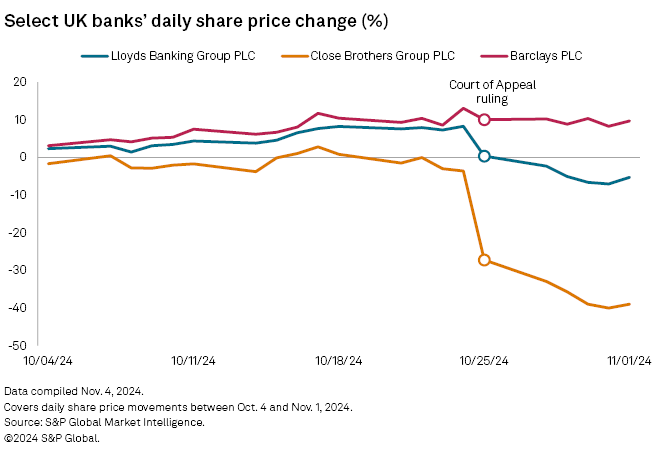
The Court of Appeal ruled Oct. 25 that certain commissions banks paid to car dealers without the borrowers' knowledge were unlawful. The case involved claims against UK-based lender Close Brothers Group PLC and the London branch of South Africa's FirstRand Ltd., which runs the MotoNovo brand in the UK.

Both banks intend to appeal the ruling, with Close Brothers saying it will temporarily pause the issuance of new UK car loans while it reviews and implements any relevant changes to its processes.

Close Brothers' shares dropped 24.5% after the judgment, while shares in Lloyds Banking Group PLC, owner of the UK's largest motor finance provider, Black Horse, sank 7.3%.

Analysts estimated Lloyds alone could face more than £2 billion in costs if a sector-wide car finance redress scheme is launched in the UK. The group has already booked £450 million in provisions related to potential compensation and costs related to its car finance business after the UK Financial Conduct Authority (FCA) launched a probe into car loan commission arrangements in early 2024.

Barclays PLC and Santander UK PLC are also expected to be among those a car finance redress scheme would impact, with the latter having delayed its third-quarter earnings release to assess the magnitude of the potential remediation after the court ruling, S&P Global Ratings analysts said in an Oct. 29 bulletin.

Similar actions and further provisioning should be expected from the exposed banks in future as they "are just the start of a long-running process," the Ratings analysts said.
SNL Image

➤ EU banks require "minimal" additional capital to meet requirements under the final Basel III reforms due for implementation in the bloc, the European Banking Authority (EBA) said Oct. 7.

Based on end-2023 data, the total capital shortfall for the 152 banks in the EBA's sample is estimated at €5.1 billion, of which the Tier 1 capital shortfall stands at about €900 million. This "can be easily raised" until the framework's full implementation in 2033, the EBA said.

Overall the minimum Tier 1 capital requirement for EU banks would increase 7.8% at full implementation, while large banks and global systemically important banks (G-SIBs) face minimum Tier 1 capital requirement increases of 8.6% and 12.2%, respectively.

The main drivers of the increase are the so-called output floor, which limits banks' use of internal models to assess credit risk, and operational risk requirements. The output floor will be phased in over the five years between 2025 and 2030, and its largest impact on banks is expected toward the end of the period, when the floor — as a percentage of non-internally modelled risk-weighted assets (RWAs) — rises to 72.5% in 2033 from 70% in 2029, the EBA said.


SNL Image

SNL Image

➤ Swedish financial regulator sets new capital requirements for SEB, Swedbank

The Swedish Financial Supervisory Authority set new capital requirements for two of the country's largest lenders, Skandinaviska Enskilda Banken AB and Swedbank AB.

➤ Austria's Euram Bank ordered to cease operations over money laundering gaps

Austria's Financial Market Authority has ordered European American Investment Bank AG (Euram Bank) to immediately cease operations, citing lapses in the bank's money laundering checks.

➤ Rapid interest rate hikes take toll on Turkish banks' earnings outlook

The central bank raised its benchmark interest rate to 50% in 2024, from 8.5% in June 2023, aiming to curb inflation. While higher rates typically boost bank margins, the sharp hike has posed challenges for lenders.

SNL Image

Regulatory action

UK banks were spared tax hikes in the country's autumn budget on Oct. 30, boosting sector stocks the same day. The industry had feared new Chancellor Rachel Reeves could raise the bank levy or bank surcharge as she seeks to improve public finances.

– The EU Commission is reviewing Banco Bilbao Vizcaya Argentaria SA's takeover bid for fellow Spanish bank Banco de Sabadell SA under the new foreign investment framework created by the EU. The probe focuses on the ways investments from other countries may disrupt the internal market and undermine fair competition within the European economic area, Europa Press reported Oct. 24.

– After removing caps on bankers' bonuses, the UK plans to also ease financial crisis-era rules that require senior bankers to wait up to eight years to receive variable pay. The Prudential Regulatory Authority (PRA) has proposed to reduce the deferral period by three years, and wants to reduce the pro rata vesting period to one year after the bonus is awarded from three years currently, PRA head Sam Woods said in a speech Oct. 17.

– The UK Treasury opened a consultation Oct. 17 on draft legislation to regulate buy-now, pay-later (BNPL) products in the country. Under the proposed rules, BNPL companies would be have to be licensed to operate by the FCA and be subject to its supervision. The consultation will run until Nov. 29, after which the government will "bring forward legislation as soon as possible."

Swiss financial watchdog FINMA Oct. 15 suspended its annual approval of the resolution and recovery plans of UBS Group AG, saying the integration of smaller rival Credit Suisse has created "obstacles" in the functioning of group structures, processes and IT platforms, which UBS must harmonize. UBS must also update its current resolution plan to include more than one option for continuation of business in a crisis, FINMA said.

The UK government plans to reform its bank ring-fencing regime, Economy Secretary Tulip Siddiq said Oct. 14. The reforms are aimed at reducing compliance burdens and allowing greater flexibility of ring-fenced banks to operate globally. They also include new rules to exempt retail-focused groups where investment banking accounts for less than 10% of Tier 1 capital from the regime.

– The European Commission on Oct. 9 launched a eight-week targeted consultation on the effectiveness of the bloc's securitization framework, which was introduced in 2019, to identify areas of improvement. The commission is asking relevant stakeholders to assess a range of issues, including due diligence, transparency, prudential and liquidity requirements within the framework, until Dec. 4. EU officials have proposed an overhaul of the framework as a means to strengthen EU banks' lending capacity, deepen the EU capital markets and boost the bloc's competitiveness, the commission said.

– The UK government is granting banks additional powers to delay and investigate suspicious payments under new legislation aimed at strengthening consumer protection against scams. The Treasury on Oct. 3 proposed extending the maximum time banks can hold the processing of transactions where there are reasonable grounds to suspect fraud to 72 hours. An estimated £460 million was lost to fraudulent activity in 2023 alone, the Treasury said.

Fines & cautions

– FINMA CEO Stefan Walter called for the removal of legal barriers preventing the watchdog from running its own preemptive on-site inspections at banks where it has identified high operational risks. The limitations of FINMA's early-intervention powers drew wider market attention after the Swiss government had to arrange a rescue deal for Credit Suisse, which was merged with UBS Group AG in early 2023.

– The UK FCA fined Starling Bank Ltd. £29 million for failings in its financial sanctions screening and repeated breaches of a requirement not to open accounts for high-risk customers, the watchdog said Oct. 2. Starling opened over 54,000 accounts for 49,000 high-risk customers between September 2021 and November 2023, despite receiving an FCA warning about serious concerns with its anti-money laundering and sanctions framework in a regulatory probe in 2021, the FCA said.

– The UK FCA also fined Volkswagen Financial Services (UK) Ltd. £5.4 million for the unfair treatment of customers in arrears between January 2017 and July 2023, and TSB Bank PLC £10.9 million for unfair treatment of distressed customers between June 2014 and March 2020.

– European Central Bank (ECB) supervisory board member Elizabeth McCaul has warned again of potential risks linked to EU banks' exposure to nonbank financial institutions, and private credit funds in particular. A recent ECB deep dive found that banks cannot "properly identify the detailed nature and levels of their full exposure" to those funds, meaning "concentration risk could be significant," McCaul said in a speech Oct. 8.

– The US Commodity Futures Trading Commission (CFTC) ordered Barclays to pay a $4 million civil penalty for failing to either correctly or timely report over five million swap transactions between 2018 and 2023, the regulator said Oct. 1.

05 Nov, 2024

FinReg Europe: UK banks fear costly car finance redress; EU ready for Basel

FinReg Europe is a monthly overview of essential banking regulation news, published on the first Tuesday of every month.

TOP NEWS

Big UK banks could face hefty costs as a recent court ruling could trigger a wide-reaching redress scheme in the car finance sector.

The Court of Appeal ruled Oct. 25 that certain commissions banks paid to car dealers without the borrowers' knowledge were unlawful. The case involved claims against UK-based lender Close Brothers Group PLC and the London branch of South Africa's FirstRand Ltd., which runs the MotoNovo brand in the UK.

Both banks intend to appeal the ruling, with Close Brothers saying it will temporarily pause the issuance of new UK car loans while it reviews and implements any relevant changes to its processes.

Close Brothers' shares dropped 24.5% after the judgment, while shares in Lloyds Banking Group PLC, owner of the UK's largest motor finance provider, Black Horse, sank 7.3%.

Analysts estimated Lloyds alone could face more than £2 billion in costs if a sector-wide car finance redress scheme is launched in the UK. The group has already booked £450 million in provisions related to potential compensation and costs related to its car finance business after the UK Financial Conduct Authority (FCA) launched a probe into car loan commission arrangements in early 2024.

Barclays PLC and Santander UK PLC are also expected to be among those a car finance redress scheme would impact, with the latter having delayed its third-quarter earnings release to assess the magnitude of the potential remediation after the court ruling, S&P Global Ratings analysts said in an Oct. 29 bulletin.

Similar actions and further provisioning should be expected from the exposed banks in future as they "are just the start of a long-running process," the Ratings analysts said.

SNL Image

➤ EU banks require "minimal" additional capital to meet requirements under the final Basel III reforms due for implementation in the bloc, the European Banking Authority (EBA) said Oct. 7.

Based on end-2023 data, the total capital shortfall for the 152 banks in the EBA's sample is estimated at €5.1 billion, of which the Tier 1 capital shortfall stands at about €900 million. This "can be easily raised" until the framework's full implementation in 2033, the EBA said.

Overall the minimum Tier 1 capital requirement for EU banks would increase 7.8% at full implementation, while large banks and global systemically important banks (G-SIBs) face minimum Tier 1 capital requirement increases of 8.6% and 12.2%, respectively.

The main drivers of the increase are the so-called output floor, which limits banks' use of internal models to assess credit risk, and operational risk requirements. The output floor will be phased in over the five years between 2025 and 2030, and its largest impact on banks is expected toward the end of the period, when the floor — as a percentage of non-internally modelled risk-weighted assets (RWAs) — rises to 72.5% in 2033 from 70% in 2029, the EBA said.

SNL Image

SNL Image

➤ Swedish financial regulator sets new capital requirements for SEB, Swedbank

The Swedish Financial Supervisory Authority set new capital requirements for two of the country's largest lenders, Skandinaviska Enskilda Banken AB and Swedbank AB.

➤ Austria's Euram Bank ordered to cease operations over money laundering gaps

Austria's Financial Market Authority has ordered European American Investment Bank AG (Euram Bank) to immediately cease operations, citing lapses in the bank's money laundering checks.

➤ Rapid interest rate hikes take toll on Turkish banks' earnings outlook

The central bank raised its benchmark interest rate to 50% in 2024, from 8.5% in June 2023, aiming to curb inflation. While higher rates typically boost bank margins, the sharp hike has posed challenges for lenders.

SNL Image

Regulatory action

UK banks were spared tax hikes in the country's autumn budget on Oct. 30, boosting sector stocks the same day. The industry had feared new Chancellor Rachel Reeves could raise the bank levy or bank surcharge as she seeks to improve public finances.

– The EU Commission is reviewing Banco Bilbao Vizcaya Argentaria SA's takeover bid for fellow Spanish bank Banco de Sabadell SA under the new foreign investment framework created by the EU. The probe focuses on the ways investments from other countries may disrupt the internal market and undermine fair competition within the European economic area, Europa Press reported Oct. 24.

– After removing caps on bankers' bonuses, the UK plans to also ease financial crisis-era rules that require senior bankers to wait up to eight years to receive variable pay. The Prudential Regulatory Authority (PRA) has proposed to reduce the deferral period by three years, and wants to reduce the pro rata vesting period to one year after the bonus is awarded from three years currently, PRA head Sam Woods said in a speech Oct. 17.

– The UK Treasury opened a consultation Oct. 17 on draft legislation to regulate buy-now, pay-later (BNPL) products in the country. Under the proposed rules, BNPL companies would be have to be licensed to operate by the FCA and be subject to its supervision. The consultation will run until Nov. 29, after which the government will "bring forward legislation as soon as possible."

Swiss financial watchdog FINMA Oct. 15 suspended its annual approval of the resolution and recovery plans of UBS Group AG, saying the integration of smaller rival Credit Suisse has created "obstacles" in the functioning of group structures, processes and IT platforms, which UBS must harmonize. UBS must also update its current resolution plan to include more than one option for continuation of business in a crisis, FINMA said.

The UK government plans to reform its bank ring-fencing regime, Economy Secretary Tulip Siddiq said Oct. 14. The reforms are aimed at reducing compliance burdens and allowing greater flexibility of ring-fenced banks to operate globally. They also include new rules to exempt retail-focused groups where investment banking accounts for less than 10% of Tier 1 capital from the regime.

– The European Commission on Oct. 9 launched a eight-week targeted consultation on the effectiveness of the bloc's securitization framework, which was introduced in 2019, to identify areas of improvement. The commission is asking relevant stakeholders to assess a range of issues, including due diligence, transparency, prudential and liquidity requirements within the framework, until Dec. 4. EU officials have proposed an overhaul of the framework as a means to strengthen EU banks' lending capacity, deepen the EU capital markets and boost the bloc's competitiveness, the commission said.

– The UK government is granting banks additional powers to delay and investigate suspicious payments under new legislation aimed at strengthening consumer protection against scams. The Treasury on Oct. 3 proposed extending the maximum time banks can hold the processing of transactions where there are reasonable grounds to suspect fraud to 72 hours. An estimated £460 million was lost to fraudulent activity in 2023 alone, the Treasury said.

Fines & cautions

– FINMA CEO Stefan Walter called for the removal of legal barriers preventing the watchdog from running its own preemptive on-site inspections at banks where it has identified high operational risks. The limitations of FINMA's early-intervention powers drew wider market attention after the Swiss government had to arrange a rescue deal for Credit Suisse, which was merged with UBS Group AG in early 2023.

– The UK FCA fined Starling Bank Ltd. £29 million for failings in its financial sanctions screening and repeated breaches of a requirement not to open accounts for high-risk customers, the watchdog said Oct. 2. Starling opened over 54,000 accounts for 49,000 high-risk customers between September 2021 and November 2023, despite receiving an FCA warning about serious concerns with its anti-money laundering and sanctions framework in a regulatory probe in 2021, the FCA said.

– The UK FCA also fined Volkswagen Financial Services (UK) Ltd. £5.4 million for the unfair treatment of customers in arrears between January 2017 and July 2023, and TSB Bank PLC £10.9 million for unfair treatment of distressed customers between June 2014 and March 2020.

– European Central Bank (ECB) supervisory board member Elizabeth McCaul has warned again of potential risks linked to EU banks' exposure to nonbank financial institutions, and private credit funds in particular. A recent ECB deep dive found that banks cannot "properly identify the detailed nature and levels of their full exposure" to those funds, meaning "concentration risk could be significant," McCaul said in a speech Oct. 8.

– The US Commodity Futures Trading Commission (CFTC) ordered Barclays to pay a $4 million civil penalty for failing to either correctly or timely report over five million swap transactions between 2018 and 2023, the regulator said Oct. 1.