21 Sep, 2023
Proposed gas ban in Washington, DC, commercial buildings fails in tight vote


| Apartment and office developers in Washington, DC, will not face all-electric construction requirements following a second defeat for natural gas restrictions in commercial buildings. Source: Mike Perry - flickr.com/mrperry/Moment via Getty Images |
After more than a year of debate and delay, a Washington, DC, board killed a proposal to restrict natural gas use in new commercial buildings.
The proposal to require all-electric construction in new commercial buildings, including apartment complexes, split the district's Construction Codes Coordinating Board (CCCB) in a 6-6 vote Sept. 21, with one member abstaining. The outcome marked the proposal's second defeat and means the CCCB will not revisit the issue until the next building code update cycle.
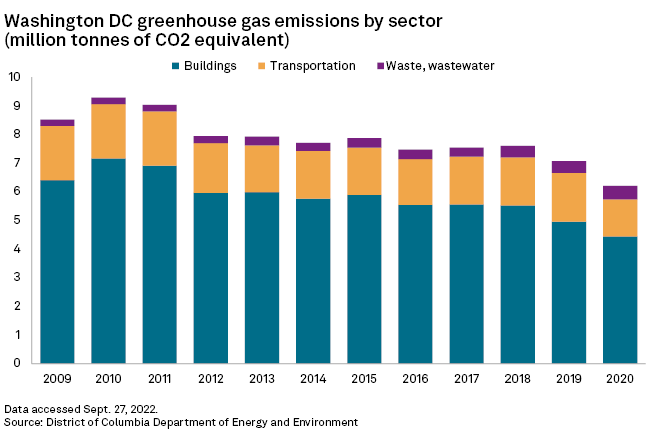
It was a substantial defeat for building electrification backers who saw the code update as an opportunity to align future construction with the city's climate goals. Washington, DC, aims to reduce economywide greenhouse gas emissions 50% by 2032 and reach carbon neutrality by 2050. The building sector generated 72% of the district's annual greenhouse gas emissions in 2020, according to city data.
The vote also created pressure for the CCCB to achieve substantial energy savings when it next updates the district's building codes.
The District of Columbia Council passed an ordinance in July 2022 ordering the CCCB to develop construction codes that require new commercial buildings to meet a net-zero energy standard. If those regulations are not in place by Jan. 1, 2027, all construction will have to follow a voluntary net-zero energy code, adopted as Appendix Z to the 2017 District of Columbia Construction Codes.
The council put the CCCB on a deadline after the board narrowly passed an all-electric construction requirement for residential buildings in May 2022. At the time, the all-electric proposal for commercial buildings was generating substantial debate over the policy's cost and emissions reduction benefits.
Debate over grid capacity
The CCCB voted down the electrification mandate in October 2022 after Potomac Electric Power Co. (Pepco) sent a last-minute email to the board that raised concerns about the electric grid's capacity to handle demand from all-electric buildings. Pepco said it needed to perform further analysis to ensure the code proposal did not affect the assumptions in a previous report, which found that the company can handle distribution system growth spurred by building electrification.

But during a December 2022 CCCB meeting, Pepco Region President Donna Cooper clarified that the company does not object to the proposal. Further, Pepco no longer believed that a new study was necessary. In its initial comments, the company instead referred to the ongoing analysis that it performs to ensure its system investments align with development in the district, Cooper said.
In April, the Washington, DC, Department of Energy and Environment (DOEE) issued a report that found the district's electric grid can handle incremental building and vehicle electrification over the next decade.
Still, opponents of the electrification mandate continued to raise concerns about grid capacity during the Sept. 21 meeting. After DOEE program analyst Casey Studhalter reminded opponents of Pepco's testimony and the DOEE's analysis, fellow CCCB board member Anthony Dale, an advisory neighborhood commissioner representing Fort Lincoln, asked whether the board had consulted PJM Interconnection LLC, which operates the region's wholesale electricity market.
In July, PJM warned that rising electricity demand, the retirement of fossil fuel-based generation and uncertainty around renewable power project developments could create reliability risks during the decade.
CCCB members on both sides of the debate have raised concerns that Pepco sources just 7% of the district's electric power generation from renewable sources, making electrification less beneficial from an emissions reduction standpoint.
Pepco does not own generation assets but instead purchases wholesale electric power supplied through PJM, Cooper told the board in December 2022. Pepco complies with the district's renewable portfolio standard and will seek to connect more solar power to its system to support DC's mandate to source 100% of electricity sold in the district from renewable sources by 2032, Cooper said. She noted that the district recently required 15% of its electricity to come from local solar resources by 2041, up from 10% previously.
Apartment developers opposed policy
Opponents managed to delay a final vote on the proposal for months, citing a procedural rule that they said precluded the board from voting on the electrification requirement after its initial defeat in October 2022.
Many of the board's electrification opponents represented commercial building developers and managers. Apartment developers stood to absorb higher construction costs if the district adopted restrictions on new gas hookups because builders sometimes shoulder the cost of electric distribution system upgrades required by new load.
Responding to those concerns in December 2022, Cooper said those costs are generally socialized among all customers. Pepco is assessing opportunities under the federal Infrastructure Investment and Jobs Act to offset the cost that customers would bear to advance resiliency and capacity-oriented projects, she said.
But Gus Mehrdad, a mechanical engineer who sits on the CCCB, said he is working on a project where the owner is pushing his firm, MCE, to reduce power consumption and push load onto natural gas to avoid paying for electric distribution system upgrades.
"I can only imagine what's going to happen if the whole building would have to be upgraded" to accommodate all-electric construction, Mehrdad said during the Sept. 21 meeting.
Gas utilities grapple with gas bans
The district's gas distributor, Washington Gas Light Co., did not immediately return a request for comment but previously told S&P Global Commodity Insights that district residents "will be best served by a fuel-neutral approach to future decarbonization efforts that leverage our infrastructure to deliver low- to no-carbon fuels of the future."
In July, the new president and CEO of Washington Gas parent AltaGas Ltd., Vern Yu, told analysts the company will take a more assertive approach to advocating for gas use in its Maryland, Virginia, and Washington, DC, territories.
Lawmakers in Montgomery and Howard counties in Maryland voted to update their building codes to require all-electric construction in most new buildings. In August, Baltimore County Councilman Izzy Patoka said he would introduce legislation to that effect.
Washington Gas distributes gas in Montgomery County, while Baltimore Gas and Electric Co. provides gas service in Baltimore County, most of Howard County and parts of Montgomery County, according to the Maryland Office of the People's Counsel. Baltimore Gas and Electric and Pepco are subsidiaries of Exelon Corp.
S&P Global Commodity Insights produces content for distribution on S&P Capital IQ Pro.