


18 Jun, 2023
Australian miners brace for higher costs as new emissions law takes effect

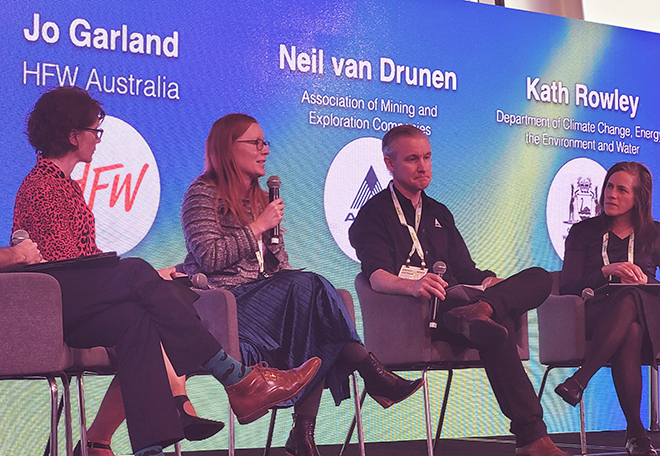
| HFW Australia partner Jo Garland (second from left) speaks about the complexity of complying with Australia's new industrial emissions limits at a summit in Perth on June 15. |
Miners see commercial opportunities amid serious operational and cost concerns in complying with Australia's new industrial emissions regime, which comes into force July 1.
Earlier in 2023, the Australian government added teeth to its 2016 Safeguard Mechanism, which aims to cut emissions by 43% from 2005 levels and targets the mining sector, among others. Legislation passed in March set baselines of allowable emissions for facilities that emit over 100,000 metric tons of CO2 per year. These baselines will then be lowered 4.9% every year until fiscal 2030.
The new rules add to an "increasingly complex, more expensive, slower, external operating environment, all of which can actually build cumulative cost," Sasha Pendal, Fortescue Metals Group Ltd.'s community and government engagement group manager, told a June 15 panel at the Energy and Mines Australia Summit in Perth, Western Australia. "Understanding about that operating environment is really important to inform investment decisions," Pendal said.
Miners have "an awful lot to consider" and "a big stream of work to be done" as the law takes effect, with some needing to change how they operate, Jo Garland, partner at law firm HFW Australia, said on the same panel.
"The largest uncertainty right now is what the baseline is that everyone is going to be held to and measured against above the 100,000 tons as a starting point," said Jason Dickfos, head of growth at distributed energy producer EDL Energy.
"Existing installations need to look for genuine efficiency initiatives that use less electricity for the same output and having a dynamic load profile" by using renewable energy when available, which will impact their baselines, Dickfos told S&P Global Commodity Insights.
Commercial opportunities
Under the new rules, facilities can continue surrendering Australian carbon credit units (ACCUs) to offset emissions and stay below their baselines. Those with emissions below their baselines can generate safeguard mechanism credits (SMCs), which can be sold to other facilities or banked for future use.
Staying ahead of reduction requirements will be a key long-term challenge, but it could also open up commercial opportunities, Fortescue's Pendal said. "As we look into the future, we see a point in the market where there could be a rush to buying high-quality ACCUs," so having access to the right number of quality ACCUs at an affordable price is key, Pendal said.
The opportunity in SMCs is also prompting Fortescue to look at partnerships "with new parties in a new lens — specifically, the potential to partner around carbon farming and other opportunities where we may be part of a future high-quality ACCU generation model," Pendal said.
ACCU and SMC prices are expected to increase over time due to a surge in demand, said David Kazmirowicz, head of emissions quant at Energetics Pty. Ltd., a climate risk and energy transition firm.
Clean energy investments versus credits
Miners are weighing how many credits they would need to buy to meet the new requirements versus spending upfront capital to install renewables, Dickfos said.
Government consultation with industry revealed "a lot of nervousness about potential compliance costs," said Kath Rowley, head of the emissions reduction division at the federal Department of Climate Change, Energy, the Environment and Water. However, "most facilities covered by the safeguard are owned by companies that already have net-zero commitments, that already have in many cases significant medium-term targets, and are already charting their path to net-zero," Rowley told the panel.
Association of Mining and Exploration Companies (AMEC) members with older assets "face a unique set of challenges as they try and decarbonize and get these offsets," Neil van Drunen, the group's industry policy director, told the panel.
Miners need policy "certainty and transparency" given that the new requirements represent "another layer of due diligence" for AMEC members buying into a mine and have implications for others with greenfield sites, van Drunen said.
To address these cost pressures, Rowley said the federal government is offering a dedicated A$600 million safeguard transformation stream to help cut Scope 1 emissions, plus a targeted A$400 million stream for industries providing clean energy industries with critical inputs such as steel, aluminum and alumina.
The government of Western Australia — the world's largest lithium and iron ore producer — is also working with the federal government to explore investments to unlock decarbonization options for the industry in the Pilbara region, the state's Environment and Climate Action Minister Reece Whitby told Commodity Insights.
Western Australia's Environmental Protection Authority has also recently updated its greenhouse gas guidance, "ensuring the Safeguard Mechanism can be taken into account, reducing the potential for regulatory duplication and reporting requirements," Whitby said.
S&P Global Commodity Insights produces content for distribution on S&P Capital IQ Pro.