


31 Mar, 2023
Carbon capture tech needed to close 'last mile' of net-zero emissions – outlook

By Bill Holland
Carbon capture and storage and direct air capture projects will be needed to get global carbon emissions close to net-zero under the most aggressive carbon reduction scenarios examined by the think tank Resources for the Future.
"Every single ambitious climate scenario that we observed in this year's outlook has carbon capture and sequestration, or CCS, at large scale, as well as direct air capture or negative emissions at large scale," Resources for the Future fellow and University of Michigan lecturer Daniel Raimi said March 29. "Clearly, we've dug a big hole in terms of the carbon budget, and we're going to need new technologies to help us get out."

Resources for the Future produces a global survey of carbon emissions scenarios created by major oil and gas producers, energy analysts and agencies. Resources for the Future converts those plans — which use a wide variety of measurement units — into common terms, allowing plans to be compared. The 2023 Global Energy Outlook, released March 29, covered 14 carbon scenarios from seven outlooks.
"As long as fossil fuel use and greenhouse gas emissions remain high, achieving international targets of 1.5 degrees C or 2 degrees C by 2100 will become ever more reliant on large-scale negative emissions technologies, CCS, and perhaps even more controversial technologies such as solar geoengineering," the group's annual report said.
The most ambitious carbon scenarios all rely on negative emissions technologies to reach or come close to net-zero emissions, according to the outlook.
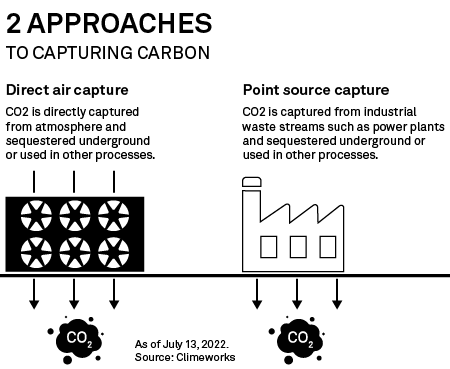
Carbon capture and storage projects corral carbon from a well or power plant and route it to underground storage, while direct air capture scrubs the carbon from the air surrounding the source of emissions. Both are still in the early stages of development and scaling up for widespread use.
The global outlook said countries and companies are "sowing the seeds of an energy transition." Investment in clean technologies is at an all-time high, the outlook said, but more investment is required as fossil fuel use increases worldwide.
"This trend will need to accelerate if the world is to have any chance of limiting global mean temperature rise to 1.5 degrees C or 2 degrees C by 2100," the outlook said. "Under scenarios that achieve these climate targets, wind and solar together produce more electricity in 2050 than all of global electricity generation in 2021."
Investment dollars are pouring into clean technologies, the outlook said, but more is needed to get the world on a path to lower carbon emissions.
In the US, a record 51 new carbon capture projects started in 2021, according to the Clean Air Task Force, spurred by changes in tax codes that increased tax credits for captured carbon.
S&P Global Commodity Insights produces content for distribution on S&P Capital IQ Pro.