


7 Apr, 2022
Power sector unfazed by EU's ban on Russian coal imports, despite high coal burn

|
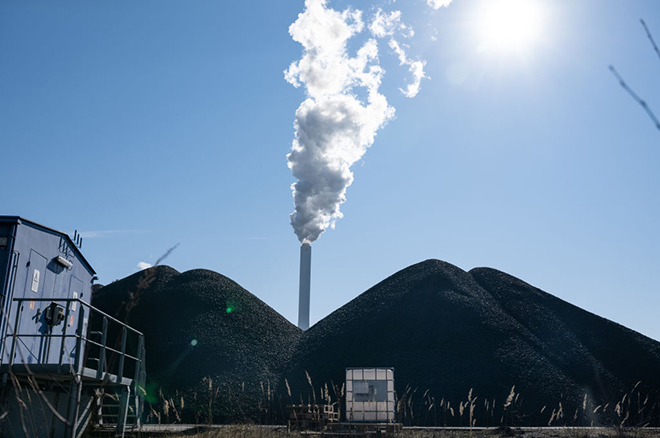
Piles of coal in front of a smokestack at the coal-fired Farge power plant near Bremen, Germany. |
The EU's proposed import ban on Russian coal due to the war in Ukraine is seen as largely symbolic given the well-supplied global market for the fuel, but countries will still need to move quickly to secure alternative stocks, given the high levels of coal burn by power stations.
"It was high time to take this step," European Commission President Ursula von der Leyen said in a speech April 6, a day after announcing the ban in the EU's fifth package of sanctions against Russia. "It is the first time that we directly sanction the import of fossil fuels from Russia, thus cutting an important revenue source."
The ban equates to €4 billion per year, von der Leyen said; about half of the EU's imported coal comes from Russia. Discussion among EU member states is ongoing, and until the package is adopted, details on the exact scope of the coal sanctions are unknown.
In practical terms, an import ban is unlikely to have wide-ranging repercussions in the coal market, given the plentiful volumes available from elsewhere, analysts said. Instead, it might be viewed more as a signal to Moscow that energy-related sanctions are not off-limits. Von der Leyen confirmed that the bloc is looking at potential sanctions on Russian oil imports, for instance, which account for much larger trading volumes than coal.
"This coal ban is symbolic," Georg Zachmann, senior fellow at Brussels-based think tank Bruegel, said in an interview. "The effects ... will be a big rebalancing of coal flows on international markets without much of a physical impact for Russia or the EU."
Others think that the significance should not be underplayed, given the EU's reliance on Russia for its coal imports.
"To slap a general import ban on another country ... in normal times would be a huge deal," Kristian Ruby, secretary-general of European utilities group Eurelectric, said in an interview, adding that the sanctions are "not as high stakes as an oil and gas ban would be."

High coal burn
While the EU should be able to find alternative supplies in what Zachmann described as a "liquid and fungible" global market, it will have to do so relatively swiftly. Coal-fired power stations in the bloc are operating at levels not seen in some time.
The EU depends on Russia for just under 70% of its imports of thermal coal, which is used in electricity generation, according to Bruegel.
An ongoing global gas crunch saw coal-fired power generation rebound in 2021, increasing nearly 20% in the EU to 421 TWh, according to energy think tank Ember. Globally, coal generation was up 9% to an all-time high of 10,042 TWh, Ember said.
That trend continued into the first quarter of 2022, with EU coal generation about 12% higher compared to the year-ago quarter, according to a preliminary analysis by Bruegel. Gas generation is also on the rise, offsetting declines in nuclear and hydropower, which has suffered from dry conditions in Europe.
Coal consumption is also increasing as the EU and individual countries take steps to reduce their reliance on Russian gas imports. The EU wants to slash its reliance on Russian gas by two-thirds by the end of 2022.
"I would not see any significant gaps here," Zachmann said about the ability of coal-fired power plants in the EU to replace Russian imports and continue operating. Operators typically keep coal stocks for several months, which will need to be replenished from other sources before they run out, the researcher said.

Germany in the spotlight
Germany, whose new government is expediting plans to phase out the fuel by 2030, saw its coal generation rebound 24% in 2021, Ember data showed.
The country, the largest importer of Russian coal in the EU, relied on Russia for about two-thirds of thermal coal imports in 2020 along with 10% of its thermal coal consumption, according to a Bruegel analysis of data from Eurostat, the EU's statistics office.
As such, coal operators in Germany already have Russia front of mind.
A spokesperson for Sweden's Vattenfall AB said the company began seeking alternative imports when the Ukraine invasion began and, since then, has stopped sourcing coal from Russia entirely. German power producer Steag GmbH's reliance on Russian coal imports was already relatively small and declining before the war, and the company can "easily compensate" for that share from other sources, a spokesperson said.
Utility EnBW Energie Baden-Württemberg AG imported about 86% of its hard coal from Russia in 2021, and a spokesperson confirmed that the group began diversifying its suppliers at the end of 2021.
Speaking to analysts March 23, EnBW CFO Thomas Kusterer described the potential for a ban on Russian coal imports as "very unlikely" but said the company would find alternative imports without trouble if necessary. The German association of coal importers said in March that Russian imports could be entirely replaced "in a few months," for example from the U.S., Colombia, South Africa, Australia, Mozambique and Indonesia.
"That risk of not being able to source coal is extremely limited. We don't see that," Kusterer said, adding that existing coal stocks would see the company through to the fall.
"The risk is not [about] running our power stations. It's a potential higher cost in sourcing the coal," Kusterer said. "But ... if we see elevated coal prices, that should also actually transfer in wholesale market prices."
Poland is the EU's second-largest importer of Russian coal. Other countries, such as Italy, the Netherlands, Spain and Finland, import much less coal from Russia on an absolute basis, but they rely on the country for a significantly higher share of their coal imports: 82% in the case of thermal coal in Finland, according to Bruegel.
S&P Global Commodity Insights produces content for distribution on S&P Capital IQ Pro.