


17 Mar, 2022
Glen Canyon hydro output imperiled as dam water drops below critical threshold

By Karin Rives
|
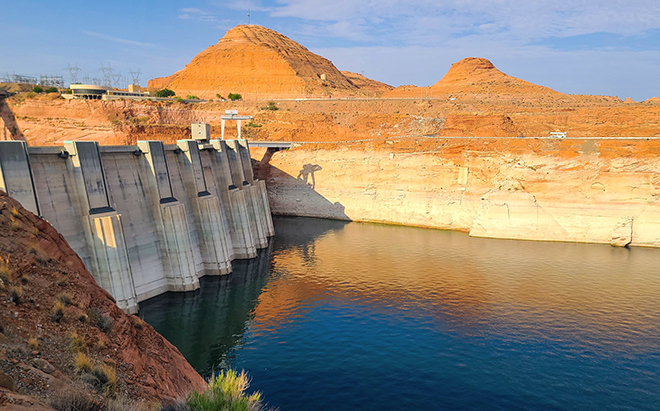
Water levels at Glen Canyon dam, seen in this August 2021 photo, have dropped below a critical threshold of 3,525 feet, threatening hydropower operations. |
An abnormally dry western U.S. winter season this year has left Lake Powell in Arizona with record-low water levels, threatening to shut down production at the Glen Canyon hydroelectric plant absent strong spring runoff.
The U.S. Bureau of Reclamation, which operates the 1,312-MW facility, said water in the dam above the plant's eight generators dropped below the critical level of 3,525 feet on March 16. That leaves just a 35-foot buffer before there would no longer be enough water for power production.
The drought in the western U.S. has significant implications for the Western Area Power Administration, the federal agency that sells and delivers the hydropower, and the 40 million end-user customers it serves.
In 2021, the agency, known as WAPA, could only supply 80% of the power it markets on average. To make up for the shortfall, WAPA had to spend nearly $457 million on wholesale power purchases, according to the agency's annual report. Such costs translate into an 11% rate increase for WAPA customers between December 2021 and December 2023.
Water releases curtailed
The Bureau of Reclamation has sought to keep water levels in the Glen Canyon Dam above the critical threshold by releasing some 161,000 acre-feet of water from other reservoirs in the Upper Colorado River Basin in 2021. The agency also decided to hold back releases from the dam between January and April, with plans to increase the water flow later in the year.
"The combined impact of these proactive actions ensured that Lake Powell will avoid dropping significantly below the target elevation of 3,525 feet during the spring of 2022," the Bureau of Reclamation wrote in a March 4 news release.
Beyond this year, the agency is "actively exploring" modifications to the dam itself to allow it to produce power below the current minimum power pool elevation, the agency added in an email.
Glen Canyon Dam, the second-largest concrete dam in the U.S., began operating in 1964 to provide power to seven of the 15 states WAPA serves. The Lake Powell reservoir in northern Arizona, a major recreational area, was created when Glen Canyon on the Colorado River was flooded by the dam structure.
Scientists: Worst drought in 1,200 years
Concerns over hydropower capacity at Glen Canyon Dam and the larger Hoover Dam on the Arizona-Nevada border have been voiced for more than a decade as drought has gripped much of the West.
Scientists say human-made climate change has fueled the two-decade-long dry spell. Citing another year of disappointing snow and rainfall in 2021, a study published by the journal Nature Climate Change in February said the West last suffered a megadrought like this 1,200 years ago.
The U.S. Drought Monitor reported March 17 that parts of California have experienced record dryness in 2022, which in turn, has left reservoirs at their lowest level so far. The weekly publication is produced by the U.S. Department of Agriculture, the National Oceanic and Atmospheric Administration and the University of Nebraska-Lincoln.
S&P Global Commodity Insights produces content for distribution on S&P Capital IQ Pro.