


21 Dec, 2022
San Juan carbon project canceled after 4-year effort to save aging NM coal plant

By Karin Rives
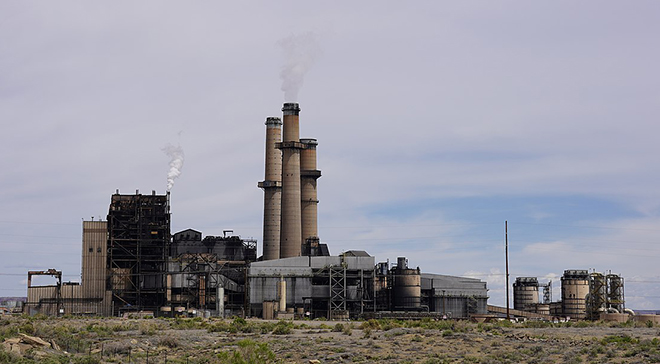
| Decommissioning of the 847-MW San Juan Generating Station in New Mexico will proceed as planned after a long-shot plan for a carbon capture project was tabled. Source: Steven Baltakatei Sandoval/Wikimedia |
A plan to build a $1.6 billion carbon capture facility in New Mexico is officially off the table after the City of Farmington withdrew from the project. The decision caps four years of increasingly tense negotiations, litigation and arbitration involving the city, partner Enchant Energy and the owners of the idled San Juan Generating Station.
Majority owner PNM Resources Inc. is planning to submit a plant decommissioning plan to San Juan County in the coming days and begin lining up contractors to proceed with the work, Tom Fallgren, PNM's vice president of generation, said in a Dec. 21 interview.
"There is no reason we wouldn't want Farmington and Enchant to move forward with this project; it would have provided jobs and other benefits," Fallgren said. "The fundamental issue was that Farmington and Enchant couldn't provide assurances they would protect our customers from additional liabilities. We went far beyond our contractual obligations to negotiate with them."
Auction of plant equipment continues
An arbitration panel earlier this month denied an emergency petition by Enchant Energy and the city to halt the auctioning of plant transformers and other equipment. The auction, which began in October to prepare for the plant's decommissioning, would cause "an existential-level risk" and make a restart difficult, Enchant Energy and the city said.
The arbitration panel's decision caused a "catastrophic blow" to northwestern New Mexico's carbon capture aspirations, the city said in a Dec. 20 press release.
San Juan is the second carbon capture project at a U.S. coal-fired power plant that met its demise in 2022. In September, NRG Energy Inc. sold the Petra Nova facility to its Japanese partner for a $3.6 million bargain price. The Houston project was suspended in 2020.
Critics of using carbon capture to prolong the life of coal-fired power plants have pointed to the high cost and lack of investment interest. They also have questioned the technology's ability to capture much climate-warming pollution. The Petra Nova facility, the only carbon capture project at a power plant to have operated in the U.S., had long outages that affected its capture rate.
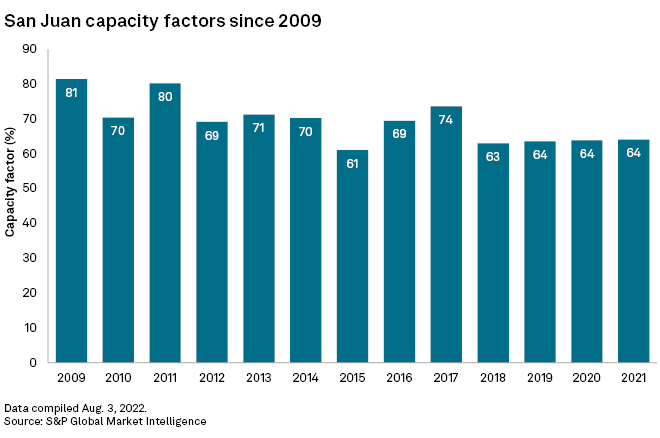
Carbon capture startup Enchant Energy and Farmington have maintained that their retrofit of San Juan would keep 95% of the flue gas from escaping the 50-year-old plant, which has operated far below capacity in recent years.
Mayor blames failure on PNM, state transition law
The San Juan project would have created 3,200 permanent jobs in an economically struggling region and generated $1.3 billion in local tax revenue over a 30-year period, the partners said in a front-end engineering design study funded in part by the U.S. Department of Energy and published in November.
Farmington Mayor Nate Duckett blamed PNM's profit motives and New Mexico's 2019 landmark Energy Transition Act for the project's failure and said the city's utility rates will continue to rise as a result.
On Dec. 16, the Farmington Electric Utility System, or FEUS, announced a rate hike it said would result in an average monthly bill increase of $9. High natural gas prices and tight energy supplies in the Western market caused the rate hike and the September closure of the San Juan plant has not helped, Duckett said in a press release.
Closing the San Juan plant "means that [FEUS] will be required to either build additional capacity or buy electricity from the market, both of which would increase customer rates and incur costs associated with the city's stranded assets" in the plant, Duckett said. "Unfortunately, profit and the [Energy Transition Act] have taken precedence over the livelihoods of real people and families."
Wall Street investors sold 'snake oil'
But Mike Eisenfeld of the San Juan Citizens Alliance, an environmental group long critical of the proposed project, said the city failed to do due diligence when little-known Wall Street investors with no background in carbon capture technology showed up four years ago to discuss the project.
The proposed plant retrofit never secured the permits or funding needed to move forward, yet its proponents pretended that it was a viable project, Eisenfeld said in an interview.
Had the city instead invested in renewable resources several years ago, city residents would have been spared rate hikes, the San Juan Citizens Alliance has argued.
"It was snake oil," Eisenfeld, himself a Farmington resident, said. "At some point, we need some answers from Farmington and from the DOE."
The Energy Department provided $25 million in grants to study the feasibility of using carbon capture at the San Juan plant and to explore wells in northwestern New Mexico where the carbon would have been injected. The City of Farmington had spent $2 million on legal bills as of September.
The DOE did not immediately return a request for comment.
S&P Global Commodity Insights produces content for distribution on S&P Capital IQ Pro.