


17 Nov, 2022
Argentina's Catamarca seeks Australian tech transfer to maximize lithium boom

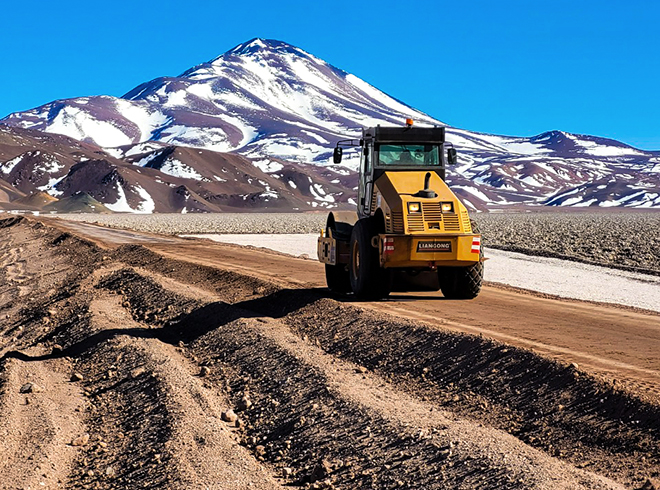
| Project management firm Audes Construcciones is working on Zijin Mining Group's 3Q lithium brine project in Argentina's Catamarca province. Source: Audes Construcciones |
Argentina's largest and oldest lithium-producing province is seeking technological help from Australia to capitalize on the investment frenzy it has enjoyed over the past year on the back of soaring prices, and to address local challenges.
Catamarca Vice Governor Rubén Dusso and representatives from the province's mining and energy departments met Western Australia's Mines Minister Bill Johnston Nov. 7 to discuss how the Australian state can aid Argentina's nascent lithium industry, leveraging a 2018 memorandum of understanding between both Argentina and the Australian state that covers cooperating in the development of mineral resources.
The Catamarca delegation also inquired on how Western Australia regulates the lithium industry, including royalties, and how it balances state and federal permitting, Dusso told S&P Global Commodity Insights.
"Catamarca is seeing a big influx of investment. The most important thing is to be able to develop local providers so none of that gets lost," Dusso said.
The delegation also attended a mining conference in Sydney earlier in November to meet local mining equipment and technology service providers.
Much of the heavy machinery in Argentina is dedicated to agriculture, and Catamarca is looking toward Australia for a technology transfer to advance its lithium industry. "We want to build more of our own mining equipment, like drill rigs, which Argentina miners currently need to import."
China's Zijin Mining Group Co. Ltd. is building a $380 million lithium carbonate plant at the 3Q brine project in the province as part of a wave of investments into Argentina's lithium industry.
Pennsylvania-based Livent Corp. unveiled a slate of projects to lift its lithium carbonate capacity to 100,000 tonnes by 2030, with a number of expansions planned for its Argentinian operations. South Korean steelmaker Posco Holdings Inc. plans to invest $4 billion to produce up to 100,000 t/y of lithium hydroxide in the country. Earlier this year, Rio Tinto Group completed its $825 million acquisition of Rincon Mining Pty. Ltd.'s Rincon lithium project in the Salta province.

Positive collaboration talks
The Australian side also showed a willingness for further collaboration. "I was pleased to meet with the Catamarca delegation during their recent visit to Western Australia and welcome the opportunity to engage further in the future," Johnston said in a statement to Commodity Insights.
The Catamarca delegation also met with the Chamber of Minerals and Energy of Western Australia Nov. 8 in Perth. The chamber regularly meets delegates from other mining jurisdictions to discuss opportunities and challenges, and share information on best practices. "Both Western Australia and Argentina boast significant lithium operations, with the Catamarca province being home to hard rock lithium deposits — the same type that we mine in Western Australia," a chamber spokesperson said in an email interview.
Australia produces at least eight times more lithium than Argentina, despite the latter holding the most reserves and resources in the world and nearly triple those held Down Under, according to S&P Global Market Intelligence data.
"Half the world's lithium is mined in Western Australia, whose industry is also the most advanced in the world. So [a collaboration] would benefit our province," Dusso said.

Local capacity challenges
Despite the influx of investments into Argentina's lithium sector over the past two years, the country’s own "lithium table" — comprising the provinces of Catamarca, Salta and Jujuy — is struggling to acquire skills and equipment that are needed to develop its upstream and downstream industry.
Catamarca, Salta and Jujuy ratified an interprovincial treaty in October 2021 to create a "lithium mining region," which in part ensures that miners use local contractors, Dusso said.
However, sourcing local labor is currently the region's biggest challenge in developing lithium projects, Dusso said.
Competition for labor and equipment is already tight across other mined commodities, Sebastian Fu, director of international operations at Audes Construcciones told Commodity Insights. "The problem is particularly acute for lithium mining because of the current high prices, which miners are trying to take advantage of to produce and sell their product."
Fu said Catamarca, Jujuy and Salta all require that most of their contractors and their workers are sourced from within the provinces. While exceptions to the rule may be made if local providers are not available, "when you want to develop local contractors to have enough competency, equipment and expertise to service the mining sector, you need to bring in external forces to form joint ventures with local groups to complete work," Fu said.
Sourcing steel also presents a challenge in Argentina. Steel structures are not allowed to be imported as companies are expected to buy them from local suppliers, Fu said.
Local providers are sometimes more costly with longer waiting periods due to equipment shortages. The situation is exacerbated by Argentina's currency devaluation, which makes it hard to import equipment.
"So you are stuck waiting to hire certain pieces of equipment, which may not be immediately available. For example, for simple 25-tonne-capacity loading trucks, the estimated waiting time currently is about six months," Fu said.
S&P Global Commodity Insights produces content for distribution on S&P Capital IQ Pro.