


13 Jan, 2022
Banco do Brasil issues 1st social bond as ESG wave seen to continue in 2022

By Steven Baria
Banco do Brasil SA's first-ever social bond issuance serves as a bellwether for Brazilian companies that would want to continue riding the ESG wave this year.
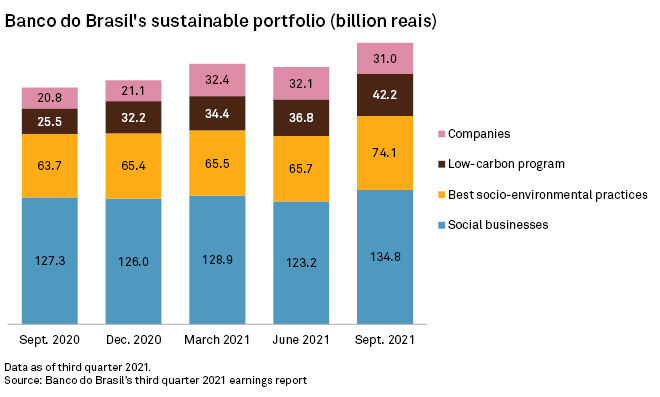
The state-owned Brazilian lender on Jan. 11 priced its $500 million bond, with a seven-year term and a yield of about 5%. The company said proceeds from the offering will be used to fund social projects, such as the Fies education loan program and credit lines for micro and small companies as well as agriculture.
Banco do Brasil's offering comes after a historic year for sustainability-linked issuances in Brazil. The total amount of these securities reached 84 billion reais in 2021, up 180% from a year ago, according to Brazilian newsletter Brazil Journal, citing data from a survey by green bond certifier SITAWI. Last year also saw the rise in the number of Brazilian companies that previously had not offered green bonds getting into the trend, SITAWI Executive Director Gustavo Pimentel said.
Growth in green bonds should continue despite a difficult year dominated by prospects of a slowing global economy and weak overall expectations for capital offerings. Sources told GlobalCapital that Banco do Brasil and Banco Bradesco SA, which also priced a $500 million bond this week, had to pay concessions at double-digit basis-point figures to proceed with their offerings given currently volatile financial conditions.
"Considering a year with increasing interest rates and lower economic prospects, we might expect eventually similar or even lower total issuance volumes [from last year], but the participation of ESG bonds will probably increase," according to Sergio Garibian, an analyst for S&P Global Ratings.
According to a 2018 report by BlackRock Investment Institute, ESG-linked portfolios tend to underperform during periods when higher-yielding investments are preferred, but are more buoyant during economic downturns. The organization also believes that green portfolios could even outperform in the long run, as sustainable offerings and climate risks increase.
Garibian noted that the possibility of "greenwashing" also rises as more companies issue ESG bonds. "Everybody wants to issue something green, so that's why there is probably a change in the composition [in the total offerings]," he said.
However, Banco do Brasil has a clear goal to support overlooked sectors. "It has been the bank's mandate for many years as they play the role for the government to support sectors such as agriculture and, in particular, small and [medium-sized] enterprises, given that other banks may not be interested in this segment," S&P Global Ratings analyst Cynthia Cohen Freue said.
The bank will use about 40% of the bonds' proceeds for agribusiness, according to Guilherme Machado, another analyst for the rating agency. "It makes sense for Banco do Brasil to be part of it since they are by far the largest player in this segment," he added.

The bank's entry into green offerings also highlights the partnership between Brazil's development-focused banks and multilateral organizations. Banco do Brasil's social bond was supported by the Inter-American Development Bank, which helped in coming up with the bank's sustainable finance framework, focused on the inclusion of low-carbon agriculture operations, among others.
"Even before [Banco do Brasil's social bond], we had many banks with operations that had a sustainable purpose, but were not defined as green bond per se," Machado said. "We have many development banks in the region that have partnerships with multilateral agencies, so I think this is a continuation from what we already have in the country."
As of Jan. 12, US$1 was equivalent to 5.56 Brazilian reais.
This S&P Global Market Intelligence news article may contain information about credit ratings issued by S&P Global Ratings. Descriptions in this news article were not prepared by S&P Global Ratings.