Legacy issues related to U.S. sanctions compliance have continued to dog banks across the globe, with Mashreqbank PSC becoming the latest lender in the Middle East to reach a settlement with U.S. authorities.
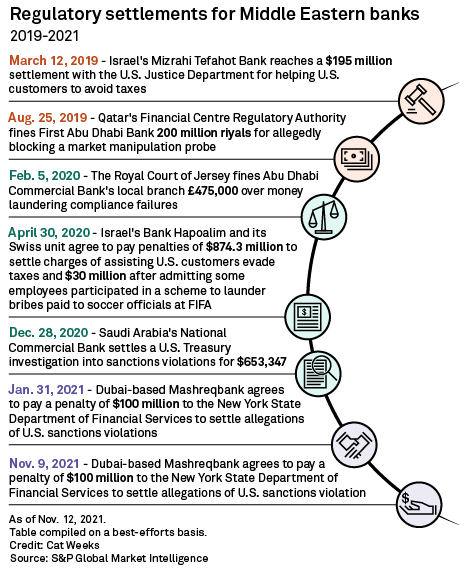
The fifth-largest bank in the United Arab Emirates by assets said Nov. 10 that it had agreed to pay $100 million in penalties to the New York State Department of Financial Services to settle allegations that it violated U.S. sanctions. The bank also reached deals with the U.S. Department of the Treasury's Office of Foreign Assets Control and the Federal Reserve Board to settle similar allegations, although these do not include any fine.
Mashreqbank is accused of illegally processing, through its London branch, about $4.09 billion of payments tied to Sudan between January 2005 and February 2009. Sudan came under U.S. sanctions in 1997 for supporting international terrorism and human rights abuses. It was removed from the U.S. list of state sponsors of terrorism in December 2020.
The Dubai-based bank said the U.S. authorities recognized its cooperation and commitment to building an effective and sustainable compliance program.
"Mashreq is committed to complying with all laws and regulations governing our industry and fully cooperated with these government regulators on this matter," it said.
The Office of Foreign Assets Control has issued 36 bank fines ranging from $12,500 to $8.9 billion between 2010 and 2019 for sanctions violations, data from financial market information provider Refinitiv showed.
Mashreqbank did not mention in its financial report for the nine months to September-end whether or not it had provisioned for the fine, while reporting general and administrative expenses of 1.91 billion dirhams for the period, up from 1.88 billion dirhams a year ago. The bank's profit attributable to owners of the parent was 265.1 million dirhams, down on a yearly basis from 352.0 million dirhams. Third-quarter attributable profit was 179.7 million dirhams, compared to a year-ago loss of 183.1 million dirhams.
Other news
* Israel's Bank Hapoalim BM reported third-quarter net profit attributable to shareholders of the bank of 1.21 billion shekels, up from 816 million shekels a year ago. The bank reported a reversal on provision for credit losses of 252 million shekels in the period, compared to a provision of 193 million shekels in the third quarter of 2020. The bank's nonperforming loans are at pre-COVID-19 levels, CFO Ram Gev told analysts at the presentation of the bank's results.
* Israel-based Mizrahi Tefahot Bank Ltd.'s third-quarter net profit attributable to shareholders stood at 845 million shekels, compared to 387 million shekels in same period a year ago. For the first nine months, the bank's net profit attributable to shareholders rose year over year to 2.51 billion shekels from 1.10 billion shekels.
* The Bank of Israel mapped out new measures aimed at bolstering competition in the mortgage market, requiring banks to present potential borrowers with uniform interest rate options, among other things. It comes as the market saw the value of new mortgages rise to more than 82 billion shekels in the first nine months of the year amid an increase in house prices and low interest rates, Bloomberg News noted.
* The Abu Dhabi Securities Exchange, along with the emirate's Department of Economic Development, submitted a proposal to the UAE's Securities and Commodities Authority for the development of what it said would be the Arabian Gulf's first regulatory framework for special purpose acquisition companies.
* Moody's revised to stable from negative the outlook on the long-term deposit ratings of nine Saudi Arabian banks including The Saudi National Bank, Al Rajhi Banking & Investment Corp., Riyad Bank, Banque Saudi Fransi and Arab National Bank, citing the lenders' resilient performance and the capacity of the government to support their operations.
* Kuwait's central bank is reviewing alternative options to Libor and requested local banks conduct a study on their exposures, contracts and data on Libor-related transactions, Al-Jarida reported.
* The Egyptian government is rolling out incentives to drive stock market activities, including lowering trading expenses on the local bourse and services charges for clearing, Daily News Egypt wrote. No tax files will also be opened for individuals investing in the stock exchange as part of the package of measures.
* Lebanon-based Blom Bank SAL reported profit attributable to equity holders of the parent of 171 million pounds for the nine months to September-end, against 83.43 billion pounds a year ago. It followed the August completion of the bank's sale of its Egyptian unit to Bahrain-based Arab Banking Corp. (BSC), or Bank ABC, for $425 million.
* CEOs of banks in Tanzania are no longer allowed to stay in the position for more than 10 years under new rules by the country's central bank, Bloomberg reported. The central bank is also prohibiting elected officials from joining the boards of financial institutions.
Abdelghani Henni contributed to this article.


