


22 Nov, 2021
ERCOT draws criticism after release of winter grid assessment
|
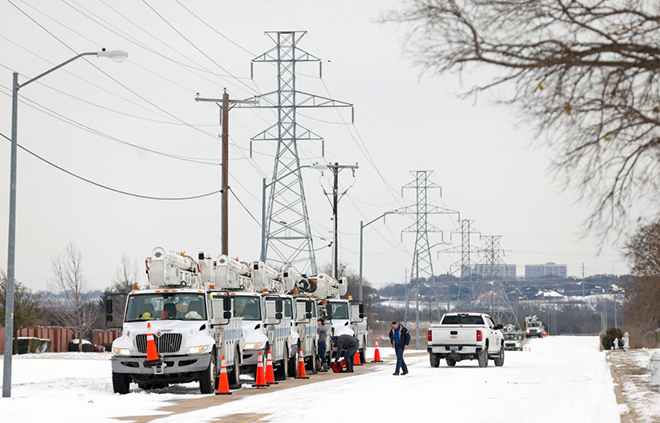
Electricity service trucks line up in Fort Worth during the massive February winter storm, which brought historic cold weather and power outages to Texas. Source: Ron Jenkins/Getty Images News via Getty Images |
The Electric Reliability Council of Texas Inc. released its annual winter assessment of resource adequacy for the electric grid late on Nov. 19, forecasting that peak demand from December to February will reach just over 62,000 MW.
The grid operator further forecast that nearly 85,000 MW of resource capacity will be available for the winter peak, leaving a reserve margin of 43%.
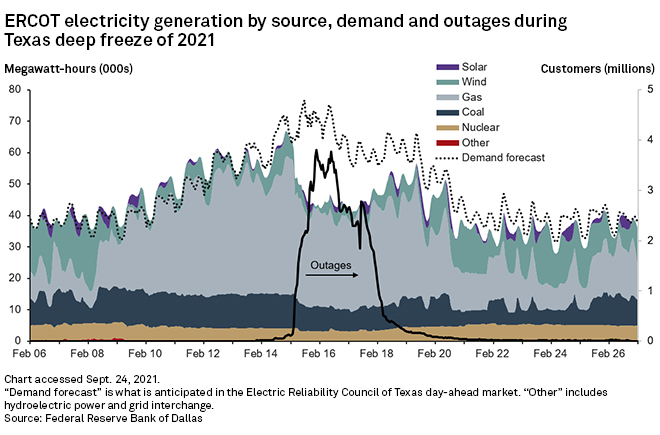
ERCOT predicted 72,772 MW of peak demand in its most extreme scenario. That is lower than the 76,800 MW of peak demand during the deadly February winter storm that nearly took down the entire power grid. Researchers at Texas A&M University said peak storm demand reached more than 80 GW.
"Assuming that the ERCOT region experiences typical winter grid conditions, ERCOT anticipates that there will be sufficient installed generating capacity available to serve the systemwide forecasted peak demand for the upcoming winter season," the report said.
ERCOT modeled its peak load off a 2011 winter storm that caused widespread blackouts.
Andrew Dessler, a professor of atmospheric sciences at Texas A&M, said in an interview that ERCOT made a "huge mistake" in not modeling for a winter weather scenario as extreme as February's storm. Dessler said ERCOT only uses the past 15 years of historical data to make such forecasts, and the agency does not make its modeling public.
"For a $200 million organization, that just seems insane that they don't use more modern tools to estimate climate variability," Dessler said.
He added that the 2011 storm was a one-in-10-year event, whereas the 2021 storm was a one-in-75-year event. If ERCOT modeled off an extreme event that occurred every 20 years, "they're going to predict the extreme peak load is much higher, and it's going to become quite clear that Texas doesn't have enough power," Dessler said.
"They're rolling the dice," Dessler said. "I have to say, nine times out of 10, it's a bet that's going to pay off. Then they'll be able to say, 'Look at what a great grid we have.'"
ERCOT said in an email that its "aggressive approach to managing the electric grid is continuing, with significant operation improvements over the summer and additional changes planned for the winter. Those include new weatherization rules, power plant inspections and non-compliance penalties, and more available generation compared to last winter."
"While not included in this assessment, it is important to note that electric delivery companies have also enhanced their grid management techniques based on lessons learned," ERCOT said in the email.
Joshua Rhodes, a researcher at the University of Texas at Austin, said in an interview that ERCOT did not need to lay out a scenario in its report that showed conditions like the grid experienced during the February 2021 storm. He does not find value in "planning around half of your power plants being offline."
"There's no way you come out OK in that scenario in any grid, ever," Rhodes said.
"PJM has the most bloated reserve margin ever, and even they would lose power," Rhodes added, referring to the PJM Interconnection LLC.
'We clearly don't have' improved communication
ERCOT, under new leadership, vowed to be more transparent in the months after the deadly Arctic blast left millions without power for days in mid-February.
But ERCOT came under fire for releasing its annual report late on a Friday without notice to the public. Typically, ERCOT provides media outlets advance notice and debriefs journalists on its seasonal assessments. ERCOT did not alert the media to the report's release.
"We were promised improved communications for the winter, and we clearly don't have it," Doug Lewin, an energy consultant and president of Stoic Energy, said in an email, adding that there should have been media availability. " ... I wonder who made the decision to release such an anticipated, important document the Friday before Thanksgiving. (The same document was released the first week of November each of the last four years)."
ERCOT did not address questions about its release of the report.
The Public Utility Commission of Texas on Nov. 22 addressed the resignation of Elaine Mendoza from ERCOT's board. A selection committee appointed by Gov. Greg Abbott and other state politicians hired Mendoza, according to a Nov. 1 PUC announcement. Mendoza, who did not return a voicemail seeking comment, sits on the board of regents for Texas A&M and is the president of a San Antonio medical informatics company.
"Upon reexamination of her duties as regent of Texas A&M University system there was a potential conflict with her role on the ERCOT board," Mike Hoke, spokesman for the PUC, said in a Nov. 22 email. "Texas A&M has a 50MW power generation facility that primarily serves its College Station campus, but does have the ability to sell electricity into the ERCOT market. Accordingly, Texas A&M is a market participant."
A law passed during the spring legislative session, SB 2, "prohibits market participants from serving on the ERCOT board," Hoke said.