


17 Apr, 2023
Federal law preempts Berkeley building gas ban, US appeals court rules

A US Court of Appeals panel found that a federal law preempts Berkeley, Calif.'s 2019 gas ban, overturning a lower court ruling to dismiss a case brought by a California restaurant trade group to overturn the pioneering policy.
The three-judge panel for the US Court of Appeals for the 9th Circuit on April 17 reversed a decision from the US District Court for the Northern District of California and remanded the case for further proceedings.
In rendering the decision, the Appeals Court panel essentially concurred with the California Restaurant Association (CRA). The CRA argued that the federal Energy Policy and Conservation Act (EPCA) preempts the Berkeley gas ban, which prohibited local officials from issuing a building permit for new construction projects that include gas infrastructure within the building.

The EPCA regulates the energy efficiency and use of consumer products and preempts local and state regulations for EPCA-covered products. In a 2019 lawsuit, the CRA argued that the Berkeley ordinance clashed with EPCA's jurisdiction over regulating the quantity of gas consumed in appliances.
Preemption argument prevails
In July 2021, US District Court Judge Yvonne Gonzalez Rogers dismissed CRA's interpretation of the EPCA as expansive and unpersuasive.
In an opinion by Judge Patrick Bumatay, the Appeals Court panel noted that the EPCA "expressly preempts state and local regulations concerning the energy use of many natural gas appliances." While Berkeley did not directly ban those appliances, it took a circuitous route to achieve the same outcome, rendering the equipment useless.
The panel held that the EPCA's preemption provision applies to building codes that regulate gas use in equipment covered by the law. By prohibiting gas piping in new construction, Berkeley prevented those covered appliances from using gas, the panel said.
Judge Diarmuid O'Scannlain said he only reached the opinion that the EPCA preempts the Berkeley gas ban due to 9th Circuit precedent. However, O'Scannlain said the law in this area is "troubling and confused — beset by tensions in Supreme Court precedents, disagreement among the circuits, and important practical questions still unanswered."
Judge M. Miller Baker expressed reservations about the CRA's standing, but regarding preemption, he wrote that "the Berkeley ordinance cut to the heart of what Congress sought to prevent — state and local manipulation of building codes for new construction to regulate the natural gas consumption of covered products when gas service is otherwise available to the premises where such products are used."
Impact of decision unclear
Berkeley was the first California city to pass an ordinance broadly restricting gas use in new construction. The Bay Area policy push has since catalyzed a movement in several states to prohibit gas use in new residential and commercial buildings.
But despite Berkeley's status as a first mover, it was not clear how impactful the Appeals Court decision would be.
In California, most local and county governments opted to follow a model developed in Menlo Park, Calif., which requires all-electric construction through an amendment to the state's Building Energy Efficiency Standards, known as Title 24. Some Golden State cities that initially followed Berkeley's model have since adopted a Title 24-based approach, including Berkeley itself.
Local and state governments have pursued a variety of policy pathways in their jurisdictions, with the Berkeley model becoming less influential in the nearly four years since it was enacted.
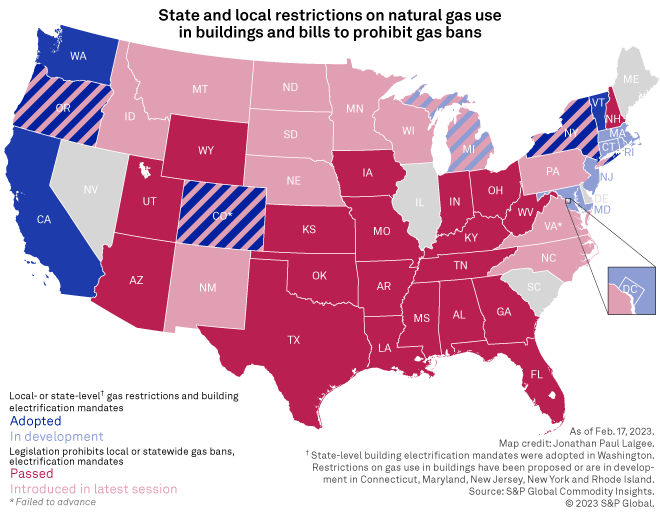
"The vast majority of cities within the 9th circuit and beyond who have passed policies to restrict pollution from gas appliances will not be impacted by this decision, and there are still ample pathways to upgrade new buildings to clean energy technologies," Matt Vespa, a senior attorney at Earthjustice, said in an April 17 press release.
The ruling applies only to the nine states within the 9th Circuit — including Washington and Oregon, where electrification movements have taken root — Vespa noted.
Still, the American Gas Association, which represents the nation's gas utilities and filed an amicus brief on behalf of CRA, applauded the decision.
"The US Court of Appeals for the 9th Circuit took a huge step today that will both safeguard energy choice for California consumers and help our nation continue on a path to achieving our energy and environmental goals," association President and CEO Karen Harbert said in a statement.
Berkeley drew support from environmentalists, the federal government, and a group of politically progressive states during CRA's appeal.
S&P Global Commodity Insights produces content for distribution on S&P Capital IQ Pro.