Research — SEPTEMBER 17, 2026
D-Wave’s bookings to surge in 2026; system sales to drive majority growth

By Vansh Rajput
D-Wave Quantum Inc. (NYSE: QBTS) is facing a test of whether rising demand for quantum computing can translate into more predictable revenue. Its shares are down 43% year-to-date and 29% over the past year, while recent results have highlighted the gap between bookings growth and reported sales. Second-quarter revenue was $3.1 million, essentially flat from a year earlier and below analyst expectations, while CFO John Markovich announced his retirement in August.
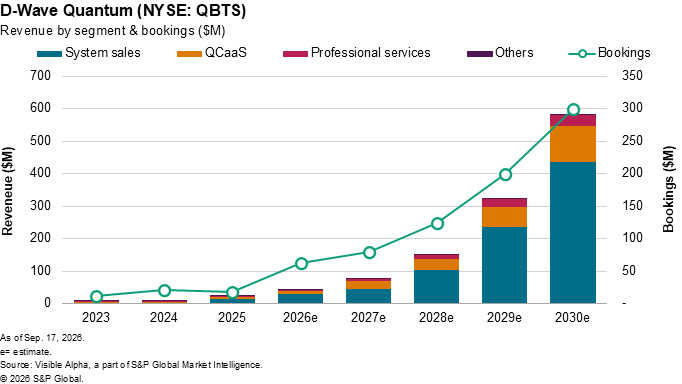
The volatility is partly structural. D-Wave’s $24.6 million of revenue in 2025 jumped 179%, but the increase was heavily influenced by its first quantum-computer system sale. The company’s system sales are recognised as installations progress towards becoming fully operational, meaning the timing of large contracts can produce substantial swings in reported revenue between periods.
Visible Alpha consensus points to another sharp increase in 2026, with revenue forecast to rise 73% year-on-year to $42.5 million. The composition of that growth remains important: system sales are expected to increase 84% to $29.8 million, accounting for roughly 70% of revenue. Quantum Computing-as-a-Service (QCaaS) revenue is forecast to rebound 69% to $9.3 million after declining 18% in 2025, although the segment remains too small to offset fluctuations in system sales. Professional services revenue is expected to grow 52% to $4.1 million.
That mix leaves D-Wave's revenue outlook dependent on hardware deployments. The company itself has said it expects system sales to carry price tags of roughly $20 million-$40 million, while the timing of revenue recognition can extend across several months or quarters.
Bookings, however, offer a different picture. Visible Alpha consensus shows analysts expect bookings rising 234% to $62.5 million in 2026, from $18.7 million in 2025. The gap between bookings and revenue is becoming central to the D-Wave story. Contracts can be signed well before they are recognised as revenue, making bookings a useful gauge of demand while leaving the timing of reported sales less predictable.
The key question is whether this growing order pipeline can develop into a broader and more recurring revenue base. D-Wave’s QCaaS business provides a recurring component, but system sales are still expected to generate the majority of 2026 revenue.
D-Wave is one of the few listed companies focused primarily on quantum computing, alongside IonQ Inc. (NYSE: IONQ), Rigetti Computing Inc. (NASDAQ: RGTI) and Quantum Computing (NASDAQ: QUBT). It also competes for customers and research spending with much larger technology groups including International Business Machines Corp., Alphabet Inc., Microsoft Corp. and Amazon.com Inc..
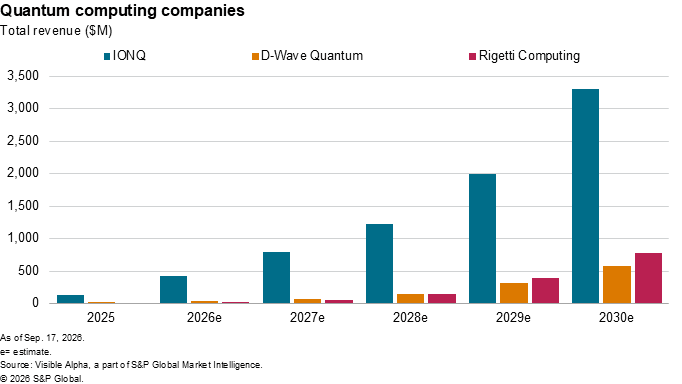
The competitive landscape is also widening for D-Wave. Following its acquisition of Quantum Circuits in January, the company is expanding beyond its established quantum-annealing technology into gate-model quantum computing, giving it exposure to a broader segment of the emerging quantum market.
This article was published by Visible Alpha, part of S&P Global Market Intelligence and not by S&P Global Ratings, which is a separately managed division of S&P Global.
Content Type
Products & Offerings
Segment
