Research — Sep 25, 2026
Gold leads in global new mine additions since 2020
By Jessica Anne Dela Cruz and Jason Holden
Between 2020 and 2025, 329 new mines entered production across 62 countries and 27 commodities, with the commodity mix reflecting the enduring appeal of precious metals and the growing importance of energy-transition minerals. A closer look at the data reveals the countries and metals that commanded the most attention from developers, as well as the industry's shifting center of gravity.

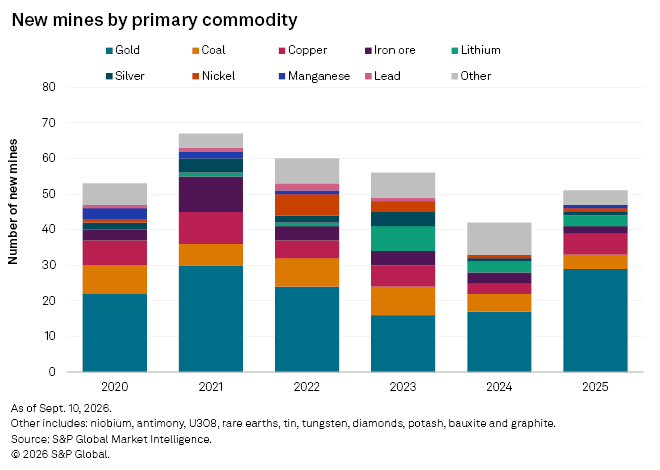
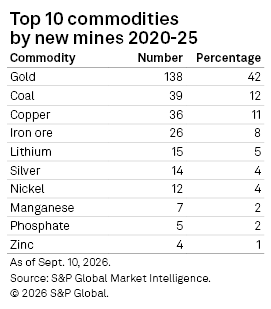
➤ Gold remained the leading commodity, with 138 new mines accounting for 42% of all projects, making it the top commodity each year during 2020-25.
➤ Lithium experienced a breakout, going from zero mines in 2020 to a peak of seven in 2023, driven by the electric vehicle boom.
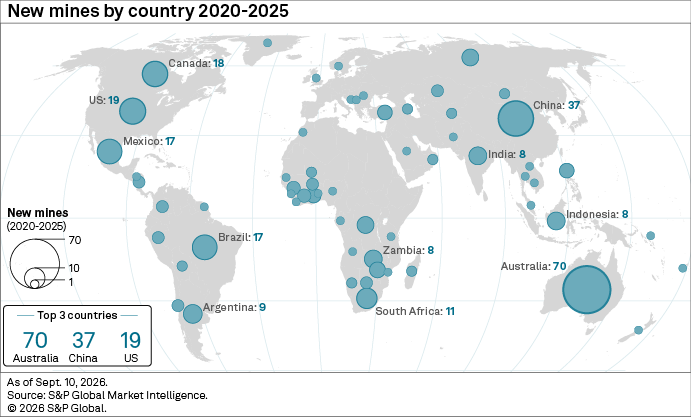
➤ Australia led globally with 70 new mines, outpacing China and the US combined.

Gold maintains preeminence in global mine delivery
With 138 new mines and 42% of all projects, gold was the most-developed commodity over 2020-25 and had the highest mine count each year during the period. The yellow metal was remarkably consistent, with the number of new mines ranging from 16 in 2023 to 30 in 2021. This reflects gold's role as a safe-haven asset amid persistent macroeconomic uncertainty, elevated inflation and volatile geopolitics. As with exploration budgets, when capital seeks refuge, gold projects attract financing.
Australia, Canada and the US accounted for the largest share of new gold production, supported by mature regulatory frameworks, deep capital markets and skilled labor pools. West Africa was also prominent, cementing its status as a major gold-producing hub with projects in Ghana, Burkina Faso, Guinea and Côte d'Ivoire, many of which were structured with government carried-interest arrangements.
Lithium mine development breakout
A total of 15 new lithium mines entered production during 2020-25. The sector began modestly with one addition each in 2021 and 2022, before surging to a peak of seven projects in 2023. Commissioning activity subsequently moderated, holding steady at three additions each in 2024 and 2025 as developers adjusted project timelines to market conditions.
Argentina, Australia and Zimbabwe emerged as key lithium jurisdictions. Argentina's brine operations in the "Lithium Triangle," such as Cauchari-Olaroz and Salar del Rincon, attracted major players, including Ganfeng Lithium Group Co. Ltd. Ltd., Rio Tinto Group, and Lithium Argentina AG. Australia's hard-rock spodumene deposits and Zimbabwe's rapidly developing lithium sector, heavily backed by Chinese capital, form a supply base that will underpin the coming decade of electrification.
Copper's global charge: Grade, geography and the green transition
The global energy transition push is evident in the copper pipeline, with 36 mine starts from 2020 to 2025, as rising demand for green energy technologies drove investment. Africa reemerged as the epicenter of growth, accounting for 11 of the new assets. The Democratic Republic of Congo and Zambia dominated the pipeline, bringing high-grade assets online, including expansions at Kamoa-Kakula and new operations such as Kisanfu and Molefe. The concentration of new copper mines in Africa is partly attributable to ore grade, with some reserve grades on the continent averaging 2%-4% copper.
The pursuit of copper extended beyond traditional hubs in Africa and Latin America. The data reveals a global footprint, with new copper capacity quietly coming online in the Middle East (Oman's Al Hadeetha and Block 4), Eastern Europe (Serbia's Timok and Romania's Baita Plai) and China (Qulong and Zhibula). Besides copper's expanding global footprint in 2020-25, sustained price strength and rising incentive pricing for copper have also expanded the qualification of an economic deposit. This is most evident in the commercialization of mine waste through tailings reprocessing. In Zambia, projects like Roan (Cu and Co Tailings) and the Large Waste Project (Large Copper Tailings Resources), pioneered by operators such as Jubilee Metals Group PLC, came online specifically to extract residual copper from legacy surface waste. It is a clear signal that in the new energy economy, every metric ton of copper counts.
Coal mine development retreats
While coal remained a heavily developed commodity in our dataset with 39 new mines over the period, its trajectory reflects a clear slowdown. Annual additions of coal projects fell from an average of nearly eight mines per year in 2020-23, to five in 2024 and down to four by 2025. This diminishing pipeline reflects tightening climate policy, investor pressure and a focus on the energy transition. In contrast to this project-level slowdown, the International Energy Agency (IEA) reports that total global coal demand increased more than 1.2 billion mt between 2020 and 2025, and is set to increase by a further 1.2% in 2026 to 8.94 billion mt.
Australia accounts for 21% of new mines
No country did more to expand global mine supply than Australia. With 70 new mines — 21% of the world's total and more than China (37) and the US (19) combined — Australia also had breadth in metals; its portfolio spans gold, iron ore, coal, lithium and nickel.
China followed, dominated by coal, gold and copper, while the US was concentrated on gold, coal and a single gold-antimony project at Stibnite Hill. Resource-rich developing nations such as Brazil, Mexico, DRC, Zambia and Indonesia also contributed, particularly in copper and nickel — metals essential to grid infrastructure and batteries.
Balancing tradition and transition
The data paints a picture of an industry balancing two imperatives. On one hand, gold's persistent dominance shows that traditional value drivers — financial security and portfolio hedging — remain as relevant as ever. On the other hand, the rise of lithium and the steady presence of copper and nickel reveal an industry repositioning itself for a decarbonized, electrified future.
Established mining jurisdictions like Australia and Canada continue to offer stability and scale, while emerging battery-metal supply chains in South America, Africa and Southeast Asia present the growth story of the decade. The mines coming online today are laying the foundations for the global economy of tomorrow.
This article was published by S&P Global Market Intelligence and not by S&P Global Ratings, which is a separately managed division of S&P Global.