Research — Sep 15, 2026
Exploration Jurisdiction Power Score, Q2 2026: Reshuffle outside top spot
Our Exploration Jurisdiction Power Score (EJPS) indicates where exploration capital is flowing and where it is pulling back with a single, comparable score across the top 20 mining jurisdictions. Updated quarterly, the index combines three key indicators — drilling activity, initial resource announcements and project milestones — to provide a data-driven view of global exploration momentum. This edition covers second quarter 2026 across gold and base metals.
Due to their size and importance on the global exploration scene, Australia, Canada and the US are broken down to the state and province level, offering a more precise view of where activity is concentrated.

➤ Western Australia remains the benchmark exploration jurisdiction globally, while the competition below the top spot is fluid.
➤ Canada continues to offer broad-based exploration growth, led by Ontario and Quebec. Nevada remains at the top for exploration in the US.
➤ The second quarter of 2026 saw multiple countries — such as Norway, Argentina and Zimbabwe — surge higher in power rankings.
➤ Outside of Western Australia, the power rankings are not due to drilling volume alone. The strongest jurisdictions are those demonstrating both exploration scale and project advancement.

Methodology
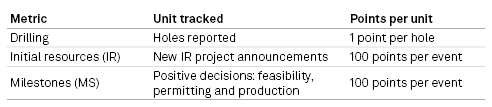
Drilling activity is weighted at one point per hole to reflect its nature as a high-volume, lower-signal metric. Initial resource and milestone announcements are each assigned 100 points, capturing their role as key de-risking events. There is no cap on the combined score, so jurisdictions that perform strongly across all three dimensions are scored accordingly.
Q2 2026 combined power ranking
The second quarter 2026 rankings confirm Western Australia's position as the leading exploration jurisdiction, while a flurry of movement in the lower rankings underscores the sector's dynamic nature. Western Australia recorded 4,094 points, up slightly from the previous quarter but still markedly lower than its fourth quarter 2025 score of 5,486. Stronger drilling activity compensated for fewer milestone achievements and the lack of new initial resource announcements.
Nevada climbed to second place, supported by an increase in drilling activity and an initial resource announcement, whereas Ontario dipped to third after being buoyed by initial resource announcements in the first quarter.
The reshuffled middle of the table reveals meaningful shifts, with some jurisdiction movement within Australia (South Australia rising into the top 10 at No. 9) and Canada (New Brunswick moving up to 19th and the Yukon sinking 13 spots to No. 25). Outside of the top two countries, countries in Africa, South America and Europe also saw significant ranking shifts.

Combined score deltas: Q1-Q2 2026
The delta table captures the full dynamics of exploration momentum, revealing both current leaders and the jurisdictions that are advancing or softening.
The gainers: Argentina, Norway and Quebec stand out as the strongest movers of the period. Argentina's leap to the top 10 was due to an increase in drilling activity, as well as a milestone at AbraSilver Resource Corp.'s Diablillos silver project, where the company announced the completion of the definitive feasibility study, with production targeted by the end of 2029. Drilling activity in the country was led by two Sable Resources Ltd. projects, Zorro and El Fierro.
Norway's jump into the top 20 jurisdictions was due to two milestones at Blue Moon Metals Inc.'s Nussir copper project, which released its feasibility study and began construction, targeting production in 2027.
Meanwhile, gold fueled Quebec's rise to the top five. In April, Amex Gold Mining Inc.'s Perron gold project reached a milestone with the release of its feasibility study and a supporting technical report. Also in April, Maple Gold Mines Ltd. announced an initial resource estimate for late-stage project Joutel, with 8.4 million metric tons grading 4.14 grams of gold per metric ton, containing 1.12 million ounces of gold.
The decliners: British Columbia's drop in the rankings was largely attributable to a sharp decline in drilling activity, with drillhole volumes falling 76%, pushing the province down to 7th place in the power rankings. Although the decline in drilling activity appears significant, it is broadly in line with the province's historical patterns, as drilling volumes have declined quarter over quarter in the second quarter for the past six years.
Chile's loss of momentum was primarily due to the absence of milestone developments and initial resource announcements in the quarter, paralleling Ontario's decline from three initial resource announcements in the first quarter to none in the second quarter.

Projects driving top jurisdictions
Western Australia remains the most actively drilled jurisdiction globally by a wide margin. For the third consecutive quarter, it hosted the majority of the top 20 projects with the most new drillholes.
The top three projects in the second quarter were in Western Australia. With 435 drillholes, Regis Resources Ltd. drilled the most holes at its Duketon Southern Operations gold mine. In April, Regis released its annual mineral resource and ore reserve estimates, which showed growth exceeding the mining depletion at Duketon.
In second place with 310 drillholes was GoldArc Resources Ltd.'s Leonora North late-stage gold project. In third with 287 holes was OzAurum Resources Ltd.'s Mulgabbie North late-stage gold project. Both companies reported grade-control drilling in the quarter, which will be used in updating models and mine plans.
Canada had more project milestones and initial resource announcements than Australia, but it trailed in total drilling activity. Its top two drilled projects for the quarter tied for 18th place, with Equinox Gold Corp.'s Musselwhite gold mine in Ontario and Banyan Gold Corp.'s Aurex-McQuesten late-stage gold project in the Yukon each reporting 101 drillholes. Nevertheless, the Yukon slipped in the power rankings.
Nevada topped the power score rankings for the US and was second overall, behind only Western Australia. The state's top drilled project for the quarter was Integra Resources Corp.'s Florida Canyon gold mine.
Côte d'Ivoire was fourth in power score rankings in the second quarter with 470 drillhole points, led by Montage Gold Corp.'s Kone gold project with 148 holes. Zimbabwe jumped to the No. 12 ranking with a surge in drilling at Caledonia Mining Corp. PLC's Motapa late-stage gold project, which reported 186 drillholes, making it the fourth most drilled project in the quarter. Although African projects accounted for 20% of the top 20 drilled projects for the quarter, the region accounted for less than 10% of the total projects drilled.

Leading jurisdictions continue to drive global exploration activity
The EJPS highlights that global exploration activity remains concentrated in a handful of leading jurisdictions, though the sources of growth are becoming more diverse. Western Australia continues to dominate at a scale unmatched elsewhere, yet its quarter-to-quarter fluctuations underscore how even the largest exploration hubs can be affected by changes in a relatively small number of major drilling programs.
Meanwhile, Canada is emerging as one of the strongest and most consistent growth markets. Ontario, British Columbia and Quebec continue to demonstrate steady drilling activity and resource advancement, reflecting sustained project development rather than short-lived exploration surges. Supported by increasing greenfield drilling activity in Newfoundland and Labrador, the Yukon and New Brunswick, Canada is strengthening its position across multiple stages of the exploration pipeline.
Outside these established jurisdictions, Côte d'Ivoire remains a standout, ranking fourth globally, despite drilling activity in the country declining to a four-quarter low. Argentina was among the strongest quarter-over-quarter performers, illustrating how a major milestone and an intensive drilling campaign at a single project can quickly elevate a jurisdiction's standing from a relatively modest base.
Overall, the latest results point to an exploration sector that remains concentrated among a few leading regions while becoming increasingly dynamic beneath the surface. Success is increasingly determined not only by the scale of drilling programs, but also by their ability to deliver discoveries, advance resources, and maintain momentum, shaping where exploration capital is deployed and where future mining assets are most likely to emerge.
Disclaimer
The Exploration Jurisdiction Power Score is intended as an indicative measure of exploration and development activity. Rankings reflect reported activity within the tracked period and may not capture all activity within a jurisdiction. All figures are subject to revision as new data becomes available.
S&P Global Energy produces content for distribution on S&P Capital IQ Pro.
This article was published by S&P Global Market Intelligence and not by S&P Global Ratings, which is a separately managed division of S&P Global.