Research — July 08, 2026
S&P Capital IQ Pro Insurance Pulse: De- and re-mutualization
By Tim Zawacki, Husain Rupawala, and Jason Woleben
Business model transformation has been a critical element of the US insurance industry evolution this decade, including rationalizing corporate structures through conversions of mutual insurance companies into mutual insurance holding companies, or MIHCs.

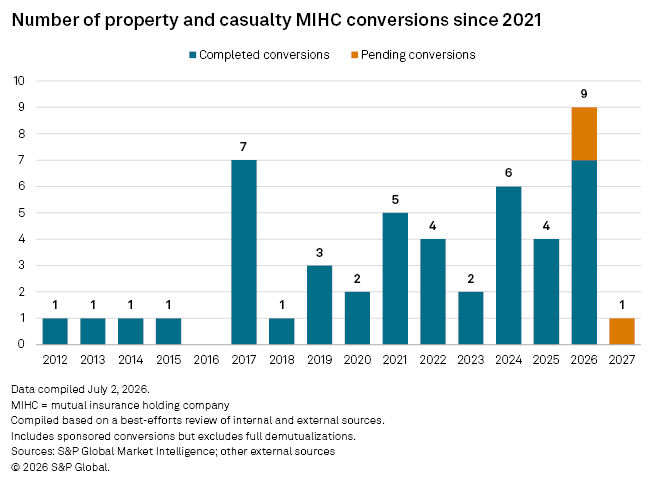
At least nine US property and casualty insurers have closed or plan to close MIHC conversions in 2026, surpassing the previous high of seven in 2017. Another conversion, involving McPherson, Kan.-based Farmers Alliance Mutual Insurance Co., is well on its way to closing at the start of 2027. Conversion statistics represent the byproduct of a best-efforts review of various publicly available sources, as well as statutory filings posted on S&P Capital IQ Pro.
Some of the immediate catalysts for the heightened conversion activity, particularly fallout from elevated Midwestern natural catastrophe losses in 2022 and 2023, appear to be waning as property insurance results have since improved dramatically. But lingering memories of the challenges that ensued, along with the pressing need to invest in new technologies and the competitive need to obtain additional financial and strategic flexibility, should drive activity, perhaps at a lower annual clip.
We also expect the occasional one-off corporate reorganization to emerge, as we have also seen over the past decade. A new Maryland law will allow for an especially novel transaction to take place.

Another P&C MIHC conversion
The pending conversion of Farmers Alliance Mutual, a regional writer of farmowners, homeowners and personal auto coverages, revives a Kansas statute that has sat largely dormant for nearly 30 years.
The insurer's plan follows the typical MIHC playbook — the Kansas mutual becomes a stock insurer beneath a newly formed holding company, with existing policyholders' membership interests preserved rather than extinguished. The stated rationale closely aligns with what similarly situated mutuals have increasingly cited in other states: enhanced ability to pursue acquisitions, invest in technology — particularly non-insurance and insurtech businesses — and access debt or equity capital without disrupting day-to-day operations or the company's mutual culture.
The conversion plan, which has already been subject to a public hearing convened by the Kansas Department of Insurance on April 10 and a policyholder vote on June 26, extends MIHC membership eligibility to policyholders of its two existing stock subsidiaries, Alliance Indemnity Co. and Alliance Insurance Co. Inc. The membership rights allow for participation in certain of the insurer's governance matters and a limited ability to share in its assets upon events such as a liquidation or dissolution. Conversion plans often differ on whether to extend membership rights to subsidiaries' policyholders, and Farmers Alliance Mutual documents express the potential for mutual members' voting rights to be diluted as a result.
The documents also raise litigation risk as a risk factor to the conversion, given the novelty of the company's use of Kansas's Mutual Conversion Act. In place since 1997, it appears to have last been successfully utilized in 1998 by Security Benefit Life Insurance Co., and not at any point, according to our records, by a P&C carrier. The statute arguably found its greatest prominence in 2001 and 2002 with Elevance Health Inc.'s unsuccessful effort to sponsor the demutualization of Blue Cross and Blue Shield of Kansas Inc. A full demutualization differs from an MIHC conversion primarily in that membership interests are extinguished. The Farmers Alliance Mutual documents make clear that the company has no plans to take that step.
Security Benefit Life ultimately demutualized in the wake of the global financial crisis, with control transferred at that time to a Guggenheim Capital LLC-led investor group that had pledged a significant capital infusion into the insurer.
Maryland's re-mutualization statute
There are additional examples of companies converting from MIHCs to fully demutualized stock insurers. Principal Financial Group Inc. represents the byproduct of such a transaction. We have also seen a stock insurer convert into a mutual insurer, albeit under particularly unique circumstances, as Massachusetts savings institutions opted to divest their ownership stakes in Savings Bank Mutual Life Insurance Co. of Massachusetts. A new Maryland statute, however, would enable the re-mutualization of a domestic insurer that had previously converted to an MIHC structure.
Maryland Senate Bill 982/House Bill 1616 passed without opposition in April and was signed by Gov. Wes Moore in May. The bill, consistent with the state's existing mutual-to-stock conversion statute, requires the submission of a conversion plan and requires approvals by a majority of the insurer's board, 75% of its members and the Maryland insurance commissioner.
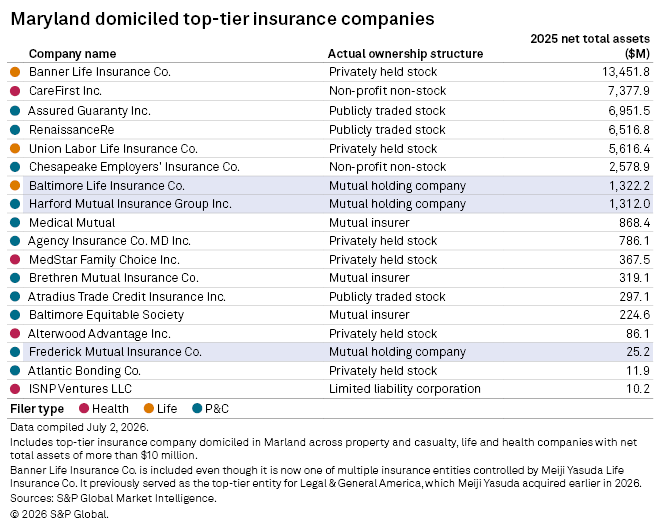
Two P&C insurers, Harford Mutual Insurance Co. and Frederick Mutual Insurance Co., and one life insurer, The Baltimore Life Insurance Co., currently operate in MIHC structures. Harford Mutual and Frederick Mutual converted in 2020 and 2022, respectively. Baltimore Life completed its conversion in 2000.
A Baltimore Life representative provided formal testimony in support of the legislation in March.
"While Baltimore Life was grateful for the ability to convert to a mutual insurance holding company structure, they believe it would benefit Maryland mutual insurance holding companies to have the flexibility to potentially revert to their original mutual insurer structure," wrote Funk & Bolton PA principal Sarah Case-Herron.
The League of Life and Health Insurers of Maryland also signaled its support, stating that the legislation would "provide additional flexibility to Maryland insurers to organize their company in the way that works best for them."
Maryland Delegate Mike Rogers noted that Baltimore Life had "never used the mutual insurance holding company structure to raise outside capital or acquire other insurance companies" and "would like the opportunity to return to their former status as a mutual insurer, if needed, in the future."
Frederick Mutual affiliated with Virginia-based mutual Northern Neck Insurance Co. in December 2025, and the insurers are now parties to an intercompany pooling agreement. Members of Frederick Mutual now control 50.1% of the insurer's intermediate holding company, with Northern Neck holding a 49.9% stake.
While there is no official designation in the statutory insurance data on S&P Capital IQ Pro to isolate MIHCs, several distinguishing features of the organizations are generally evident on insurers' corporate structure pages: the presence of an intermediate holding company and a policyholder-controlled ultimate parent. The "NAIC Ownership Structure" field on our screener application is not always indicative of a converted insurer's status as a stock insurer: Frederick Mutual, for example, continues to list itself as a Mutual Company.
This article was published by S&P Global Market Intelligence and not by S&P Global Ratings, which is a separately managed division of S&P Global.