Research — July 02, 2026
S&P Capital IQ Pro Insurance Pulse: Schedule BA and rate filing approval time
By Jason Woleben and Tim Zawacki
The activities of state insurance regulators remain in focus amid continued headlines about the intersection of insurance and the private markets. But for many people in the US, the most immediate insurance-related concerns vis-à-vis regulators continue to pertain to the availability and affordability of homeowners insurance coverage even after multiple successive periods with relatively light catastrophe losses.

Improvements in the nature and scope of investment-related disclosures have been some of the most tangible signs of the ongoing efforts in the evolution of regulatory oversight. The National Association of Insurance Commissioners effected a new framework for determining whether specific assets qualify for classification as bonds at the start of 2025, then overhauled the categorization of investments in the schedule containing loan- and security-level reporting on bond holdings. These changes also impacted the categorization of other long-term invested assets, including some debt securities that had been reported as bonds in 2024 and prior, on Schedule BA. This new reporting has taken on new relevance in recent weeks, with The Wall Street Journal's publication of an article highlighting growth in private funds investing among US property and casualty insurers.
Managing the fallout from natural catastrophe risk also remains a key priority for state insurance regulators as carriers continue in a number of markets to raise rates, institute peril-specific deductibles and refine underwriting processes. The industry has been challenged in its response to elevated natural catastrophe losses in 2022 and 2023, which occurred at the same time carriers faced loss-cost inflation from post-pandemic supply chain and labor market disruption, in part due to material inconsistencies in its ability to raise rates in as timely a manner as desired. An upcoming November 2026 state insurance commissioner election in California, the state where the industry has struggled the most in recent years to implement needed rate changes, could result in dramatic adverse changes that would go beyond the limitations and restrictions imposed nearly four decades ago by Proposition 103.

Schedule BA holdings
The introduction of new reporting fields on Schedule BA to accommodate reclassified bonds likely served as the most noticeable change in that section of the 2025 annual investment schedules, but they were not the only ones.
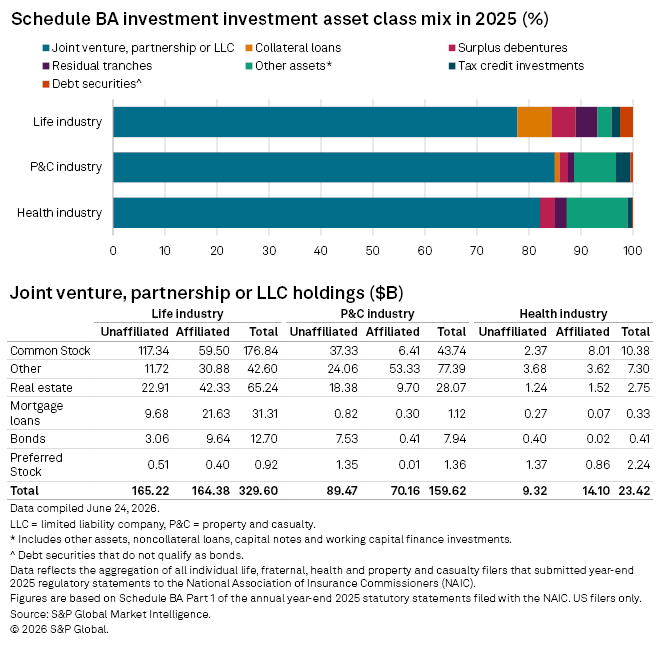
The 2025 annual statement blanks also tweaked the reporting of interests in joint ventures, partnerships or limited liability companies, which most notably includes stakes in private equity, venture capital and hedge funds, to consolidate non‐registered private funds. Those funds, which had been broken out into unique categories under the previous reporting, accounted for just 1.6% of the US life industry's Schedule BA fund interests at year-end 2024. These changes create challenges in tracking allocations to certain types of funds between the old and new reporting, but the composition of the major line items — affiliated and unaffiliated interests with characteristics of common stock — are essentially unaffected.
It is on this basis that the Journal's reporting focused on consistent increases in allocation to Schedule BA funds in the P&C industry at a time when much of the focus on the intersection of the private markets and the insurance industry has been on life and annuity carriers.
When compiling all of the Schedule BA funds data under the 2024 and 2025 reporting formats, we found, based on data compiled June 24, that P&C and life sector general accounts positions at year-end carrying values increased by 9.8% and 8.8%, respectively, to represent 5.8% and 5.3% of total cash and invested assets. Aggregate carrying values of interests with characteristics of common stock increased by 10.4% for the P&C sector and 4.7% for life general accounts, the former of which represented a four-year high and the latter of which compared unfavorably to the comparable growth rates in five out of the past six years. The year-over-year growth incorporates both changes in allocations to these investments as well as valuation increases, which served as a particular driver of the P&C sector's 2025 expansion.
To view the new schedule BA reporting investment breakouts for US insurers' through the S&P Global Market Intelligence Excel plug-in, use the following steps:
1) Launch the S&P Capital IQ Pro screener tool in Excel or by clicking here;
2) Under "Industry & Asset Data," select "Insurance Statutory Financials (US);"
3) For the drop-down selections, select the applicable insurance sector under Filer Types and "SNL Groups/Unaffiliated Cos." for the Reporting Level, then add "Industry aggregates (SNL)" under the Entity Types if you wish to return a sector reporting view;
4) Click Display Columns and then, under the Category option, select the "Investment Data Summary" dropdown, then "Schedule BA Part 1" and you can select the "Conditional Fair Value" [Keyfield 120795]. Make sure to select 2025Y for the Period and the specific investment class under the Stat Asset Issuer Type / Asset Type dropdown. Once the items have been added, click "apply;"
6) Click Run Screen and then Export.
S&P Capital IQ Pro's screening tool also now includes the new, more granular reporting for Schedule BA collateral loans, which took effect in the first quarter of 2026. This reporting precedes the proposed future implementation of differentiated risk-based capital charges to be assigned to those loans, dependent upon the nature of their underlying collateral.
Homeowners filings average approval time
We have voiced concerns in recent months about the potential political fallout from the US P&C industry's rapid transition from a period of financial strife to one of historical success as measured by key performance indicators such as net underwriting profits and combined ratios.
The rhetoric emerging from the upcoming California insurance commissioner election seems to bear out this scenario in the nation's largest state. Jane Kim, a candidate who has proposed a state-run single-payer system for natural catastrophe risk and mandatory minimum loss ratios for private auto and homeowners insurers as a means of promoting the affordability and availability of coverage, emerged as one of the two victors in a June 9 primary. The industry has long wrestled with the unique facets of Proposition 103, with the associated fallout having included tacit limitations on the magnitude of filed rate changes and lengthy timelines for filing approvals.
An analysis leveraging a new "Days to Approve" field introduced earlier this week on S&P Capital IQ Pro's Excel screener application highlights the extent to which California's timelines for approving homeowners rate changes serves as an outliner. For the nearly 32,000 homeowners insurance filings disposed by state regulators and not disapproved or withdrawn from the start of 2016 through June 23, 2026, a stretch of just over a decade, California filings took a median of 225 days from submission to closure as compared with the national median of 35 days. This ranked second only to Colorado, where in the past, under the state's file-and-use system, some filings would remain open long after the rate took effect to allow for a regulatory compliance and completeness review.
There are many caveats associated with rate filing regimes from state to state, making it difficult to conduct an apples-to-apples analysis on a national basis. In this case, we would also consider calculating state-level medians based on the number of days elapsed from the time of a filing's submission to the date it took effect for renewal business. California ranks last on this basis, for example.
Use the S&P Global Market Intelligence Excel plug-in tool to recreate our analysis that evaluated the average length of time it took state regulators to approve US property and casualty insurers homeowners' rate change requests, following these steps:
1) Launch the S&P Capital IQ Pro screener tool in Excel or by clicking here;
2) Under "Industry & Asset Data," select "Insurance Product filings (US);"
3) For the drop-down selections, select the "Homeowners Sub-TOI Combination, Owner Occupied and Condominium Homeowners" for the Type of Insurance, "Rate" for Filing Type, only "Closed/Disposed" under Disposition Status;
4) In the Add Criteria box, type "Disposition Status" [Keyfield 247125], then Apply, Not In, then check "Disapproved", "Other" and "Withdrawn. Click Add. Repeat a similar process with an additional Criteria by using "Overall % Rate Impact (Disposition Info)" [Keyfield 247146], then "Is Not NA".
5) Click Display Columns and then, Category option, select "General Information" dropdown, then select our new "Days to Approval (days)" [Keyfield 406030] as well as Date Submitted [Keyfield 246861] and Renewal Business Effective [Keyfield 247130]. You may find other information reported under the "Disposition Information" dropdown informative as well; such as, "Written Premium Change (Disposition Info) [Keyfield 247147], Rate Filing Written Premium (Disposition Info) [Keyfield 247149], Overall % Rate Impact (Disposition Info) [Keyfield 247146] and Number of Policyholders Affected (Disposition Info) [Keyfield 247148];
6) Once all of your desired items have been added, click "apply;"
While the last several years have demonstrated that there are no easy solutions to the issues that have created availability and affordability issuers in California homeowners insurance market, the implications of the commissioner's race will require further analysis as the candidates further flesh out their proposals — particularly those with the potential to completely reshape how the market operates.
This article was published by S&P Global Market Intelligence and not by S&P Global Ratings, which is a separately managed division of S&P Global.