Research — July 08, 2026
Lithium spreads normalize while cobalt remains supported by upstream supply risk

By Pranay Shukla
Key implications
– Lithium carbonate-spodumene spreads have entered a normalization phase as mine restarts and inventory rebuilding reduce salt pricing power.
– Carbonate continues to outperform hydroxide on resilient demand for lithium-iron-phosphate batteries and energy storage systems, although renewed nickel-manganese-cobalt (NMC) demand remains the principal upside risk.
– Democratic Republic of Congo supply risk continues to underpin cobalt hydroxide relative to sulfate, but downstream inventories remain too high for full pass-through.
|
|
|
|
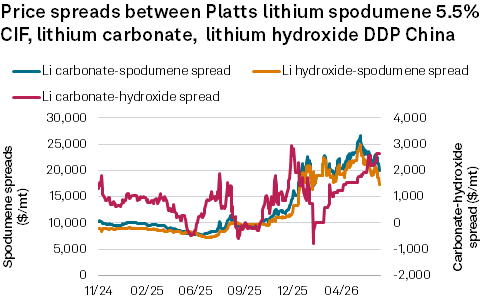
Price action across battery materials is increasingly being driven by relative-value opportunities rather than outright directional moves, as localized supply disruptions, inventory cycles and demand divergence reshape spreads across the value chain. The top-left chart highlights this transition in lithium, showing the sharp expansion of the lithium carbonate-spodumene spread from around $11,500 per metric ton in late 2025 to more than $24,000/mt in May 2026 before retracing through June. The rally reflected disruptions to spodumene concentrate supply, tighter availability of lithium salts and aggressive downstream restocking, allowing salt prices to significantly outperform feedstock.
However, the subsequent compression in both carbonate and hydroxide-spodumene spreads signals that the market has entered a normalization phase as mine restarts, improving concentrate availability and higher inventories reduced conversion margins. This suggests the disruption premium has largely been priced out, leaving spreads rather than outright prices as the cleaner expression of lithium market fundamentals.
Demand divergence remains evident within lithium chemicals. As illustrated by the widening carbonate-hydroxide spread in the top-left chart, lithium carbonate has consistently outperformed lithium hydroxide, reflecting resilient demand from LFP batteries and energy storage systems, while weaker NMC battery demand, elevated hydroxide inventories and conversion flexibility have weighed on hydroxide pricing. Although the current market continues to favor a carbonate-over-hydroxide bias, the position remains sensitive to any recovery in NMC demand or renewed destocking in carbonate markets.
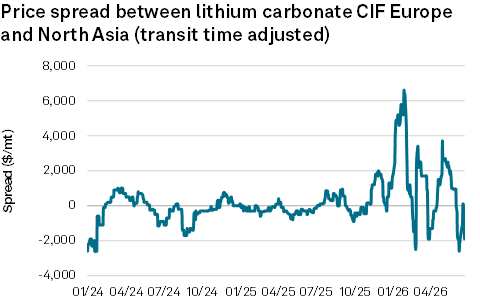
Regional lithium pricing also underscores the importance of flow dynamics rather than structural regional premiums. The top-right chart, showing the Europe-North Asia lithium carbonate spread adjusted for transit time, experienced significant volatility during the first quarter before compressing sharply. Rather than indicating a lasting European premium, these swings largely reflected temporary logistics disruptions, inventory positioning and arbitrage opportunities. As supply chains normalize and freight flows improve, regional spreads have become increasingly mean-reverting, reinforcing the view that timing and inventory management are more influential than sustained regional tightness.
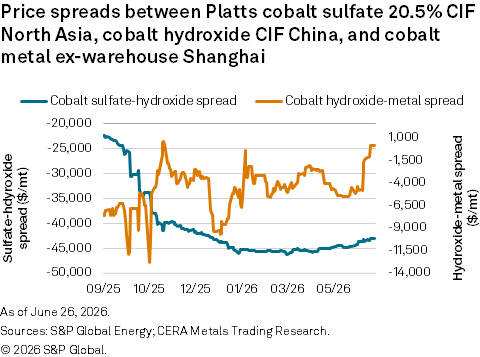
Cobalt markets continue to tell a different story, remaining primarily driven by upstream supply risk. The bottom-left chart shows cobalt hydroxide strengthening relative to both sulfate and Shanghai cobalt metal as DRC export restrictions and quota uncertainty tightened raw material availability. However, the transmission of this upstream strength through the value chain has remained incomplete, with elevated downstream inventories, subdued chemical demand and increased recycled supply limiting the pass-through into sulfate prices. While hydroxide prices have softened since March alongside partial market normalization, the spread structure suggests upstream tightness continues to dominate until inventories across the refining chain are more fully drawn down.
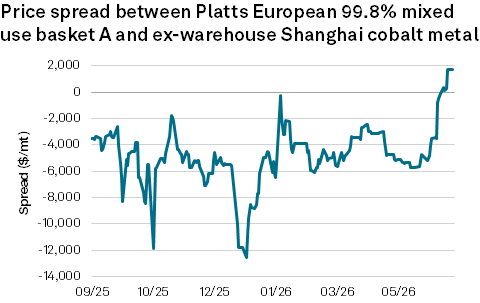
Regional cobalt pricing further illustrates the divergence between Chinese and European markets. The bottom-right chart shows the spread between European mixed-use cobalt basket A prices and Shanghai cobalt metal narrowing significantly before moving into premium territory. This reflects persistent weakness in Chinese domestic metal prices amid weak consumption and inventory overhang, while European values have remained comparatively supported by tighter refined availability and ongoing DRC-related supply concerns. The divergence highlights regional differences in inventories, financing costs and contract structures rather than a broad-based recovery in global cobalt demand.
Overall, the four charts point to a common conclusion: battery material markets are transitioning from broad supply-shock-driven price rallies toward increasingly selective relative-value opportunities. Lithium has entered a normalization phase, with disruption-driven margins unwinding and spreads gradually compressing, while cobalt continues to derive support from upstream supply constraints that have yet to fully transmit downstream. In this environment, relative value positioning remains more compelling than outright directional exposure, with a preference for carbonate over hydroxide in lithium and continued constructive positioning in cobalt hydroxide relative to downstream products until inventory imbalances across the supply chain are resolved.
For questions or more information, please contact:
Pranay Shukla, Director, Metals Trading Research, pranay.shukla@spglobal.com
Denise Serene Pascual, Analyst, Metals Trading Research, d.pascual@spglobal.com
S&P Global Energy produces content for distribution on S&P Capital IQ Pro.
This article was published by S&P Global Market Intelligence and not by S&P Global Ratings, which is a separately managed division of S&P Global.